Catawba reading begins here with the Nation’s river-centered history, scholarly context on changing coalitions, and its public environmental responsibilities. These sources have different perspectives and periods; they do not establish membership or affiliation for every organization using a related name.
See each region’s evidence for historical or present-day scope.
Homeland / region
Southeast / Carolinas
Research depth
Source guide
Source collection
5 annotated resources · 4 Indigenous-led
Inspected sources
3 substantive works · selected content reviewed
Initial adequacy
Still unfinished
Source review
October 28, 2026
A source guide for a deeper dive.This entry provides a brief orientation and an organized reading path. A comprehensive deep dive has not yet been completed. Follow the annotated sources and distinguish primary community accounts from outside reference material.
Still unfinished
A bounded actual-content starting path and specifically scoped credited picture are available. Fuller history, source comparison and community review remain open; quantity does not establish completion.
Assessment recorded October 28, 2026. This is separate from research completion and community review.
Review community-directed language, pottery and family histories without assuming rights to reproduce cultural objects.
New River Catawba and Saponi-Catawba legacy leads need their own authorship/identity review; no current-government membership bridge is inferred.
Inspect original treaties, land records and selected historical scholarship before extending dates or legal claims.
Backdrop photographs & credits
These photographs have individual, documented connections to this entry. Their captions and source records define the people, place, object, and period shown; no one photograph represents every community within a broader label.
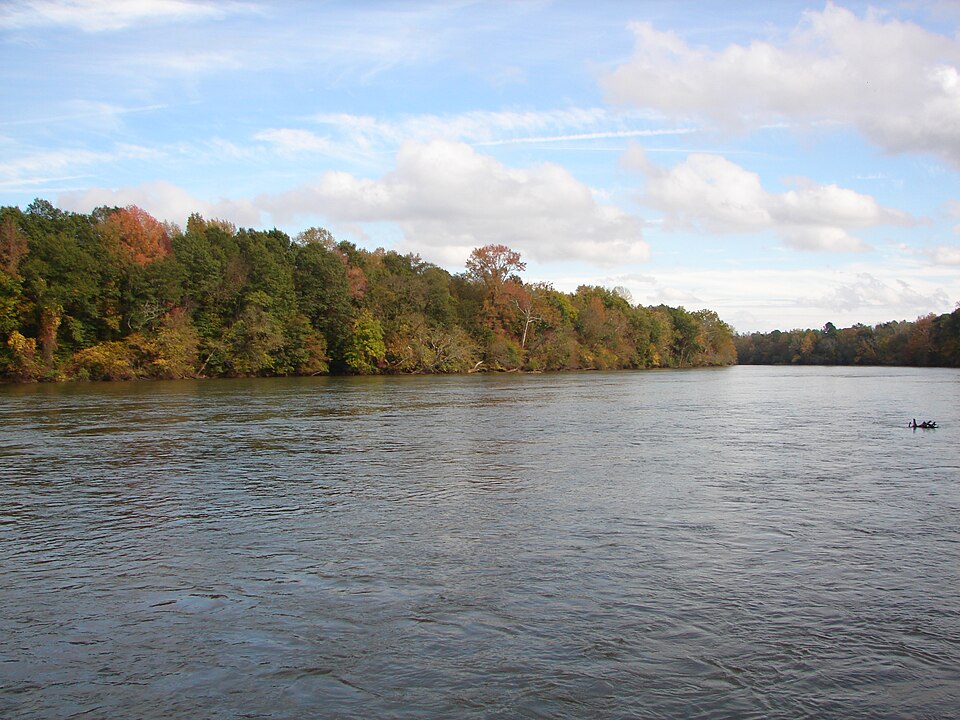
Catawba River at River Park, Rock Hill Holden LeCroy(Hlecroy) / Wikimedia Commons. Author-released public domain.
A public river landscape at Rock Hill, not a photographed reservation boundary, claim of ownership, named citizens or current environmental assessment. The Nation’s own history and environmental account explicitly connect its community with the Catawba River/York County setting. The item’s fall description andJune 2010 upload timestamp do not establish a capture date. Complete available retrieved JPEG imported unchanged. Background/card CSS crops and overlays affect presentation; the opened page retains the complete available frame proportionally.
Image, association, and reuse record reviewed 2026-10-28.
Full photographs are displayed proportionally above. A translucent background copy may be cropped by the viewport; it does not replace the complete image or its record.
The visual treatment does not change the research status, evidence, or remaining gaps recorded in this profile.
Start reading here
A short purposeful path through selected actual-content works. Read annotations for community, period and inspection limits; this is not a complete history or community endorsement.
Follow the Nation’s public account of present institutional responsibilities.
These are selected starting points. The full annotated collection, source perspectives, inspection limits and remaining research questions follow below. A starting guide is not an exhaustive history or community endorsement.
01
Identity and context
The Catawba Nation is a contemporary tribal nation with deep connections to the Carolinas.
Focus the next stage of research on: Catawba-authored history, language, pottery, land and governance. The sources below are selected reading paths; their authorship, dates and community scope should guide how they are used.
The Nation’s history describes villages, farming and fishing along the Catawba River, followed by expanding trade and colonial pressure. It also explains how outsiders extended the name Catawba across river-valley communities. This is the Nation’s own historical account; its estimates and interpretations should be distinguished from the original records still to inspect.
David G. Moore’s scholarly account treats the historical Catawba Nation as a coalition shaped by colonial trade, conflict and refuge. It helps explain why one old label may involve several community histories. That historical process does not automatically establish the current affiliation of another community or organization.
The Environmental Protections Division connects its work with the Nation’s river setting. Its public account describes air and water programmes, monitoring, natural-resource management and community infrastructure responsibilities. These are stated areas of work and development, not independently measured environmental outcomes or a map of present legal boundaries.
Review community-directed language, pottery and family histories without assuming rights to reproduce cultural objects.
New River Catawba and Saponi-Catawba legacy leads need their own authorship/identity review; no current-government membership bridge is inferred.
Inspect original treaties, land records and selected historical scholarship before extending dates or legal claims.
Cohort10: selected actual-content reviews preserve their institutional/community scope. Existing source cards are upgraded at the same ID and URL where noted; repeated publications are not globally new works.
Maps with context
Historical maps
Explore authentic historical documents connected to this entry. Their names and boundaries reflect their makers and periods.
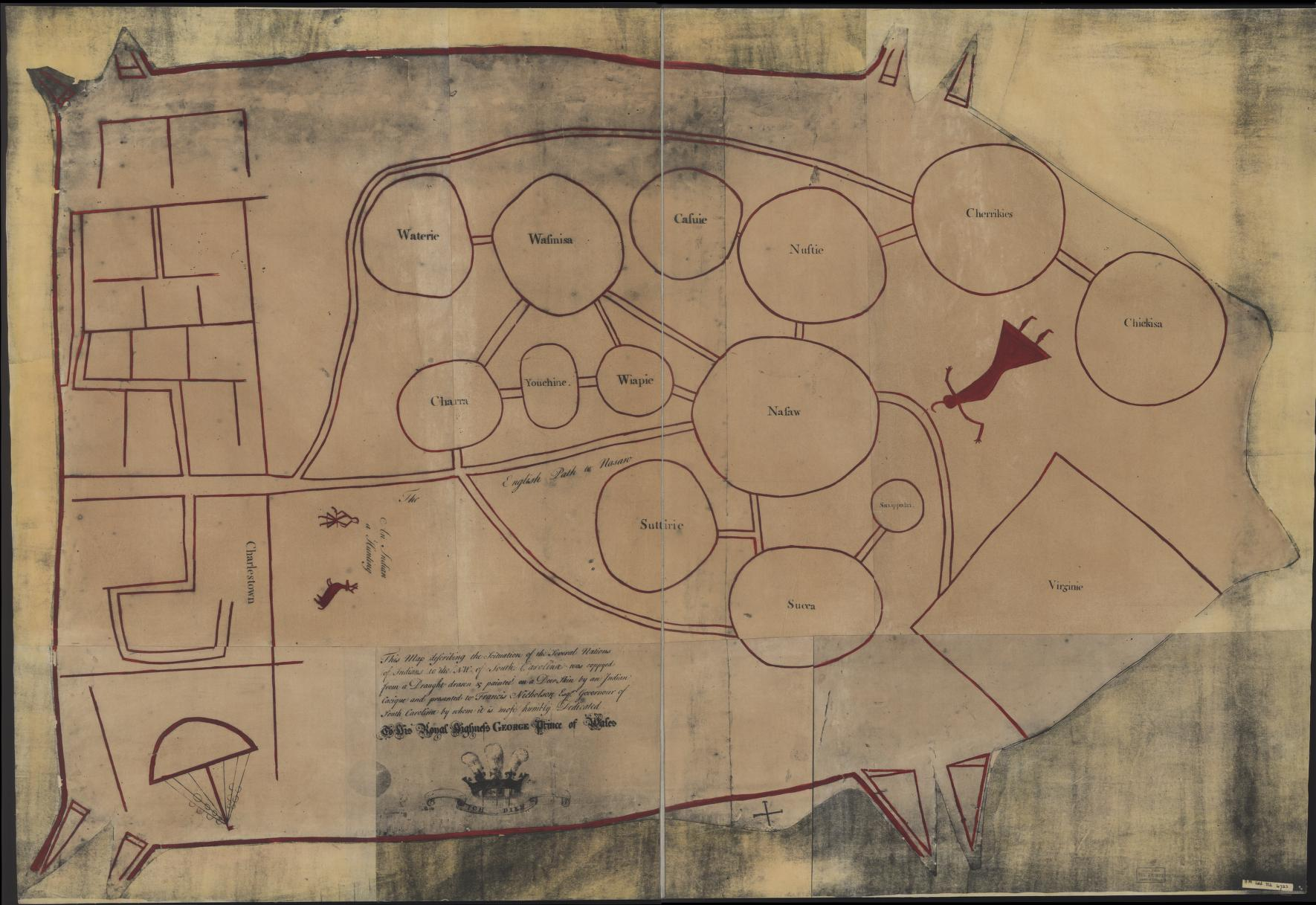
c. 1721 design; LOC reproduction, 1929 · Historical community represented: Nasaw
Catawba deerskin map: archival reproduction
Unidentified Indigenous maker; colonial copy associated with Francis Nicholson
Nasaw occupies the largest central circle. LOC identifies it as a central Catawba community, making this an educational link to Catawba history and relationships rather than proof of the maker's identity.
Historical scope: Network represented around 1721; surviving copies and reproductions have separate dates.
Underlying mapmaker and colonial copyist unnamed. Supplied digital reproduction; exact scan provenance unconfirmed. Historical interpretation: Library of Congress and Newberry Library. Archive reuse and provenance notes ↗
These map connections are a growing selection. Historical depictions do not establish current boundaries, and a link does not imply community authorship or endorsement.
Follow the reading path
Sources & further reading
Open any title to read the original source. Annotations explain what each link can help you explore.
No Indigenous-led source is identified in this entry yet. This is a gap in this collection, and does not imply an absence of community knowledge or organization.
Community or Indigenous-organization perspective linked for this entry. Use “History and Culture – New River Catawba” to begin with the publisher’s own account; check whether its scope is one community or a wider people.
Community or Indigenous-organization perspective linked for this entry. Use “Saponi-Catawba History | Saponi-CatawbaNation” to begin with the publisher’s own account; check whether its scope is one community or a wider people.
The Nation’s own historical account connects river villages, farming, trade and adaptation. Its perspective is distinct from the other organizational reading leads inherited by this broader entry.
Inspection: Content reviewed for the stated scope
Scope: Complete We are Proud of our Past historical unit through the Merrell reference. Later heritage narratives, pottery-maker biographies and current membership figures were not adopted.
Review recorded: October 28, 2026
Access note: Normal public HTTP 200 body read. No underlying colonial journals, treaty, land deeds, historic census or pottery objects inspected. Chronological estimates, warfare superlatives, current legal claims and population/acreage figures are not independently verified or adopted.
A named scholarly reference distinguishes the historical Catawba coalition from a single unchanged community. Read its account of colonial trade and refugees alongside the Nation’s own history.
Inspection: Content reviewed for the stated scope
Scope: Opening historical paragraphs from The Catawba people are often referred to as the Catawba Nation through the 1750s/French-and-Indian-War discussion, before Reeling from the effects. Author/date and 2025 revision credit read; later current totals and casino/legal material not used.
Review recorded: October 28, 2026
Access note: Normal public HTTP 200 text read. Copyright notice restricts redistribution; no source text, historical map or pottery image is reproduced publicly. Original ethnographies, colonial records and linked publications uninspected. Period labels and refugee movement do not establish present affiliation, and wording implying disappearance of other peoples is not adopted.
The Nation describes water, air and environmental-monitoring responsibilities within its river setting. These are the department’s public aims and work categories, not independently assessed results.
Inspection: Content reviewed for the stated scope
Scope: Complete Environmental Protections Division body from its geographic introduction through the department list, before Division Contacts. Staff contacts and linked drinking-water reports excluded.
Review recorded: October 28, 2026
Access note: Normal public HTTP 200 prose read. No monitoring dataset, water-quality report, maps, boundary records or current environmental-condition assessment inspected. Programme development and stewardship are stated responsibilities; no claim every goal has been achieved.