Cayuse people have a distinct history within the Confederated Tribes of the Umatilla Indian Reservation. These readings connect river-valley and horse-mobility histories with shared institutions, language work and attributed reflections on continuing Cayuse identity.
See each region’s evidence for historical or present-day scope.
Homeland / region
Pacific Northwest / Oregon / Washington
Research depth
Source guide
Source collection
4 annotated resources · 2 Indigenous-led
Inspected sources
3 substantive works · selected content reviewed
Initial adequacy
Still unfinished
Source review
October 28, 2026
A source guide for a deeper dive.This entry provides a brief orientation and an organized reading path. A comprehensive deep dive has not yet been completed. Follow the annotated sources and distinguish primary community accounts from outside reference material.
Still unfinished
A bounded actual-content starting path and specifically scoped credited picture are available. Fuller history, source comparison and community review remain open; quantity does not establish completion.
Assessment recorded October 28, 2026. This is separate from research completion and community review.
Add more Cayuse-authored scholarship and independently read primary treaty/removal/trial records.
Distinguish original Cayuse language from later Nez Perce-related usage;inspect public scholarship and actual learning materials.
Broaden family/community perspectives beyond institutional accounts and one attributed reflection.
Pendleton river picture is modern Umatilla Basin context, not an identified ancestral headwaters village, current jurisdiction or universal Cayuse landscape.
Backdrop photographs & credits
These photographs have individual, documented connections to this entry. Their captions and source records define the people, place, object, and period shown; no one photograph represents every community within a broader label.
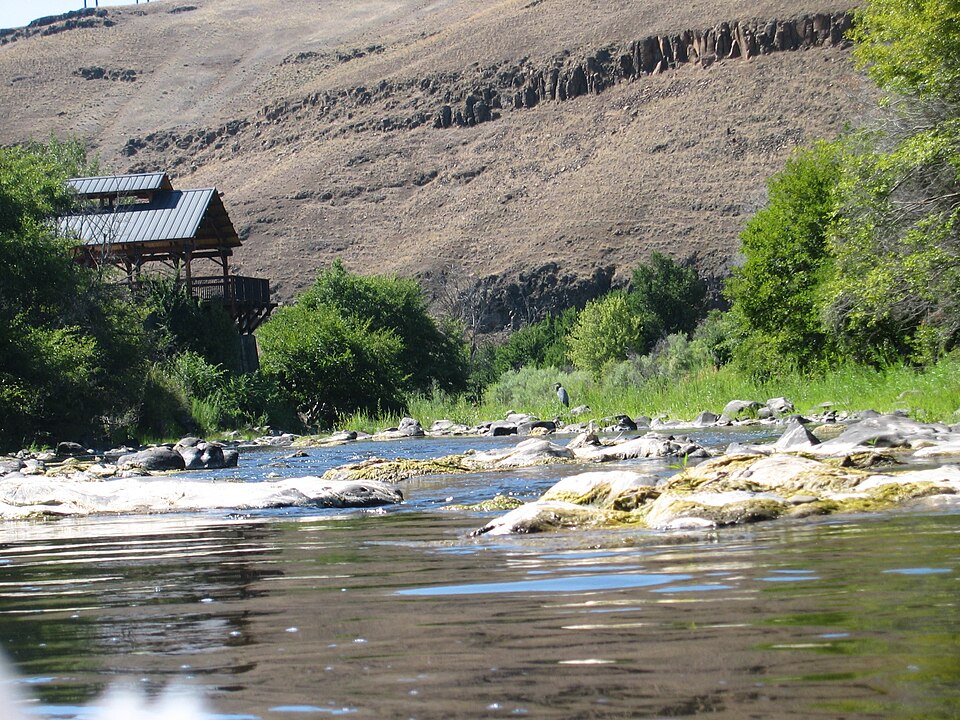
Umatilla River at Pendleton, Oregon Bobjgalindo / Wikimedia Commons — CC BY-SA 4.0
Modern Umatilla River at Pendleton regional context for explicitly described Cayuse Umatilla Basin history. Not an assertion Pendleton is the named headwaters village, a current reservation boundary or a uniquely Cayuse river ownership claim. Complete available retrieved JPEG imported unchanged. Background/card CSS crops and overlays affect presentation; the opened page retains the complete available frame proportionally.
Image, association, and reuse record reviewed 2026-10-28.
Full photographs are displayed proportionally above. A translucent background copy may be cropped by the viewport; it does not replace the complete image or its record.
The visual treatment does not change the research status, evidence, or remaining gaps recorded in this profile.
Start reading here
A short purposeful path through selected actual-content works. Read annotations for community, period and inspection limits; this is not a complete history or community endorsement.
Compare a historical overview and attributed reflection critically.
These are selected starting points. The full annotated collection, source perspectives, inspection limits and remaining research questions follow below. A starting guide is not an exhaustive history or community endorsement.
01
Identity and context
Cayuse people are one of the constituent peoples of the Confederated Tribes of the Umatilla Indian Reservation.
Focus the next stage of research on: Cayuse perspectives on colonial encounters, language and contemporary confederated government. The sources below are selected reading paths; their authorship, dates and community scope should guide how they are used.
CTUIR’s account locates Cayuse histories in Blue Mountain tributary valleys and the Umatilla Basin while describing relationships with Umatilla, Walla Walla and other Plateau peoples. Trade, family ties and shared government do not make the constituent names interchangeable. The modern river image is regional setting, not proof of a particular historic village.
The selected histories describe riverine life and the ways horses expanded Cayuse travel and exchange. These are historical interpretations with attributed oral-memory elements, not a single fixed boundary picture. Older outsiders’ character judgments in the historical literature are not adopted as descriptions of Cayuse people.
The programme describes recording speakers, archiving materials and teaching in the confederated community. Its language distinctions require care:original Cayuse language history is not interchangeable with the Weyíiletpuu/Nez Perce usage it describes. Language loss cannot establish that Cayuse people ceased to exist.
Tate’s essay quotes a 2009 reflection by Roberta Conner about a renewed willingness to identify publicly as Cayuse. That named perspective offers a route into continuity and changing community experience. It is not a current survey or a statement that every person experienced identity in the same way.
Add more Cayuse-authored scholarship and independently read primary treaty/removal/trial records.
Distinguish original Cayuse language from later Nez Perce-related usage;inspect public scholarship and actual learning materials.
Broaden family/community perspectives beyond institutional accounts and one attributed reflection.
Pendleton river picture is modern Umatilla Basin context, not an identified ancestral headwaters village, current jurisdiction or universal Cayuse landscape.
Cohort11: selected actual-content reviews preserve their institutional/community scope. Existing source cards are upgraded at the same ID and URL where noted; repeated publications are not globally new works.
Follow the reading path
Sources & further reading
Open any title to read the original source. Annotations explain what each link can help you explore.
No Indigenous-led source is identified in this entry yet. This is a gap in this collection, and does not imply an absence of community knowledge or organization.
Cassandra Tate’s 2013 essay offers a historical overview and attributed community perspectives. Selected sections are useful, while its stereotypes, old statistics and claims of historical primacy are not adopted.
Inspection: Content reviewed for the stated scope
Scope: Actual selected body: People of the Rye Grass, nonceremonial mobility/trade paragraphs in Acquisition of the Horse, and Reclaiming a Heritage including attributed Roberta Conner reflection. Other violence/trial sections, illustrations and underlying cited interviews not independently reviewed.
Review recorded: October 28, 2026
Access note: Actual selected public content read on 2026-10-28 through normalHTTP200, ordinary web reader or stated PDF pages. No access bypass or outreach. Linked originals, recordings, images and full collections were not automatically reviewed or licensed. NormalHTTP200 HTML; postedApril3, 2013. No current population, budget or land figures adopted. Old outsider characterizations remain historical quotations, not Atlas descriptions. No universal first/only claims or present legal determination.
Historical context for this entry. Read “Native-Land.ca | Our home on native land” with attention to the author, period covered, and communities named; compare with community-published accounts where available.
The government’s substantial history distinguishes Cayuse, Umatilla and Walla Walla while describing relationships, mobility and trade. Selected Cayuse/Umatilla-basin context does not erase constituent histories.
Inspection: Content reviewed for the stated scope
Scope: Actual selected body: People of the lower Columbia; Cayuse river-valley/horse/mobility paragraphs including Umatilla headwaters and basin; shared family/trade relationships. Language discussion read alongside the separate programme page. Sacred/ceremonial and broad later political narrative not republished.
Review recorded: October 28, 2026
Access note: Actual selected public content read on 2026-10-28 through normalHTTP200, ordinary web reader or stated PDF pages. No access bypass or outreach. Linked originals, recordings, images and full collections were not automatically reviewed or licensed. NormalHTTP200 HTML. Whole lengthy page not claimed read. Oral-memory elements remain attributed; underlying interviews, treaties and legal/trial records uninspected. Do not generalize its broad language-group wording or infer current boundaries.
The programme explains recording, archiving and teaching in the shared community while distinguishing the languages and dialect histories associated with constituent peoples.
Inspection: Content reviewed for the stated scope
Scope: Complete actual public body: introductory purpose, recording/archiving/teaching, Umatilla dictionary introduction, Dialects Distinct But Connected, and mission. No dictionary entries, recordings or lessons inspected.
Review recorded: October 28, 2026
Access note: Actual selected public content read on 2026-10-28 through normalHTTP200, ordinary web reader or stated PDF pages. No access bypass or outreach. Linked originals, recordings, images and full collections were not automatically reviewed or licensed. NormalHTTP200 HTML. Original Cayuse language history is distinguished from Weyíiletpuu/Nez Perce usage described for Cayuse people. Reduced use or language extinction does not mean disappearance of the people. No current speaker totals, outcomes or classifications beyond this stated scope.
Related entries may represent alternate names, constituent communities, wider groupings, or historical connections. Read the naming notes before treating entries as equivalent.
Robey’s Atlas of Indigenous North America · Compiled October 19, 2026 · Cayuse