This broader Cherokee guide pairs the Cherokee Nation’s history and language programme with a distinct United Keetoowah Band museum account. It offers selected institutional perspectives, not one merged government or a complete account of all Cherokee communities. Eastern Band and other community-directed histories remain important further reading.
See each region’s evidence for historical or present-day scope.
Homeland / region
Southeast / Oklahoma / North Carolina
Research depth
Source guide
Source collection
6 annotated resources · 4 Indigenous-led
Inspected sources
3 substantive works · selected content reviewed
Initial adequacy
Still unfinished
Source review
October 28, 2026
A source guide for a deeper dive.This entry provides a brief orientation and an organized reading path. A comprehensive deep dive has not yet been completed. Follow the annotated sources and distinguish primary community accounts from outside reference material.
Still unfinished
A bounded actual-content starting path and specifically scoped credited picture are available. Fuller history, source comparison and community review remain open; quantity does not establish completion.
Assessment recorded October 28, 2026. This is separate from research completion and community review.
Read Eastern Band and other individual community publications rather than treating one institutional account as all Cherokee history.
Legacy umbraco history remains unread after expired-certificate failure; the FAQ and language directory are supporting navigation, not extra substantive works.
Original treaty/court records, family histories and actual language lessons require their own review.
Backdrop photographs & credits
These photographs have individual, documented connections to this entry. Their captions and source records define the people, place, object, and period shown; no one photograph represents every community within a broader label.
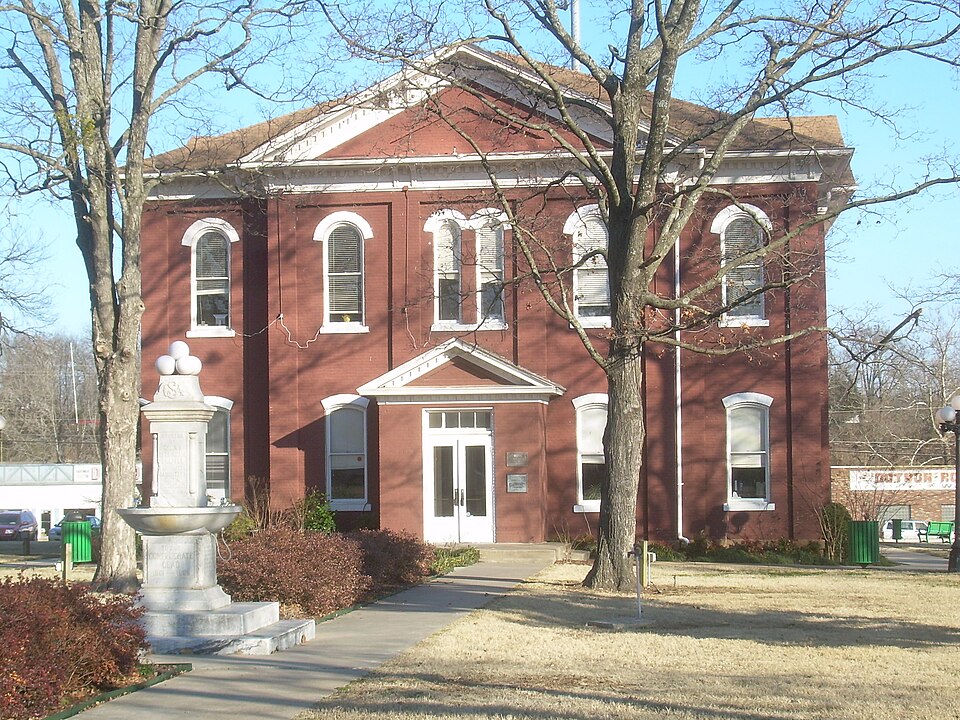
Cherokee National Capitol exterior, 2008 Caleb Long / Wikimedia Commons. CC BY-SA 2.5 Generic.
One Cherokee Nation historic government-building setting at Tahlequah, not all Cherokee governments or citizens. The 2008 photograph predates later museum renovations. The full exterior frame retains an incidental grounds monument; it is not isolated, newly licensed as separate art, endorsed or presented as a traditional motif. The record’s former judicial-use description is not asserted as current. Complete available retrieved JPEG imported unchanged. Background/card CSS crops and overlays affect presentation; the opened page retains the complete available frame proportionally.
Image, association, and reuse record reviewed 2026-10-28.
Full photographs are displayed proportionally above. A translucent background copy may be cropped by the viewport; it does not replace the complete image or its record.
The visual treatment does not change the research status, evidence, or remaining gaps recorded in this profile.
Start reading here
A short purposeful path through selected actual-content works. Read annotations for community, period and inspection limits; this is not a complete history or community endorsement.
Compare a separately named government’s public cultural institution.
These are selected starting points. The full annotated collection, source perspectives, inspection limits and remaining research questions follow below. A starting guide is not an exhaustive history or community endorsement.
01
Identity and context
Cherokee people continue through multiple distinct nations and communities. No single government should stand in for the whole people.
Focus the next stage of research on: Cherokee-authored removal histories, language and syllabary, and distinct contemporary governments. The sources below are selected reading paths; their authorship, dates and community scope should guide how they are used.
The Cherokee Nation’s current history distinguishes earlier westward movement from forced removal and describes rebuilding government, schools and a newspaper at Tahlequah. The account helps readers avoid treating all migration as one event or as voluntary. Original treaties, records and the perspectives of other Cherokee communities remain separate research tasks.
The Cherokee Language Master Apprentice Program describes pairing adult learners with fluent speakers in an immersion setting, with teaching as an important aim. Its public explanation also links language use with community participation. This is the programme’s account of its approach; the directory has not assessed learner outcomes or current application conditions.
A 2024 UKB Media report describes the John Hair Cultural Center & Keetoowah Museum’s galleries, library, classroom and language work. It explicitly says Keetoowah people share Cherokee heritage while maintaining their own identity. The report is a route into that government’s institutions, not evidence that every archive is unrestricted or every Cherokee government has the same history.
Read Eastern Band and other individual community publications rather than treating one institutional account as all Cherokee history.
Legacy umbraco history remains unread after expired-certificate failure; the FAQ and language directory are supporting navigation, not extra substantive works.
Original treaty/court records, family histories and actual language lessons require their own review.
Cohort10: selected actual-content reviews preserve their institutional/community scope. Existing source cards are upgraded at the same ID and URL where noted; repeated publications are not globally new works.
Maps with context
Historical maps
Explore authentic historical documents connected to this entry. Their names and boundaries reflect their makers and periods.
c. 1721 design; LOC reproduction, 1929 · Represented historical people
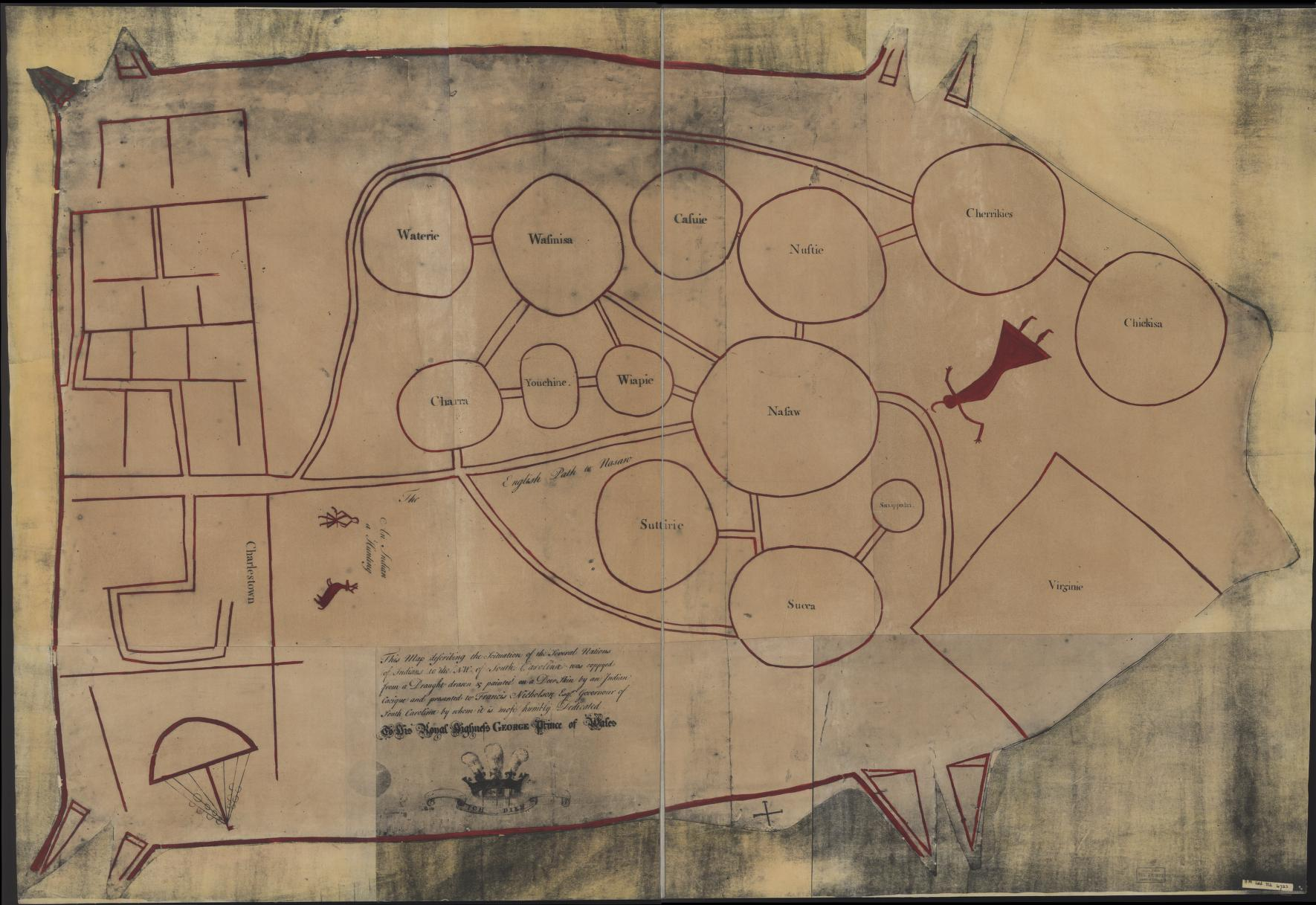
Catawba deerskin map: archival reproduction
Unidentified Indigenous maker; colonial copy associated with Francis Nicholson
Cherrikies appears in the upper-right circle. Newberry explicitly identifies Cherokee among these represented communities. The link concerns historical representation.
Underlying mapmaker and colonial copyist unnamed. Supplied digital reproduction; exact scan provenance unconfirmed. Historical interpretation: Library of Congress and Newberry Library. Archive reuse and provenance notes ↗
1760 · Named subject of historical map
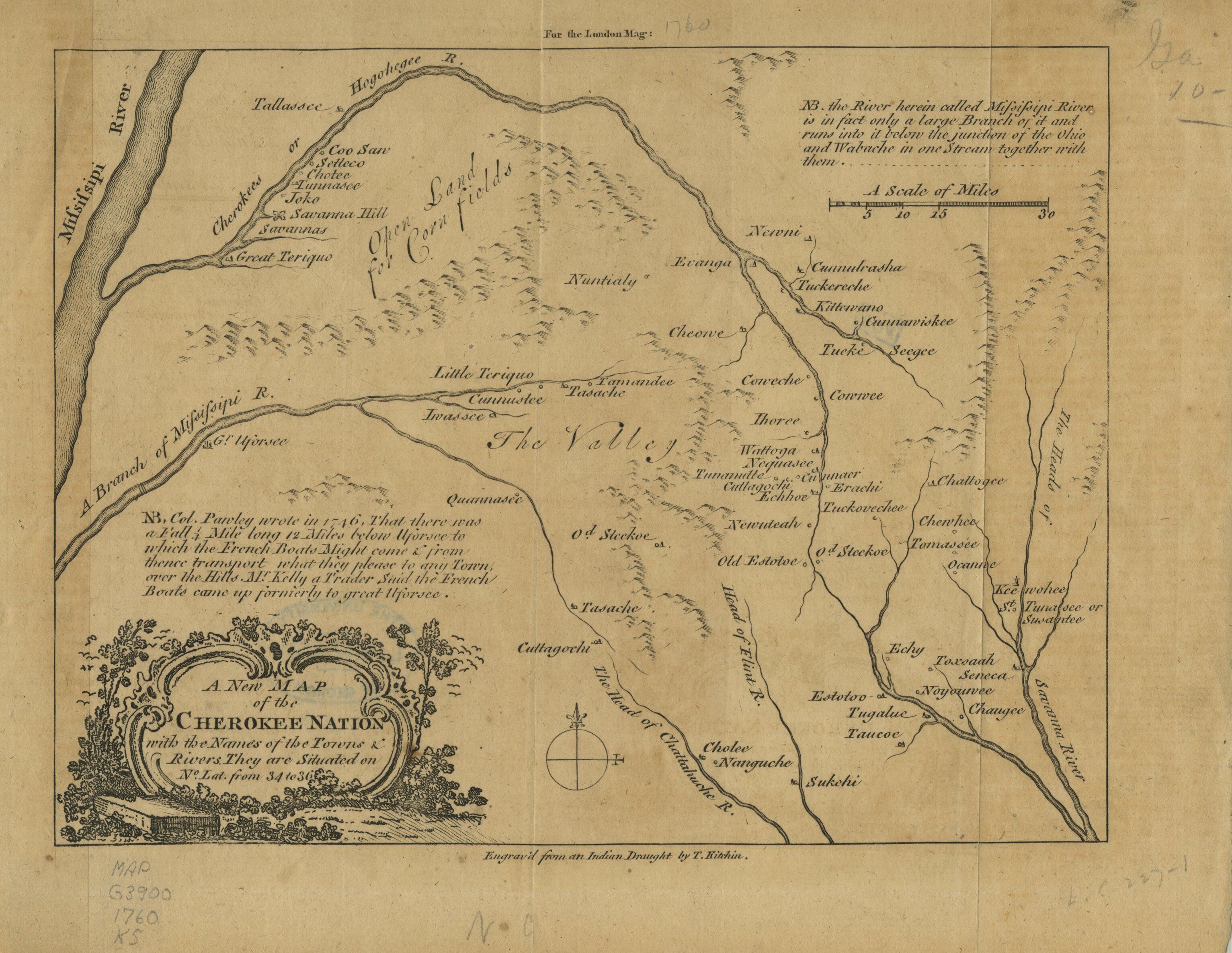
A new map of the Cherokee Nation
Thomas Kitchin (engraver); unidentified Indigenous draught credited on the sheet
This engraving depicts Cherokee towns and rivers in 1760. Its title identifies the Cherokee Nation, without assigning the map to a single present-day Cherokee government.
A new map of the Cherokee Nation, 1760, hmap1760k5, Hargrett Rare Book and Manuscript Library, University of Georgia Libraries; presented by the Digital Library of Georgia. Engraved by Thomas Kitchin. No Copyright — United States ↗
These map connections are a growing selection. Historical depictions do not establish current boundaries, and a link does not imply community authorship or endorsement.
Follow the reading path
Sources & further reading
Open any title to read the original source. Annotations explain what each link can help you explore.
No Indigenous-led source is identified in this entry yet. This is a gap in this collection, and does not imply an absence of community knowledge or organization.
Legacy Cherokee Nation history URL retained as an access-limited lead. A normal request failed because its SSL certificate was expired; no underlying text was retrieved here. The current official history URL is reviewed separately and is the only version counted.
Inspection: Content review not recorded
Access recorded: October 19, 2026
Access note: One normal request reported CERTIFICATE_VERIFY_FAILED/expired certificate. Verification was not disabled and no retry, login or challenge bypass was attempted. This is a retrieval limit, not proof of a reader paywall or permanent site failure.
Counting note: Access-only metadata correction; no actual-content review or duplicate-work count claimed.
The inherited FAQ route returned a title and navigation rather than substantive historical answers. It is retained as supporting context and excluded from the reviewed history count.
Inspection: Supporting or limited review; see scope
Scope: Actual current public title, one-sentence introduction and FAQ navigation read; no substantive answers retrieved.
Review recorded: October 28, 2026
Access note: Public web reader showed the current page body. No full historical narrative or linked FAQ answer inspection is claimed; use the separately reviewed official History publication.
The short introduction and programme list help readers navigate. The detailed master-apprentice publication is reviewed separately; the directory is not an additional substantive work.
Inspection: Supporting or limited review; see scope
Scope: Actual short introductory purpose, programme list and closing language-renewal statement, web lines 139–192; linked programme materials not thereby inspected.
Review recorded: October 28, 2026
Access note: Public actual HTML read. This is a programme directory, not a complete curriculum, lesson review or outcome evaluation; current contact, events and benefit details not adopted.
The current official history distinguishes earlier westward movement from forced removal and describes rebuilding at Tahlequah. It is the Nation’s own interpretation, not a substitute for the original treaties or every Cherokee government’s history.
Inspection: Content reviewed for the stated scope
Scope: Selected complete units European Contact, Settlement, and Land Cessions; Conflicts with the State of Georgia; Forced Removal, Internal Conflict, and Reunification, ending before The Civil War Comes to the Indian Territory. Present legal/citizenship conclusions later on the page excluded.
Review recorded: October 28, 2026
Access note: Normal current official HTTP 200 HTML read. The inherited umbraco URL failed expired-certificate verification in a normal request; no SSL bypass or retry. Current URL is the reviewed publication, not counted alongside an unread legacy copy. Original treaties, court decisions, population/loss figures and present legal status were not independently checked.
The programme explains pairing adult learners with fluent speakers and using immersion to prepare teachers. Public descriptions of learning approach are distinct from measured outcomes or current application advice.
Inspection: Content reviewed for the stated scope
Scope: Actual introductory purpose/immersion paragraphs and selected FAQ answers on availability, community interaction, fluency and later teaching work. Eligibility, payments, contacts, applications and numerical class sizes not adopted.
Review recorded: October 28, 2026
Access note: Normal public HTTP 200 body read; page shows an October 6, 2026 update. No classes, learner assessments, linked lessons, videos or application records inspected. The programme’s aims and reported graduate paths are attributed; no fluency guarantee or current benefit/eligibility guidance.
A July 16, 2024 report describes the United Keetoowah Band’s own museum, library, classroom and language work. It explicitly preserves Keetoowah identity rather than treating all Cherokee institutions as interchangeable.
Inspection: Content reviewed for the stated scope
Scope: Complete substantive news body from Since 2011 through the paragraph on archives and distinct Keetoowah history, before contact details. Publication/byline and programme dates read; images and linked celebration footage not inspected.
Review recorded: October 28, 2026
Access note: Normal public HTTP 200 text read. This is a dated UKB institutional report; no museum visit, archive use, class/film viewing, underlying grant record or current programme evaluation. Public archive availability is on request, not unrestricted copying permission.