This broader Tŝilhqot’in route introduces a National Government language plan, a particular Xeni Gwet’in caretaker-area account, and a collaboratively produced discussion of salmon stewardship after the 2024 landslide. Individual communities and attributed experiences remain distinct.
See each region’s evidence for historical or present-day scope.
Homeland / region
British Columbia
Research depth
Source guide
Source collection
6 annotated resources · 6 Indigenous-led
Inspected sources
3 substantive works · selected content reviewed
Initial adequacy
Still unfinished
Source review
October 28, 2026
A source guide for a deeper dive.This entry provides a brief orientation and an organized reading path. A comprehensive deep dive has not yet been completed. Follow the annotated sources and distinguish primary community accounts from outside reference material.
Still unfinished
A bounded actual-content starting path and specifically scoped credited picture are available. Fuller history, source comparison and community review remain open; quantity does not establish completion.
Assessment recorded October 28, 2026. This is separate from research completion and community review.
Develop distinct community histories and inspect relevant original public records.
Review dated programme evaluations before stating language outcomes.
Compare the selected disaster report with underlying studies and later community publications; no current fisheries or legal advice is supplied.
Backdrop photographs & credits
These photographs have individual, documented connections to this entry. Their captions and source records define the people, place, object, and period shown; no one photograph represents every community within a broader label.
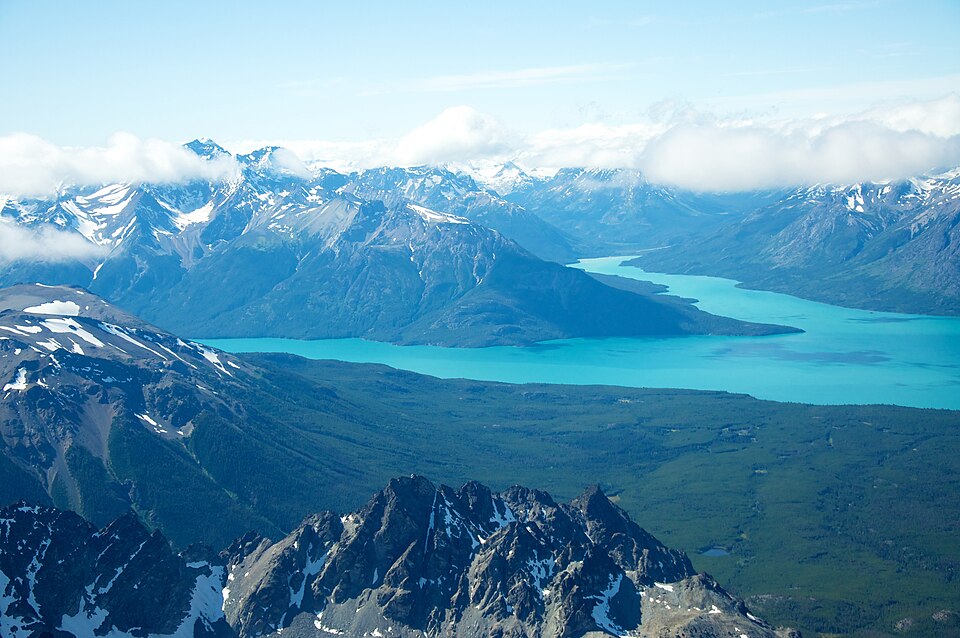
Aerial view of Chilko Lake, 2011 Sam Beebe / Ecotrust / Wikimedia Commons · CC BY 2.0 (exact media notice and Flickr review)
Photographer-identified aerial Chilko Lake. TNG’s Xeni Gwet’in caretaker-area account and collaborative salmon report explicitly name the lake. A 2011 waterbody view, not every community’s land, a boundary, the 2024 landslide or proof of current habitat conditions. Exact Commons media notice grants CC BY 2.0 and Flickr review confirms it; EXIF carries a different Creative Commons version string, which is retained as an inspection limit. Complete available retrieved JPEG imported unchanged. Background/card CSS crops and overlays affect presentation; the opened page retains the complete available frame proportionally.
Image, association, and reuse record reviewed 2026-10-28.
Full photographs are displayed proportionally above. A translucent background copy may be cropped by the viewport; it does not replace the complete image or its record.
The visual treatment does not change the research status, evidence, or remaining gaps recorded in this profile.
Start reading here
A short purposeful path through selected actual-content works. Read annotations for community, period and inspection limits; this is not a complete history or community endorsement.
Compare the dated collaborative report’s stewardship discussion with later evidence.
These are selected starting points. The full annotated collection, source perspectives, inspection limits and remaining research questions follow below. A starting guide is not an exhaustive history or community endorsement.
01
Identity and context
Tŝilhqot’in is a people’s own name used alongside Chilcotin. Tŝilhqot’in institutions connect language, history and territory.
Focus the next stage of research on: Community governments, language and territorial histories. The sources below are selected reading paths; their authorship, dates and community scope should guide how they are used.
The 2026 plan organizes language work around teaching and immersion, intergenerational learning, resources and coordinated governance. It links these directions with an earlier strategy. The listed actions express intended work; they do not establish that every programme has been delivered or that all learning outcomes were achieved.
One caretaker-area history within the broader Nation
The Nemiah Valley account identifies a particular Xeni Gwet’in caretaker area between Chilko and Taseko lakes. It recounts opposition to proposed development and attributes personal interpretation. This is one community/place history, not a substitute for every Tŝilhqot’in community’s account.
The 2025 report connects Chilko Lake sockeye with community concerns after the 2024 landslide. It presents stewardship as a response to changing waters and cumulative pressures. The 2011 aerial lake photograph predates that event; it is not a view of the slide, proof of habitat recovery or a fisheries forecast.
Develop distinct community histories and inspect relevant original public records.
Review dated programme evaluations before stating language outcomes.
Compare the selected disaster report with underlying studies and later community publications; no current fisheries or legal advice is supplied.
Cohort11: selected actual-content reviews preserve their institutional/community scope. Existing source cards are upgraded at the same ID and URL where noted; repeated publications are not globally new works.
Follow the reading path
Sources & further reading
Open any title to read the original source. Annotations explain what each link can help you explore.
No Indigenous-led source is identified in this entry yet. This is a gap in this collection, and does not imply an absence of community knowledge or organization.
Indigenous-ledTŝilhqot’in National GovernmentSource 1Supporting reference · outside substantive inspected count
The National Government’s brief introduction links language continuity with ongoing initiatives. Supporting orientation; the substantive plan is separately reviewed.
Inspection: Supporting or limited review; see scope
Scope: Actual short introductory paragraph and public resource links only.
Review recorded: October 28, 2026
Access note: Normal HTTP200 body read. Linked lessons, recordings, statistics and place-name map uninspected. One short introductory paragraph is excluded from the substantive-work count.
A linked language-resource application retained as a learning lead. Its actual lesson content was not available in the inspected reader response and is excluded.
Inspection: Content review not recorded
Access recorded: October 28, 2026
Access note: Normal reader returned a zero-line JavaScript application shell. No lesson, audio, game, transcript or complete application body inspected; no content-review date is added.
The plan links prior strategy with teaching capacity, intergenerational learning, resources and governance. Proposed actions and reported milestones are distinguished from measured results.
Inspection: Content reviewed for the stated scope
Scope: Actual PDF cover and selected pp.3–7:background, purpose, four work streams and selected curriculum/teacher-capacity actions.12-page PDF obtained, not fully read.
Review recorded: October 28, 2026
Access note: Normal HTTP200 PDF/text read. Underlying programme evaluations, lessons, recordings and committee records uninspected. Future actions are not assumed completed; no outcome totals adopted.
A particular Xeni Gwet’in caretaker-area history supplies a community/place example within the broader Nation. Personal interpretations are attributed rather than made universal.
Inspection: Content reviewed for the stated scope
Scope: Actual selected The Land and the People of Xeni body, Chilko/Taseko setting and public account of opposition to proposed development. Underlying declarations and private cultural narratives uninspected.
Review recorded: October 28, 2026
Access note: Normal HTTP200 HTML/text read. No precise boundaries, current title opinion, horse ancestry, superlative salmon counts or private teachings adopted. Roger William quotations are mediated through the page’s cited 2000 source, not an interview inspected here.
Selected discussion places Chilko Lake sockeye within the Nation’s account of the 2024 landslide response. Reported experience and interpretation are attributed, not a current fisheries forecast.
Inspection: Content reviewed for the stated scope
Scope: Actual acknowledgments PDF p.3 / printed2 and selected PDF pp.19–22 / printed18–21:changing waters and Chilko-sockeye stewardship discussion.40-page report obtained, not fully read.
Review recorded: October 28, 2026
Access note: Normal HTTP200 PDF/text read. Interviews, ecological studies, photos, ceremonial practices and the rest of the report uninspected. Numerical biological claims, unanimity and current conservation/access advice not adopted.