The Chitimacha Tribe of Louisiana presents continuing community history around the Atchafalaya Basin and Bayou Teche, language-renewal work and institutions for community care. These three selected readings introduce different parts of that account; a parallel USET profile remains supporting context with an unresolved date discrepancy.
See each region’s evidence for historical or present-day scope.
Homeland / region
Southeast / Louisiana
Research depth
Source guide
Source collection
5 annotated resources · 4 Indigenous-led
Inspected sources
3 substantive works · selected content reviewed
Initial adequacy
Still unfinished
Source review
October 28, 2026
A source guide for a deeper dive.This entry provides a brief orientation and an organized reading path. A comprehensive deep dive has not yet been completed. Follow the annotated sources and distinguish primary community accounts from outside reference material.
Still unfinished
A bounded actual-content starting path and specifically scoped credited picture are available. Fuller history, source comparison and community review remain open; quantity does not establish completion.
Assessment recorded October 28, 2026. This is separate from research completion and community review.
Compare the original constitution/adoption records to resolve the 1970 vote-date discrepancy.
Read selected colonial and land records alongside community interpretation rather than repeating numerical superlatives.
The older comparative-grammar PDF remains an unread lead; inspect relevant public language scholarship without reproducing restricted materials.
Backdrop photographs & credits
These photographs have individual, documented connections to this entry. Their captions and source records define the people, place, object, and period shown; no one photograph represents every community within a broader label.
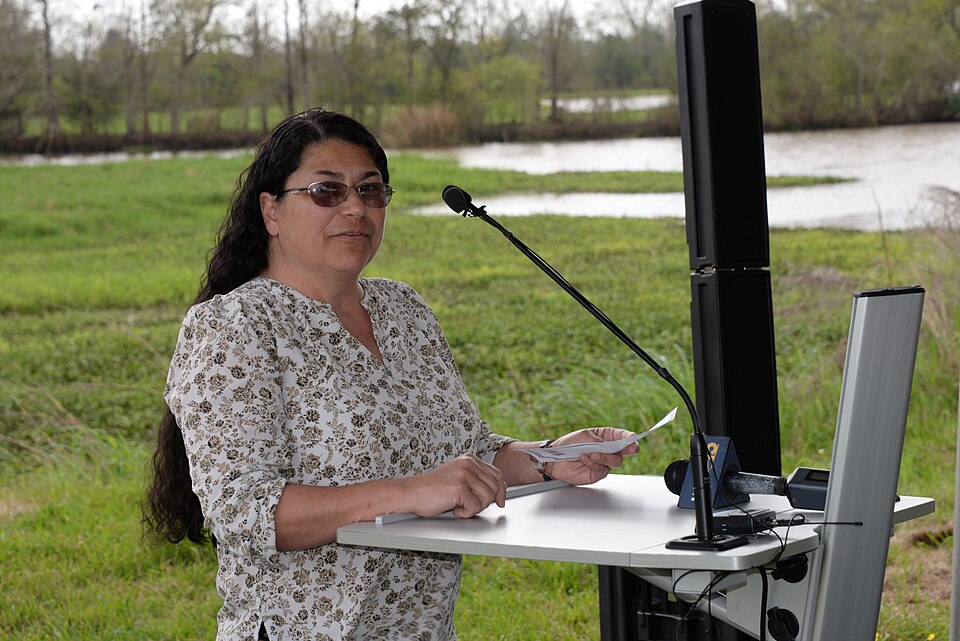
Melissa Darden at the Charenton Floodgate public groundbreaking, 2023 Team New Orleans / U.S.Army Corps of Engineers · Public Domain
USACE’s dated caption identifies Melissa Darden as Chitimacha Tribal Council Chairman at this 2023 public infrastructure event. The office is a captioned 2023 role, not a current-office assertion. A public civic event, not private cultural ceremony, a portrait of everyone or proof that the project later finished. Complete available retrieved JPEG imported unchanged. Background/card CSS crops and overlays affect presentation; the opened page retains the complete available frame proportionally.
Image, association, and reuse record reviewed 2026-10-28.
Full photographs are displayed proportionally above. A translucent background copy may be cropped by the viewport; it does not replace the complete image or its record.
The visual treatment does not change the research status, evidence, or remaining gaps recorded in this profile.
Start reading here
A short purposeful path through selected actual-content works. Read annotations for community, period and inspection limits; this is not a complete history or community endorsement.
Add the distinct public programme account of elder housing and support.
These are selected starting points. The full annotated collection, source perspectives, inspection limits and remaining research questions follow below. A starting guide is not an exhaustive history or community endorsement.
01
Identity and context
The Chitimacha Tribe of Louisiana publishes its own history and language resources.
Focus the next stage of research on: Homelands, Chitimacha language revitalization, sovereignty and contemporary institutions. The sources below are selected reading paths; their authorship, dates and community scope should guide how they are used.
The Tribe locates its history in the Atchafalaya Basin and Bayou Teche area and recounts colonial war, displacement and later land pressures. Oral-history elements remain the Tribe’s attributed account. Its history page and the USET profile disagree on the constitution-vote date, so that detail remains open pending the original record.
The Tribe’s language account credits earlier speakers and documentation, then describes learning through tribal educational institutions and tools. This is a story of continuing community work. Earlier speakers’ deaths or a language’s reduced use do not establish that the people disappeared.
RiverCane’s public explanation describes housing and coordinated support intended to help elders live independently. Its account also introduces meal and transport services. These are the Tribe’s stated programme purposes; the directory does not verify current eligibility, availability or individual outcomes.
Compare the original constitution/adoption records to resolve the 1970 vote-date discrepancy.
Read selected colonial and land records alongside community interpretation rather than repeating numerical superlatives.
The older comparative-grammar PDF remains an unread lead; inspect relevant public language scholarship without reproducing restricted materials.
Cohort10: selected actual-content reviews preserve their institutional/community scope. Existing source cards are upgraded at the same ID and URL where noted; repeated publications are not globally new works.
Follow the reading path
Sources & further reading
Open any title to read the original source. Annotations explain what each link can help you explore.
No Indigenous-led source is identified in this entry yet. This is a gap in this collection, and does not imply an absence of community knowledge or organization.
Indigenous-ledChitimacha Tribe of LouisianaSource 1
The Tribe credits earlier speakers and documentation while describing language renewal through schools and educational tools. This is its own account of continuity and learning, not an assertion that language loss ended a people.
Inspection: Content reviewed for the stated scope
Scope: Actual main language body, reader lines96–99, including credited speakers, documentation and the account of renewal through educational institutions.
Review recorded: October 28, 2026
Access note: Public HTML body read. Original Swadesh recordings, archival transcriptions, software and lessons were not inspected. Recording-hour totals and current proficiency are not independently verified; death dates of speakers do not mark the disappearance of the people.
A 2022 institutional profile offers a condensed Chitimacha account that substantially parallels the Tribe’s history page. Retained as supporting context, not a second independent counted history.
Inspection: Supporting or limited review; see scope
Scope: Actual complete Chitimacha profile on PDF p.28 / printed p.26 of the207-page book. Other member listings and incidental references are not substantive reviews.
Review recorded: October 28, 2026
Access note: Normal HTTP200 PDF/text read. Its September14, 1970 constitution-vote date conflicts with November7, 1970 on the Tribe’s history page; underlying constitution records were not reviewed. Do not select one date or adopt 2022 population/governance figures as current.
A language reference linked for this entry. Read “A STRUCTURAL AND LEXICAL COMPARISON OF THE TUNICA, CHITIMACHA, AND ATAKAPA LANGUAGES” for terminology and documentation, and distinguish linguistic labels from the names of political communities.
The Tribe places its continuing community within the Atchafalaya Basin and Bayou Teche area and recounts colonial disruption and later land pressures. Oral history and the Tribe’s interpretation remain attributed.
Inspection: Content reviewed for the stated scope
Scope: Actual substantial historical body: homeland/continuity introduction, 1706–1718 conflict and displacement, later land pressures and constitution chronology. Legend narratives and contemporary numerical claims are not reproduced.
Review recorded: October 28, 2026
Access note: Public substantial indexed body read. Original colonial records, claims files and constitution were not inspected. The constitution-vote date differs from the 2022 USET profile; numerical superlatives, exact current land/population figures and legal conclusions are not adopted.
The Tribe explains RiverCane as an elder-housing and support programme intended to sustain independent living. The programme description adds a contemporary institutional dimension to the historical and language readings.
Inspection: Content reviewed for the stated scope
Scope: Actual mission/design paragraphs112–114 and selected elder-service explanations135–141 in the public reader. This is the programme named RiverCane, not a guide to basketry material.
Review recorded: October 28, 2026
Access note: Public HTML body read normally. Underlying council resolution, policies, eligibility decisions, staffing and outcomes were not inspected. Undated rents, capacity, participant counts and service schedules are not reproduced as current advice.