This broader Clallam reading route leads to distinct S’Klallam communities and governments. Jamestown’s history names Jamestown, Lower Elwha and Port Gamble separately. The Lower Elwha timeline and Jamestown history are community-specific voices, rather than accounts of one merged government.
See each region’s evidence for historical or present-day scope.
Homeland / region
Pacific Northwest / Washington
Research depth
Source guide
Source collection
2 annotated resources · 2 Indigenous-led
Inspected sources
2 substantive works · selected content reviewed
Initial adequacy
Still unfinished
Source review
October 28, 2026
A source guide for a deeper dive.This entry provides a brief orientation and an organized reading path. A comprehensive deep dive has not yet been completed. Follow the annotated sources and distinguish primary community accounts from outside reference material.
Still unfinished
A bounded actual-content starting path and specifically scoped credited picture are available. Fuller history, source comparison and community review remain open; quantity does not establish completion.
Assessment recorded October 28, 2026. This is separate from research completion and community review.
Review Port Gamble and appropriate other S’Klallam community publications individually, without automatic affiliation or alias assumptions.
Original deeds, treaty records, fuller language publications and later timeline entries remain unreviewed.
Backdrop photographs & credits
These photographs have individual, documented connections to this entry. Their captions and source records define the people, place, object, and period shown; no one photograph represents every community within a broader label.
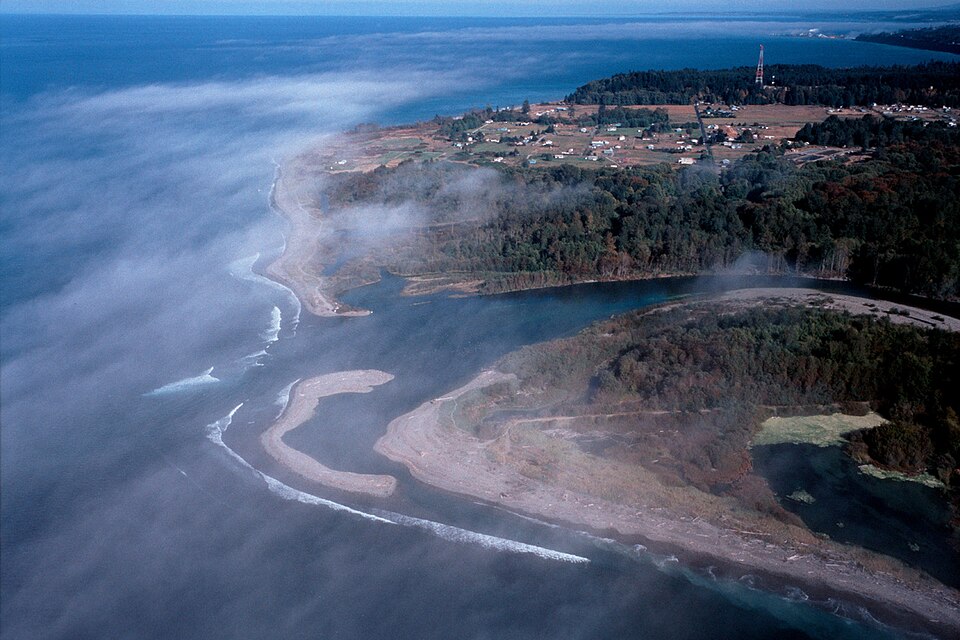
Elwha River mouth, NPS aerial photograph 2005 National Park Service / Olympic National Park; via Wikimedia Commons. Public domain U.S. federal work.
A dated aerial river-mouth landscape connected here specifically to the Lower Elwha example within the broader Clallam reading route. Lower Elwha’s own timeline explicitly discusses Elwha River homesteads. This 2005 image is not a current river-state assessment, a community boundary or representation of all S’Klallam communities. Complete available retrieved JPEG imported unchanged. Background/card CSS crops and overlays affect presentation; the opened page retains the complete available frame proportionally.
Image, association, and reuse record reviewed 2026-10-28.
Full photographs are displayed proportionally above. A translucent background copy may be cropped by the viewport; it does not replace the complete image or its record.
The visual treatment does not change the research status, evidence, or remaining gaps recorded in this profile.
Start reading here
A short purposeful path through selected actual-content works. Read annotations for community, period and inspection limits; this is not a complete history or community endorsement.
Compare Jamestown’s own history and the distinction among named governments.
These are selected starting points. The full annotated collection, source perspectives, inspection limits and remaining research questions follow below. A starting guide is not an exhaustive history or community endorsement.
01
Identity and context
Clallam is an older spelling encountered alongside Klallam and S’Klallam in community names.
Focus the next stage of research on: Individual S’Klallam governments, language and relationships across the northern Olympic Peninsula. The sources below are selected reading paths; their authorship, dates and community scope should guide how they are used.
Lower Elwha’s public timeline places treaty-making, incoming settlement and river homesteads in the same nineteenth-century chronology. Its 1855 and 1859 entries discuss the Point No Point treaty, while its 1874 entry describes Elwha-area homesteads. These are the Tribe’s selected historical entries; original deeds and treaty records need separate examination.
Jamestown’s history identifies three separate S’Klallam tribal governments and explains its own community’s decision to buy land in 1874. It follows local livelihoods and later institution-building. This reading route helps distinguish a broader people label from individual communities; it does not make one government’s history stand for every S’Klallam community.
Review Port Gamble and appropriate other S’Klallam community publications individually, without automatic affiliation or alias assumptions.
Original deeds, treaty records, fuller language publications and later timeline entries remain unreviewed.
Cohort09: selected actual-content reviews preserve their institutional/community scope. Existing source cards are upgraded at the same ID and URL where noted; repeated publications are not globally new works.
Follow the reading path
Sources & further reading
Open any title to read the original source. Annotations explain what each link can help you explore.
No Indigenous-led source is identified in this entry yet. This is a gap in this collection, and does not imply an absence of community knowledge or organization.
A Lower Elwha community timeline places disruption, treaty-making, settlement and river homesteads in chronological context. Its Elwha-centered perspective complements, rather than replaces, other S’Klallam governments’ histories.
Inspection: Content reviewed for the stated scope
Scope: Actual returned timeline from the 1700–1799 heading through the 1853–1899 portion visible at web lines 3–54; focus on entries 1855/1859 and 1874. Later twentieth-/twenty-first-century entries were not read.
Review recorded: October 28, 2026
Access note: Public initial HTML body read; a later request for the lower part timed out and was not retried. No original census, treaty, land record, disease register or current legal analysis was checked. Timeline figures and assertions of present legal status are not adopted.
Jamestown’s own history identifies three distinct S’Klallam tribal governments and explains its community’s land purchase, livelihood and recognition history. Its perspective is one named community within the wider reading route.
Inspection: Content reviewed for the stated scope
Scope: Complete main historical prose, web lines 89–105, covering named S’Klallam bands, seasonal livelihoods,1874 Jamestown land purchase and the community’s later institutional history. Image permission notices were also read; images were not copied.
Review recorded: October 28, 2026
Access note: Actual public HTML body read. No original deeds, treaty text, court records or current legal status analysis checked. Population, acreage, prehistoric date and treaty-rights conclusions are not independently verified or adopted. Page photos expressly say do not reproduce without permission and remain excluded.