Coos is a useful reading name for connected Hanis and Miluk communities, rather than a synonym for one language or every current government. This path focuses on community-published naming analysis and the historical account of the Confederated Tribes of Coos, Lower Umpqua and Siuslaw Indians.
See each region’s evidence for historical or present-day scope.
Homeland / region
Pacific Northwest / Oregon
Research depth
Source guide
Source collection
4 annotated resources · 3 Indigenous-led
Inspected sources
2 substantive works · selected content reviewed
Initial adequacy
Still unfinished
Source review
October 28, 2026
A source guide for a deeper dive.This entry provides a brief orientation and an organized reading path. A comprehensive deep dive has not yet been completed. Follow the annotated sources and distinguish primary community accounts from outside reference material.
Still unfinished
A bounded actual-content starting path and specifically scoped credited picture are available. Fuller history, source comparison and community review remain open; quantity does not establish completion.
Assessment recorded October 28, 2026. This is separate from research completion and community review.
Develop further separately scoped Hanis, Miluk and modern-government reading routes with verified community evidence.
Read original removal, termination/restoration records alongside community accounts.
Respect member-only language access; add public substantive learning resources only after inspection.
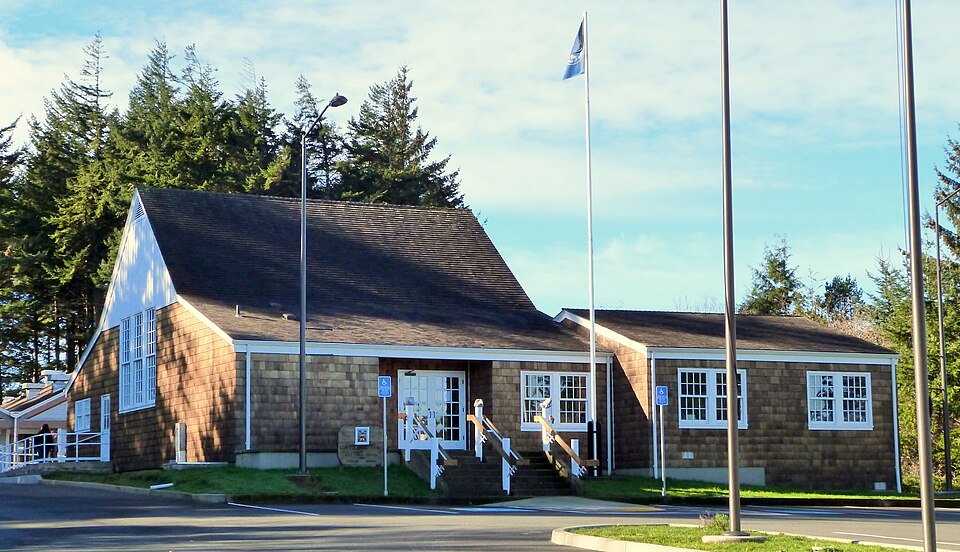
Tribal Hall photo represents a named confederated institution, not all Coos people or a traditional dwelling.
Backdrop photographs & credits
These photographs have individual, documented connections to this entry. Their captions and source records define the people, place, object, and period shown; no one photograph represents every community within a broader label.
Historic Tribal Hall of CTCLUSI Ian Poellet / Wikimedia Commons — CC BY-SA 4.0
The named confederated Tribal Hall at Coos Bay is specifically connected to the government’s institutional history. Not a traditional Coos dwelling, all Coos people or an exclusively Coos institution. Photograph caption says built 1940; Tribe history discusses 1941 trust/hall context, so no exact building-construction date is asserted. Small sign/flag emblems are incidental parts of the whole-building view; not isolated, interpreted or reused as Atlas design. Complete available retrieved JPEG imported unchanged. Background/card CSS crops and overlays affect presentation; the opened page retains the complete available frame proportionally.
Image, association, and reuse record reviewed 2026-10-28.
Full photographs are displayed proportionally above. A translucent background copy may be cropped by the viewport; it does not replace the complete image or its record.
The visual treatment does not change the research status, evidence, or remaining gaps recorded in this profile.
Start reading here
A short purposeful path through selected actual-content works. Read annotations for community, period and inspection limits; this is not a complete history or community endorsement.
Then read the government’s removal, continuity and restoration account.
These are selected starting points. The full annotated collection, source perspectives, inspection limits and remaining research questions follow below. A starting guide is not an exhaustive history or community endorsement.
01
Identity and context
Coos peoples have homelands on the southern Oregon coast and continue through contemporary confederated communities.
Focus the next stage of research on: Hanis and Miluk language histories, coastal homelands and community government. The sources below are selected reading paths; their authorship, dates and community scope should guide how they are used.
Whereat-Phillips and Helms explain that Hanis and Miluk are distinct languages associated with connected Coos Bay communities. Their article cautions against assuming that a language name automatically marks a single political unit. It describes village autonomy and relationships as more complex than the broad names recorded by outsiders.
The Confederated Tribes’ history recounts removal to Fort Umpqua and the Alsea subagency, later termination and the struggle for restoration. It emphasizes that community identity and the Tribal Hall continued through the termination period. This is a shared confederated history; the Coos reading label does not erase Lower Umpqua or Siuslaw people.
The linguists’ article is an accessible place to begin with names and language relationships. The government’s separate language page offers a short public invitation to relearn ancestral languages; its member-only materials have not been inspected. Reduced language use is not evidence that the people disappeared.
Develop further separately scoped Hanis, Miluk and modern-government reading routes with verified community evidence.
Read original removal, termination/restoration records alongside community accounts.
Respect member-only language access; add public substantive learning resources only after inspection.
Tribal Hall photo represents a named confederated institution, not all Coos people or a traditional dwelling.
Cohort11: selected actual-content reviews preserve their institutional/community scope. Existing source cards are upgraded at the same ID and URL where noted; repeated publications are not globally new works.
Follow the reading path
Sources & further reading
Open any title to read the original source. Annotations explain what each link can help you explore.
No Indigenous-led source is identified in this entry yet. This is a gap in this collection, and does not imply an absence of community knowledge or organization.
Indigenous-ledConfederated Tribes of Coos, Lower Umpqua and Siuslaw IndiansSource 1
The Confederated Tribes introduces distinct peoples and a shared history of removal, termination opposition and restoration. It is one modern government’s account, not a single-government definition of all Coos people.
Inspection: Content reviewed for the stated scope
Scope: Actual web-reader body: introductory Hanis/Miluk and other constituent-community paragraphs; selected 1855–1860 removal, 1916/1941 Tribal Hall and 1954–1984 termination/restoration timeline. No ceremonial narrative or colonial-racial quotation republished.
Review recorded: October 28, 2026
Access note: Actual selected public content read on 2026-10-28 through normalHTTP200, ordinary web reader or stated PDF pages. No access bypass or outreach. Linked originals, recordings, images and full collections were not automatically reviewed or licensed. Direct script requests403; ordinary reader supplied actual full selected body. Exact mortality/population figures and current service/territorial claims not adopted. Underlying treaty, legislation, manuscripts and page images uninspected.
A brief public statement identifies Miluk, Hanis, Siuslaw and Lower Umpqua descendants and invites language relearning. It is supporting context, not a full publicly inspected language collection.
Inspection: Supporting or limited review; see scope
Scope: Complete short public introductory statement read in ordinary web reader; the tribal-member login and restricted content were not entered.
Review recorded: October 28, 2026
Access note: Actual selected public content read on 2026-10-28 through normalHTTP200, ordinary web reader or stated PDF pages. No access bypass or outreach. Linked originals, recordings, images and full collections were not automatically reviewed or licensed. Direct script403. No lessons, recordings, dictionaries, current fluency totals or learning outcomes reviewed. Excluded from substantive minimum counts because the publicly accessible content is a brief mission/introduction.
Historical context for this entry. Read “Seeking recognition : the termination and restoration of the Coos, Lower Umpqua, and Siuslaw Indians, 1855-1984 / David R.M. Beck | Smithsonian Institution” with attention to the author, period covered, and communities named; compare with community-published accounts where available.
Tribal linguists explain why language, village and broad people names cannot be treated as interchangeable. Their attributed analysis helps readers understand Hanis and Miluk within the Coos reading route.
Inspection: Content reviewed for the stated scope
Scope: Actual20-page PDF: complete selected article on printed/PDFp8, contributed by Patty Whereat-Phillips and Enna Helms. Read linguistic/community naming, village autonomy, affiliations and uncertain etymologies. Adjacent class notice and unrelatedp9 encountered but not used.
Review recorded: October 28, 2026
Access note: Actual selected public content read on 2026-10-28 through normalHTTP200, ordinary web reader or stated PDF pages. No access bypass or outreach. Linked originals, recordings, images and full collections were not automatically reviewed or licensed. NormalHTTP200 PDF and selected text read. Onlyp8 article counted as one work; rest of issue, linked video/blog and original linguistic documents not reviewed. No sensitive-site coordinates, origin narrative or class access credentials republished.
Related entries may represent alternate names, constituent communities, wider groupings, or historical connections. Read the naming notes before treating entries as equivalent.
Robey’s Atlas of Indigenous North America · Compiled October 19, 2026 · Coos