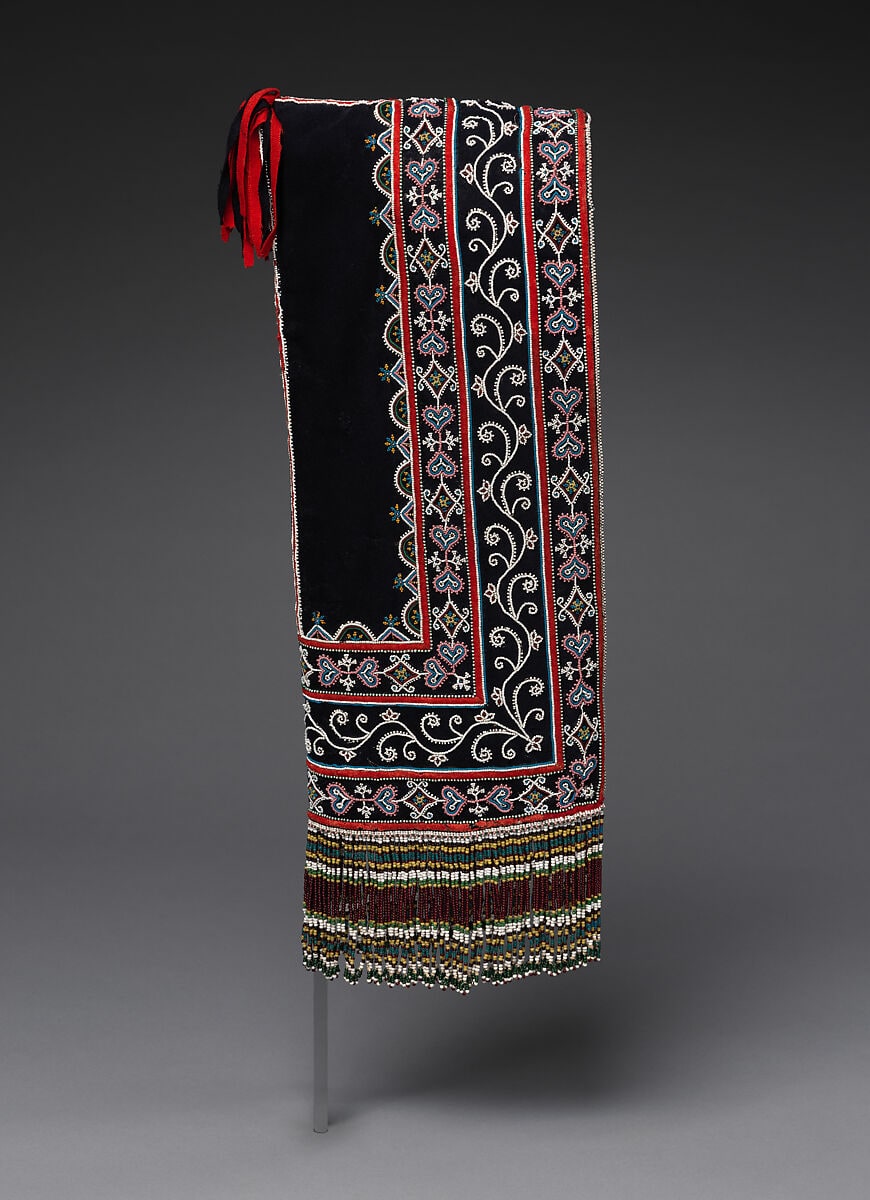
Woman’s hood, James Bay Cree, circa 1840James Bay Cree maker (name unrecorded). Woman’s hood, c. 1840. The Metropolitan Museum of Art, The Charles and Valerie Diker Collection of Native American Art, Gift of Charles and Valerie Diker, 2021, 2021.434.28. Image CC0.
This starter guide currently focuses on the Eeyou of Eeyou Istchee through a Cree government's own community account. Wider Cree coverage still needs research.
See each region’s evidence for historical or present-day scope.
Homeland / region
Canada / Northern United States
Research depth
Source guide
Source collection
2 annotated resources · 2 Indigenous-led
Inspected sources
2 substantive works · selected content reviewed
Initial adequacy
Still unfinished
Source review
October 28, 2026
A source guide for a deeper dive.This entry provides a brief orientation and an organized reading path. A comprehensive deep dive has not yet been completed. Follow the annotated sources and distinguish primary community accounts from outside reference material.
Still unfinished
A bounded actual-content starting path and specifically scoped credited picture are available. Fuller history, source comparison and community review remain open; quantity does not establish completion.
Assessment recorded October 28, 2026. This is separate from research completion and community review.
Extend reading through independently scoped Cree communities and languages beyond Eeyou Istchee; this path is not a history of all Cree peoples.
Inspect original institutional records and public community evaluations before extending the Institute’s retrospective or claiming later outcomes.
Add community-directed language, family and historical publications with their own dates and access limits.
Keep the existing James Bay Cree hood as one specifically attributed museum object, not every Cree community’s attire or a present-government portrait.
No current demographic totals, officeholders, legal powers, program availability or universal community endorsement are established.
Backdrop photographs & credits
These photographs have individual, documented connections to this entry. Their captions and source records define the people, place, object, and period shown; no one photograph represents every community within a broader label.
Woman’s hood, James Bay Cree, circa 1840 James Bay Cree maker (name unrecorded). Woman’s hood, c. 1840. The Metropolitan Museum of Art, The Charles and Valerie Diker Collection of Native American Art, Gift of Charles and Valerie Diker, 2021, 2021.434.28. Image CC0.
Precisely James Bay Cree example on broader Cree reading route; not a claim that all Cree communities share identical hoodwork or that the maker belongs to a named present government. Visual/cultural-object and reuse review only. No profile historical synthesis or substantive-source count added. No restricted ceremonial context identified in inspected object record. Original frame retained. Proportional JPEG compression; web maximum 1,400 pixels, card maximum 500 pixels, no cropping, retouching or generated content. Directory cards and page backdrops may use CSS crops and translucent overlays; the opened image preserves the complete delivered frame.
Image, association, and reuse record reviewed 2026-10-26.
Full photographs are displayed proportionally above. A translucent background copy may be cropped by the viewport; it does not replace the complete image or its record.
The visual treatment does not change the research status, evidence, or remaining gaps recorded in this profile.
Start reading here
A short purposeful path through selected actual-content works. Read annotations for community, period and inspection limits; this is not a complete history or community endorsement.
Follow one James Bay Cree institution’s own historical account; wider Cree histories remain outside this small starting path.
These are selected starting points. The full annotated collection, source perspectives, inspection limits and remaining research questions follow below. A starting guide is not an exhaustive history or community endorsement.
01
Identity and context
The Cree Nation of Eeyou Istchee identifies its people as Eeyou and locates its homeland primarily in northern Québec, with historically occupied lands in Ontario. Its community account emphasizes distinct local histories alongside shared connections and describes local governments working through regional institutions.
Start with this government's own community descriptions and follow its links to individual First Nations. Research beyond Eeyou Istchee is still needed before this guide can represent the wider range of Cree communities and languages.
In its own retrospective, Aanischaaukamikw describes decades of discussion leading to a cultural institute at Oujé-Bougoumou. It dates an intensified project to1998, construction to2009 and the first public opening toNovember2011. The account introduces a James Bay Cree effort to preserve and share knowledge; it does not stand for every Cree community or establish the results of all later programs.
The old Cow Creek Umpqua publication is unrelated to Cree and should be replaced, not relabelled.
The source distinguishes local First Nations and an Eeyou regional government; these are not a single government for all Cree people.
No census counts, area totals, current officers, present treaty membership or current legal conclusions are asserted.
Keep the broader entry name Cree and kind Wider grouping / peoples. This is a limited starter reading path, not a proposed renaming of all Cree as Eeyou.
Do not add unrelated Plains Cree, Nêhiyaw or other regional assertions from this one page. No map data or canonical source was edited.
Extend reading through independently scoped Cree communities and languages beyond Eeyou Istchee; this path is not a history of all Cree peoples.
Inspect original institutional records and public community evaluations before extending the Institute’s retrospective or claiming later outcomes.
Add community-directed language, family and historical publications with their own dates and access limits.
Keep the existing James Bay Cree hood as one specifically attributed museum object, not every Cree community’s attire or a present-government portrait.
No current demographic totals, officeholders, legal powers, program availability or universal community endorsement are established.
Cohort08: selected actual-content reviews preserve their institutional/community scope. Existing source cards are upgraded at the same ID and URL where noted; repeated publications are not globally new works.
Follow the reading path
Sources & further reading
Open any title to read the original source. Annotations explain what each link can help you explore.
No Indigenous-led source is identified in this entry yet. This is a gap in this collection, and does not imply an absence of community knowledge or organization.
Indigenous-ledGrand Council of the Crees (Eeyou Istchee) / Cree Nation GovernmentSource 1
The Cree government's community account connects Eeyou identity, northern Québec homeland, historical Ontario lands and distinct local histories. Read the introduction, governance paragraphs and community descriptions. Scope is Eeyou Istchee, not every Cree people or language. Undated totals, officeholders and treaty-process statements are not adopted as current.
The Institute’s own retrospective traces planning, institutional partnerships, construction and its2011 public opening. It records a specifically James Bay Cree institution, not every Cree community or a measured account of all later programming.
Inspection: Content reviewed for the stated scope
Scope: Complete substantive History body on the public legacy site, web lines27–34:1998 planning, named architect/site, partnerships,2009 construction and November2011 public opening. The1998 quotation is historical testimony, not a current officeholder statement.
Review recorded: October 28, 2026
Access note: Actual complete article body was returned and read by the web reader on2026-10-28. A later repeat request timed out; no account, challenge or bypass was used. Current About retrieval also timed out. Linked videos, collections, underlying agreements and later program reports were not inspected.