Duwamish public accounts connect communities with the waterways of the Seattle region and describe continuing cultural and language work. These readings present the Duwamish Tribe’s own explanations of names, family relationships and learning. They do not resolve contested recognition, enrollment or present legal questions, or speak for every descendant or neighboring government.
See each region’s evidence for historical or present-day scope.
Homeland / region
Pacific Northwest / Washington
Research depth
Source guide
Source collection
4 annotated resources · 3 Indigenous-led
Inspected sources
2 substantive works · selected content reviewed
Initial adequacy
Still unfinished
Source review
October 28, 2026
A source guide for a deeper dive.This entry provides a brief orientation and an organized reading path. A comprehensive deep dive has not yet been completed. Follow the annotated sources and distinguish primary community accounts from outside reference material.
Still unfinished
A bounded actual-content starting path and specifically scoped credited picture are available. Fuller history, source comparison and community review remain open; quantity does not establish completion.
Assessment recorded October 28, 2026. This is separate from research completion and community review.
Add dated community publications and selected original historical records beyond institutional introductory pages.
Review linguistic scholarship and teaching materials separately; do not infer disappearance from language change.
Inspect recognition-related primary decisions separately before making current legal statements, with other relevant community perspectives clearly distinguished.
Backdrop photographs & credits
These photographs have individual, documented connections to this entry. Their captions and source records define the people, place, object, and period shown; no one photograph represents every community within a broader label.
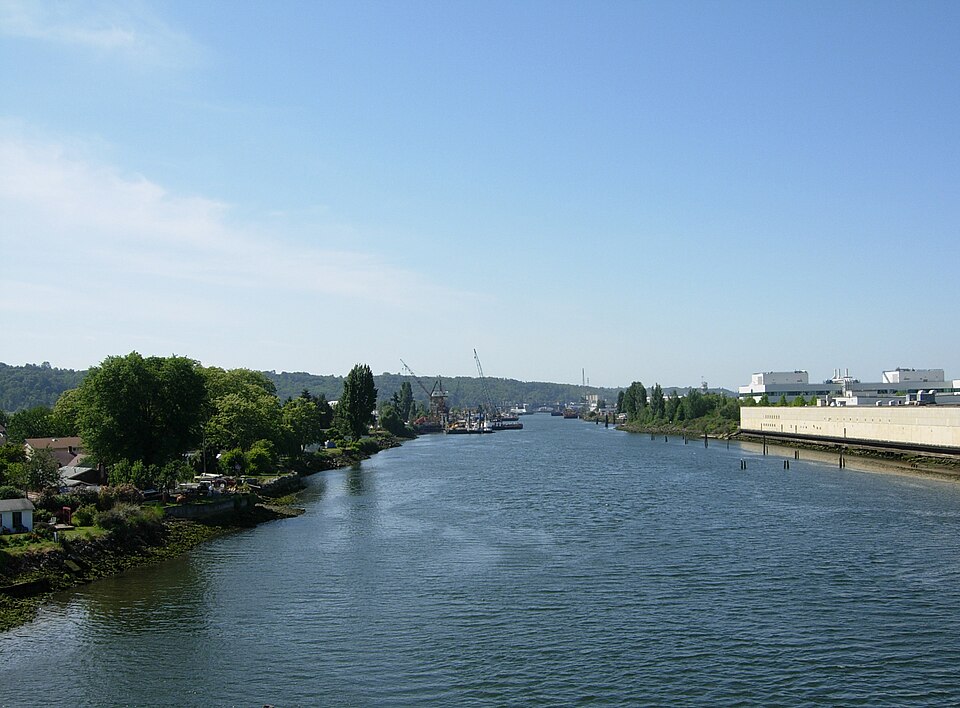
Duwamish River seen from South Park Bridge, 2007 Benjamin Cody / Wikimedia Commons · CC BY-SA 3.0
Exact record identifies the Duwamish River at South Park in Seattle. The Tribe’s FAQ and Culture Today actual bodies connect Duwamish names and life with the river. A dated modern waterway view, not a precolonial reconstruction, boundary, claim of present title or photograph of tribal members. Unchanged complete 960×708 JPEG delivered by the exact provider-listed 960px preview link, retrieved normally HTTP 200 by root and independently viewed locally by this agent. The larger record-linked original and camera original were not inspected. No new crop, resizing, compression, retouching, colorization or generation applied; CSS display crops and overlays may affect presentation. Image remains CC BY-SA 3.0 with creator, source and license credits. Complete available retrieved JPEG imported unchanged. Background/card CSS crops and overlays affect presentation; the opened page retains the complete available frame proportionally.
Image, association, and reuse record reviewed 2026-10-28.
Full photographs are displayed proportionally above. A translucent background copy may be cropped by the viewport; it does not replace the complete image or its record.
The visual treatment does not change the research status, evidence, or remaining gaps recorded in this profile.
Start reading here
A short purposeful path through selected actual-content works. Read annotations for community, period and inspection limits; this is not a complete history or community endorsement.
Then read its substantial public account of households, canoes and Lushootseed learning.
These are selected starting points. The full annotated collection, source perspectives, inspection limits and remaining research questions follow below. A starting guide is not an exhaustive history or community endorsement.
01
Identity and context
Duwamish communities have enduring relationships with the Seattle region. The Tribe publishes its own account of identity and history.
Focus the next stage of research on: Duwamish perspectives, local homelands, language and political history. The sources below are selected reading paths; their authorship, dates and community scope should guide how they are used.
The Tribe’s FAQ names the Duwamish, Black and Cedar rivers, Elliott Bay and Lake Washington when explaining its homeland relationships. Culture Today describes Duwamish as an anglicized name associated with people of the inside, while emphasizing distinctions among local groups. These are the Tribe’s own explanations. The directory has not inferred present political affiliation from a waterway, settled recognition disputes, or assumed that one institution represents every descendant’s account.
Culture Today describes winter households and family connections, followed by seasonal travel for gathering, fishing, visiting and trade. Its public account connects canoes with those water-based routes. The page also describes a Lushootseed program instituted in 2002 and its language-learning aims at the Longhouse. This is an introduction to the Tribe’s interpretation and stated educational work, rather than an independent assessment of language outcomes or a reproduction of ceremonial knowledge.
Add dated community publications and selected original historical records beyond institutional introductory pages.
Review linguistic scholarship and teaching materials separately; do not infer disappearance from language change.
Inspect recognition-related primary decisions separately before making current legal statements, with other relevant community perspectives clearly distinguished.
Cohort09: selected actual-content reviews preserve their institutional/community scope. Existing source cards are upgraded at the same ID and URL where noted; repeated publications are not globally new works.
Follow the reading path
Sources & further reading
Open any title to read the original source. Annotations explain what each link can help you explore.
No Indigenous-led source is identified in this entry yet. This is a gap in this collection, and does not imply an absence of community knowledge or organization.
Selected substantial FAQ answers explain the Tribe’s self-identification, named waterways and the kinds of evidence it uses to describe homeland relationships. Its institutional perspective is attributed; membership figures, recognition litigation and legal interpretations were not adopted as independent conclusions.
Inspection: Content reviewed for the stated scope
Scope: Actual selected FAQ body: Who are the Duwamish Tribe?; how the Tribe identifies traditional territory; and continuing community/family ties, reader lines 194–208. Other FAQ answers were encountered but no current population, lawsuit status or legal holdings carried into the guide.
Review recorded: October 28, 2026
Access note: Actual selected public HTML body read through the web reader; no login or paywall encountered. Linked publications, underlying archives, video/audio and photographs were not thereby fully inspected or cleared for reproduction.
Community or Indigenous-organization perspective linked for this entry. Use “Duwamish River — Duwamish Tribe” to begin with the publisher’s own account; check whether its scope is one community or a wider people.
Historical context for this entry. Read “Duwamish History” with attention to the author, period covered, and communities named; compare with community-published accounts where available.
Selected substantial sections explain the Tribe’s public account of names, households, water travel and Lushootseed learning. These descriptions are attributed community interpretations; neither ceremonial instructions nor health and longevity claims are reproduced.
Inspection: Content reviewed for the stated scope
Scope: Actual Culture Today HTML body read through normal HTTP 200 retrieval and saved privately. Synthesis uses opening name/group explanation, The Home, The Language and Canoeing sections. Linked media and source photographs not inspected/licensed; spiritual, medicinal and ceremony details not used.
Review recorded: October 28, 2026
Access note: The web reader confirmed the source page; the substantial body was then read from ordinary HTTP 200 HTML retrieved with Python urllib. No challenge or access bypass, login or paywall. Linked audio/video, underlying linguistic research and photographs were not independently inspected.