Haida public sources offer distinct routes through governance, living arts and community knowledge. The Council of the Haida Nation explains its Haida Gwaii institutions, while a collaborative museum guide emphasizes named makers and language. A separate Alaska tribal-government history should be read within its own institutional scope.
See each region’s evidence for historical or present-day scope.
Homeland / region
Pacific Northwest / Haida Gwaii / Alaska
Research depth
Source guide
Source collection
3 annotated resources · 2 Indigenous-led
Inspected sources
3 substantive works · selected content reviewed
Initial adequacy
Still unfinished
Source review
October 28, 2026
A source guide for a deeper dive.This entry provides a brief orientation and an organized reading path. A comprehensive deep dive has not yet been completed. Follow the annotated sources and distinguish primary community accounts from outside reference material.
Still unfinished
A bounded actual-content starting path and specifically scoped credited picture are available. Fuller history, source comparison and community review remain open; quantity does not establish completion.
Assessment recorded October 28, 2026. This is separate from research completion and community review.
Compare community-authored histories across Haida Gwaii and Alaska without treating one government as every Haida community.
Review current constitutional documents and selected maker-led educational works; linked objects and recordings remain separate tasks.
Backdrop photographs & credits
These photographs have individual, documented connections to this entry. Their captions and source records define the people, place, object, and period shown; no one photograph represents every community within a broader label.
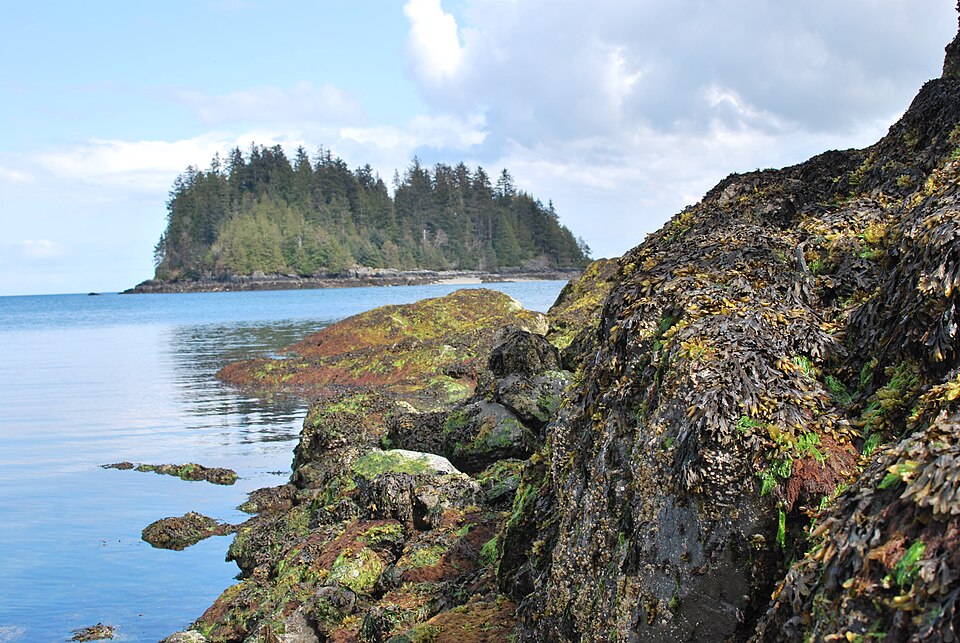
Rocky Skidegate waterfront, 2011 Karen Neoh; Wikimedia Commons / original Karen Neoh Flickr photograph. CC BY 2.0 Generic.
A waterfront view at one specifically identified Haida community. CHN’s institutional account explicitly identifies Skidegate Band Council as a Haida village government. This is not all Haida communities, a boundary or a depiction of every citizen. Actual pixels show a coastal landscape, not a village-building portrait or a cultural object. The item names Skidegate; the Council’s account identifies the village-government context. No named island, surveyed boundary or universal Haida representation inferred. Complete available retrieved JPEG imported unchanged. Background/card CSS crops and overlays affect presentation; the opened page retains the complete available frame proportionally.
Image, association, and reuse record reviewed 2026-10-28.
Full photographs are displayed proportionally above. A translucent background copy may be cropped by the viewport; it does not replace the complete image or its record.
The visual treatment does not change the research status, evidence, or remaining gaps recorded in this profile.
Start reading here
A short purposeful path through selected actual-content works. Read annotations for community, period and inspection limits; this is not a complete history or community endorsement.
Compare an Alaska government’s distinct institutional history.
These are selected starting points. The full annotated collection, source perspectives, inspection limits and remaining research questions follow below. A starting guide is not an exhaustive history or community endorsement.
01
Identity and context
Haida people have homelands in Haida Gwaii and southeastern Alaska, with distinct contemporary communities.
Focus the next stage of research on: Haida-authored history, language revitalization, governance and relationships to land and sea. The sources below are selected reading paths; their authorship, dates and community scope should guide how they are used.
The Council of the Haida Nation traces its formation to 1974 and explains relationships among national, hereditary and village institutions. Its account distinguishes Old Massett Village Council and Skidegate Band Council as village governments with community responsibilities. This provides an institutional starting point for Haida Gwaii, while detailed constitutional and community histories require their own review.
The Canadian Museum of History’s collaborative guide presents Haida making as connected with language, practical knowledge and relationships. It also explains how colonial collecting could separate belongings from named makers and their intended meanings. Haida contributors helped select and review the educational package. The linked objects and recordings need separate reading and reuse checks.
The Central Council of Tlingit and Haida Indian Tribes of Alaska presents a separate history of collective political advocacy and institution-building. Its timeline concerns that tribal government; it does not collapse Tlingit and Haida identities or replace individual community histories.
Compare community-authored histories across Haida Gwaii and Alaska without treating one government as every Haida community.
Review current constitutional documents and selected maker-led educational works; linked objects and recordings remain separate tasks.
Cohort08: selected actual-content reviews preserve their institutional/community scope. Existing source cards are upgraded at the same ID and URL where noted; repeated publications are not globally new works.
Follow the reading path
Sources & further reading
Open any title to read the original source. Annotations explain what each link can help you explore.
No Indigenous-led source is identified in this entry yet. This is a gap in this collection, and does not imply an absence of community knowledge or organization.
Read the Council’s historical origins and explanations of hereditary, village and national institutions. This is the Council’s own account, not a single governmental model for every Haida community.
Inspection: Content reviewed for the stated scope
Scope: Selected complete historical/governance paragraphs, web lines 94–105, 116, 180–189, 257–260. The current officials roster and 2003 constitutional-version wording were not adopted.
Review recorded: October 28, 2026
Access note: Public main body read normally. No original 1974 minutes, election law or current legal interpretation checked. The page contains historical constitutional references; no present officeholders or exact jurisdiction asserted.
The Central Council’s timeline offers an Alaska institutional history involving Tlingit and Haida people. It is complementary to, and distinct from, the Council of the Haida Nation account.
Inspection: Content reviewed for the stated scope
Scope: Complete Our History timeline and Generations to Come/mission body, web lines 65–119; leadership biographies and linked laws/cases not separately reviewed.
Review recorded: October 28, 2026
Access note: Public actual HTML body read. This is the Central Council’s institutional history and interpretation, not every Tlingit or Haida community’s government. Underlying statutes, court records, amounts and present rights not independently checked; no demographic totals or ceremonies reproduced.
Substantial introduction relates making, language, exchange and colonial collecting. Credits Ariane Xay Kuyaas, Sean Young and Jaskwaan Bedard. Linked objects, lessons and videos were not individually reviewed.
Inspection: Content reviewed for the stated scope
Scope: Complete main introductory prose and acknowledgments, ending with thanks to named Haida collaborators; topic tiles read only as navigation.
Review recorded: October 28, 2026
Access note: Web extraction exceeded4MB size limit; normal same-URL HTML 200 retrieved and actual body read. Museum/community-collaborative interpretation, not permission to reproduce objects, motifs, recordings or restricted knowledge. No individual craft instructions copied.