Haisla public history connects Kitamaat Village with fishing, oolichan processing, trade and seasonal movement. These starting readings combine the Nation’s historical interpretation with a Haisla–First Nations Education Foundation language resource, distinguishing the broader people, the band government and particular language descriptions.
See each region’s evidence for historical or present-day scope.
Homeland / region
British Columbia
Research depth
Source guide
Source collection
4 annotated resources · 3 Indigenous-led
Inspected sources
2 substantive works · selected content reviewed
Initial adequacy
Still unfinished
Source review
October 28, 2026
A source guide for a deeper dive.This entry provides a brief orientation and an organized reading path. A comprehensive deep dive has not yet been completed. Follow the annotated sources and distinguish primary community accounts from outside reference material.
Still unfinished
A bounded actual-content starting path and specifically scoped credited picture are available. Fuller history, source comparison and community review remain open; quantity does not establish completion.
Assessment recorded October 28, 2026. This is separate from research completion and community review.
Add fuller Haisla-authored histories and public accounts of particular families and communities.
Inspect original council records and historical scholarship before extending the colonial-policy chronology.
Review public language-teaching materials and their stated use conditions; no audio or vocabulary inspection is claimed here.
The existing Cedar LNG assessment link remains an unread lead in this batch, not a newly inspected work.
Backdrop photographs & credits
These photographs have individual, documented connections to this entry. Their captions and source records define the people, place, object, and period shown; no one photograph represents every community within a broader label.
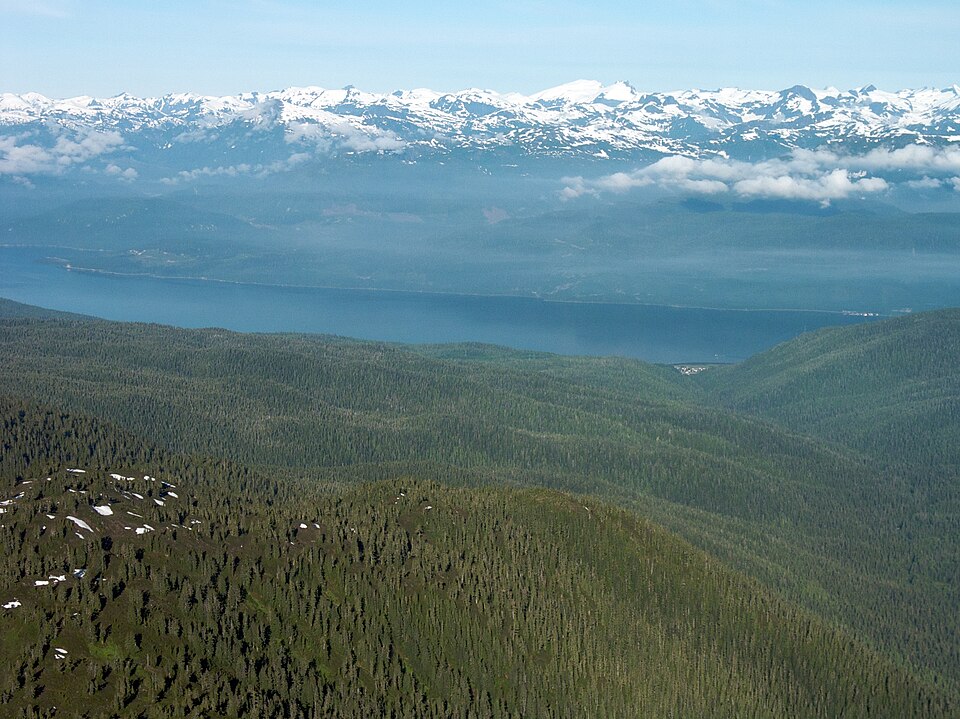
Channel, forest and mountains in the Kitamaat Village record,2008 Sam Beebe/Ecotrust / Wikimedia Commons · CC BY-SA 3.0
Exact photographer record identifies Kitamaat Village. Haisla Nation history explicitly identifies the Haisla with this village and distinguishes Kitamaat Village from the later nearby town Kitimat. A dated settlement view, not the whole people, all Haisla lands or current housing conditions. Commons records Panoramio license verification on June27,2016. Required attribution is Sam Beebe/Ecotrust; EXIF also contains an older CC BY3.0 line, while the explicit file licensing grants CC BY-SA3.0, which is the selected license. Actual inspected frame is a wide forest/channel/mountain landscape with a small distant settled area; it is not a close photograph or comprehensive view of the village or its cultural objects. Unchanged complete provider-listed960px full-frame preview, retrieved normally200 and locally inspected. The larger record original was not inspected or copied by this agent. No new crop, resizing, retouching or generation. CSS display crops/overlays may affect presentation. Image remains CC BY-SA 3.0 with creator/source/license credit. Complete available retrieved JPEG imported unchanged. Background/card CSS crops and overlays affect presentation; the opened page retains the complete available frame proportionally.
Image, association, and reuse record reviewed 2026-10-28.
Full photographs are displayed proportionally above. A translucent background copy may be cropped by the viewport; it does not replace the complete image or its record.
The visual treatment does not change the research status, evidence, or remaining gaps recorded in this profile.
Start reading here
A short purposeful path through selected actual-content works. Read annotations for community, period and inspection limits; this is not a complete history or community endorsement.
Then use the collaborative language introduction to understand dialect and spelling context.
These are selected starting points. The full annotated collection, source perspectives, inspection limits and remaining research questions follow below. A starting guide is not an exhaustive history or community endorsement.
01
Identity and context
Haisla communities have homelands on the north coast of British Columbia.
Focus the next stage of research on: Haisla-authored history, language, Kitamaat and territorial relationships. The sources below are selected reading paths; their authorship, dates and community scope should guide how they are used.
Haisla Nation’s history connects the people with Kitamaat Village and surrounding lands and waters. It describes fishing, hunting and trade, giving oolichan oil particular importance as food and an exchange item. Its explanation of the names Kitamaat and Kitimat is expressly grounded in oral history. The account also describes the disruption of seasonal movement and governance under colonial policies. Original records behind those interpretations still need separate inspection.
The Haisla LanguageCloud resource identifies Kitamaat and Kitlope dialects and explains that more than one accurate alphabet has been used to write Haisla. Its chosen transcription is based on an alphabet devised by Emmon Bach. The platform identifies itself as a collaboration between Haisla and the First Nations Education Foundation. This short introduction helps readers approach spelling differences without treating every written variation as a different people or community.
Add fuller Haisla-authored histories and public accounts of particular families and communities.
Inspect original council records and historical scholarship before extending the colonial-policy chronology.
Review public language-teaching materials and their stated use conditions; no audio or vocabulary inspection is claimed here.
The existing Cedar LNG assessment link remains an unread lead in this batch, not a newly inspected work.
Cohort08: selected actual-content reviews preserve their institutional/community scope. Existing source cards are upgraded at the same ID and URL where noted; repeated publications are not globally new works.
Follow the reading path
Sources & further reading
Open any title to read the original source. Annotations explain what each link can help you explore.
No Indigenous-led source is identified in this entry yet. This is a gap in this collection, and does not imply an absence of community knowledge or organization.
Community or Indigenous-organization perspective linked for this entry. Use “x̄á’isla LanguageCloud” to begin with the publisher’s own account; check whether its scope is one community or a wider people.
Read the complete About x̄á’isla body, including the Kitamaat/Kitlope dialect descriptions and explanation of transcription based on Emmon Bach’s alphabet. The collaborative platform distinguishes several accurate writing systems. No audio recordings, vocabulary database, teaching outcomes or linked resources were inspected; linguistic relationships do not make different peoples or governments interchangeable.
Inspection: Content reviewed for the stated scope
Scope: Complete substantive language-page body and collaboration credit. Its overlapping about-platform page p122-s1 is retained but not counted as an additional substantive work.
Review recorded: October 28, 2026
Access note: Actual selected public HTML body read through the web reader. No login or paywall encountered. Linked publications, original records, videos and site photographs were not independently inspected or licensed through this source review.
Historical context for this entry. Read “Cedar LNG Project Environmental Assessment Certificate Application - Section 11: Haisla Nation” with attention to the author, period covered, and communities named; compare with community-published accounts where available.
Read the Since Time Immemorial body, selecting public accounts of Kitamaat, seasonal travel, oolichan trade and colonial disruption. Name explanations and historical interpretation remain attributed to the Nation. Current population totals, monetary equivalences, detailed legal claims and later awards chronology were not independently verified or used.
Inspection: Content reviewed for the stated scope
Scope: Read the history body; synthesis uses opening place/food/trade paragraphs and selected colonial-disruption discussion. Original council records, Tales of Kitamaat and source photographs not inspected.
Review recorded: October 28, 2026
Access note: Actual selected public HTML body read through the web reader. No login or paywall encountered. Linked publications, original records, videos and site photographs were not independently inspected or licensed through this source review.