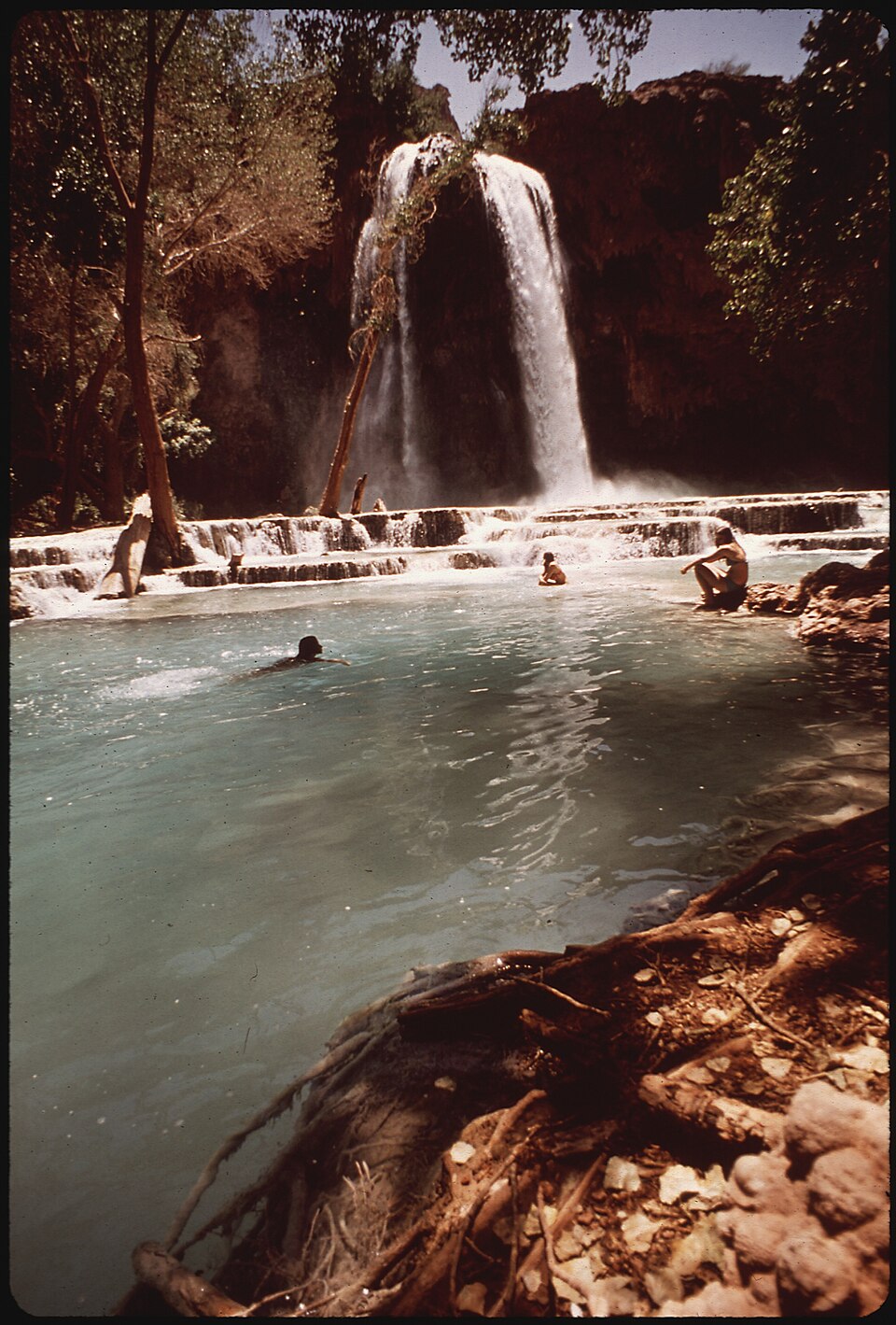
Arizona—Havasu Falls, May 1972Terry Eiler (Terrill Eiler) / U.S. National Archives, DOCUMERICA; NAID 544101 /412-DA-1608 · Public domain — EPA official-duty image, as specified by the media record
The Havasupai Tribe’s introduction to Supai emphasizes water and cultivated food. This starting path adds a Havasupai-informed research framework and an attributed public account of Ethel Jack’s advocacy, connecting community life, environmental inquiry and twentieth-century history.
See each region’s evidence for historical or present-day scope.
Homeland / region
Southwest / Arizona
Research depth
Source guide
Source collection
5 annotated resources · 1 Indigenous-led
Inspected sources
3 substantive works · selected content reviewed
Initial adequacy
Still unfinished
Source review
October 28, 2026
A source guide for a deeper dive.This entry provides a brief orientation and an organized reading path. A comprehensive deep dive has not yet been completed. Follow the annotated sources and distinguish primary community accounts from outside reference material.
Still unfinished
A bounded actual-content starting path and specifically scoped credited picture are available. Fuller history, source comparison and community review remain open; quantity does not establish completion.
Assessment recorded October 28, 2026. This is separate from research completion and community review.
Read community-published histories and underlying twentieth-century land-return records more fully.
Personal recollections remain attributed; no current territorial, health or visitor-access determination is made.
The USGS report’s later detailed cultural sections, figures and appendices were not reviewed.
Backdrop photographs & credits
These photographs have individual, documented connections to this entry. Their captions and source records define the people, place, object, and period shown; no one photograph represents every community within a broader label.
Arizona—Havasu Falls, May 1972 Terry Eiler (Terrill Eiler) / U.S. National Archives, DOCUMERICA; NAID 544101 /412-DA-1608 · Public domain — EPA official-duty image, as specified by the media record
NARA-identified Havasu Falls landscape. The Tribe’s Supai account specifically connects community life with these canyon waters. Historical scenery, not present access or water-safety advice. Three ordinary swimmers/visitors visible in the historical frame remain unidentified; no Tribal affiliation, relationship or age is inferred. Complete available retrieved JPEG imported unchanged. Background/card CSS crops and overlays affect presentation; the opened page retains the complete available frame proportionally.
Image, association, and reuse record reviewed 2026-10-28.
Full photographs are displayed proportionally above. A translucent background copy may be cropped by the viewport; it does not replace the complete image or its record.
The visual treatment does not change the research status, evidence, or remaining gaps recorded in this profile.
Start reading here
A short purposeful path through selected actual-content works. Read annotations for community, period and inspection limits; this is not a complete history or community endorsement.
Read how Havasupai perspectives inform the research framework.
These are selected starting points. The full annotated collection, source perspectives, inspection limits and remaining research questions follow below. A starting guide is not an exhaustive history or community endorsement.
01
Identity and context
The Havasupai Tribe has enduring relationships with the Grand Canyon region and Havasu Canyon.
Focus the next stage of research on: Havasupai community perspectives, language, land and contemporary tribal government. The sources below are selected reading paths; their authorship, dates and community scope should guide how they are used.
The Tribe describes Supai through Havasu Baaja, the People of the Blue Green Waters, and through spring water supporting corn, squash and beans. This community account gives the waterfall photograph a specific setting, while the 1972 image remains a dated landscape rather than a picture of current access conditions.
NPS follows Ethel Jack’s basketry, her family’s experiences of displacement and her work seeking the return of Havasupai lands. It connects her Washington advocacy with the 1975 return. The account draws partly on published recollections; it is a route into that history, not independent inspection of the interviews or legislation.
Tilousi and Hinck’s USGS report explains why risk models should include Havasupai perspectives and uses of resources. The introduction also says other Tribal applications would need to reflect their own knowledge systems. It describes a research framework, not measured exposure outcomes or health advice.
Read community-published histories and underlying twentieth-century land-return records more fully.
Personal recollections remain attributed; no current territorial, health or visitor-access determination is made.
The USGS report’s later detailed cultural sections, figures and appendices were not reviewed.
Cohort12: selected actual-content reviews preserve their institutional/community scope. Existing source cards are upgraded at the same ID and URL where noted; repeated publications are not globally new works.
Follow the reading path
Sources & further reading
Open any title to read the original source. Annotations explain what each link can help you explore.
No Indigenous-led source is identified in this entry yet. This is a gap in this collection, and does not imply an absence of community knowledge or organization.
Historical context for this entry. Read “Havasupai Tribe of the Havasupai Reservation, Arizona | Native American Advancement, Initiatives, and Research” with attention to the author, period covered, and communities named; compare with community-published accounts where available.
A language reference linked for this entry. Read “Pai Language and the Havasupai, Yavapai, and Hualapai Indian Tribes (Baja, Walapai, Upland Yuman)” for terminology and documentation, and distinguish linguistic labels from the names of political communities.
Carletta Tilousi and Jo Ellen Hinck explain how Havasupai perspectives can change environmental-risk research questions and exposure models.
Inspection: Content reviewed for the stated scope
Scope: Actual title/authors, first-posted and revised dates, Acknowledgments, Abstract and complete Introduction. Later detailed cultural/ceremonial sections, figures and appendices were not reviewed or reproduced.
Review recorded: October 28, 2026
Access note: Normal HTTP 200 complete HTML delivery; only named selections read. Published 30 January 2024 and revised 1 February 2024. A conceptual research framework is not a finding of measured human exposure or medical, water-safety or legal advice.
The Tribe introduces Supai, its Havasu Baaja name and the connection between spring water and cultivated crops.
Inspection: Content reviewed for the stated scope
Scope: Actual complete two-paragraph About Supai body, especially opening name, water and agriculture sentences. Acreage, travel instructions and duration superlatives are not adopted.
Review recorded: October 28, 2026
Access note: Normal HTTP 200 HTML/text read. This undated community introduction is not visitor-permit guidance or a current access, transport or legal-boundary determination.
The Havasupai-focused section follows basket maker Ethel Jack’s advocacy and family experience of displacement, ending with the 1975 land return.
Inspection: Content reviewed for the stated scope
Scope: Actual Havasupai/Ethel Jack body, reader lines 55–60, and its citation to Betty Leavengood, Grand Canyon Women, 2014, pp 195–196. Other artist sections were encountered separately, not counted as Havasupai history.
Review recorded: October 28, 2026
Access note: Normal HTTP 200 public body read. Underlying biography, personal interviews and original legislation uninspected. Memories and the agency’s historical interpretation stay attributed; acreage and present title are not independently established.