These Hopi reading routes join community-led education and food-system work with selected histories of Nampeyo and Fred Kabotie. The Hopi Foundation and Natwani Coalition speak as community organizations; their accounts do not replace the distinct voices of villages or the Tribal government.
See each region’s evidence for historical or present-day scope.
Homeland / region
Southwest / Arizona
Research depth
Source guide
Source collection
6 annotated resources · 4 Indigenous-led
Inspected sources
3 substantive works · selected content reviewed
Initial adequacy
Still unfinished
Source review
October 28, 2026
A source guide for a deeper dive.This entry provides a brief orientation and an organized reading path. A comprehensive deep dive has not yet been completed. Follow the annotated sources and distinguish primary community accounts from outside reference material.
Still unfinished
A bounded actual-content starting path and specifically scoped credited picture are available. Fuller history, source comparison and community review remain open; quantity does not establish completion.
Assessment recorded October 28, 2026. This is separate from research completion and community review.
Read village-specific and Tribal-government publications alongside these nonprofit perspectives.
Inspect underlying artist biographies and selected public programme evaluations.
The historical photograph is not a present-day portrait of all Hopi villages; no ceremonial imagery is reproduced.
Backdrop photographs & credits
These photographs have individual, documented connections to this entry. Their captions and source records define the people, place, object, and period shown; no one photograph represents every community within a broader label.
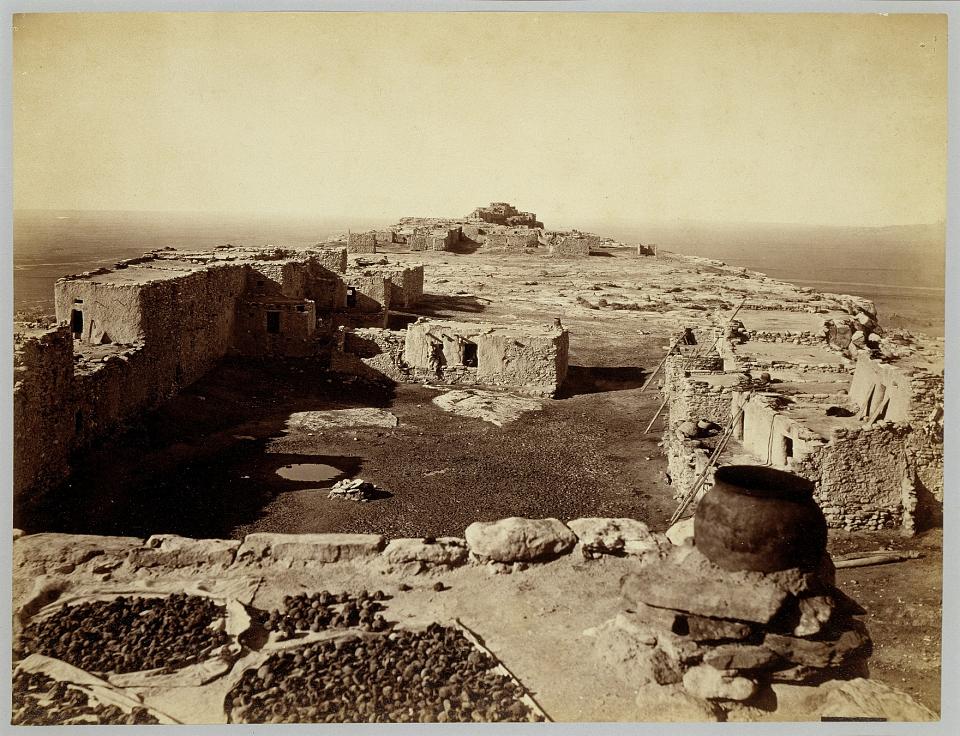
Hopi Mesa, ca 1872 John K. Hillers / Smithsonian American Art Museum, 1994.91.77 · Free to use — exact SAAM item designation
Outside historical albumen-silver photograph identified by SAAM as Hopi Mesa. Not a present-day image, every village, Pueblo-made art or a territorial boundary. Complete available retrieved JPEG imported unchanged. Background/card CSS crops and overlays affect presentation; the opened page retains the complete available frame proportionally.
Image, association, and reuse record reviewed 2026-10-28.
Full photographs are displayed proportionally above. A translucent background copy may be cropped by the viewport; it does not replace the complete image or its record.
The visual treatment does not change the research status, evidence, or remaining gaps recorded in this profile.
Start reading here
A short purposeful path through selected actual-content works. Read annotations for community, period and inspection limits; this is not a complete history or community endorsement.
Follow two individually identified artists through a public historical account.
These are selected starting points. The full annotated collection, source perspectives, inspection limits and remaining research questions follow below. A starting guide is not an exhaustive history or community endorsement.
01
Identity and context
Hopi people have homelands in northeastern Arizona and a living language, community life and tribal institutions.
Focus the next stage of research on: Hopi-authored histories, village distinctions, language and contemporary government. The sources below are selected reading paths; their authorship, dates and community scope should guide how they are used.
The Hopi Foundation dates its beginnings to 1985 and incorporation to 1987. It describes responding to needs raised locally, supporting practical projects and sharing what communities learn. Its current-work account includes radio, leadership, farming and other programmes, offering a route into contemporary institution building.
Natwani’s initiatives connect seed protection with farmer conversations, youth learning, community grants and food-system assessment. These are the Coalition’s descriptions of purposes and activities. The linked assessments, recordings and curricula require their own reading before claims about results are made.
NPS introduces Nampeyo, born at Hano, also called Tewa Village, and follows her pottery’s influence. Its Fred Kabotie section traces his work at Grand Canyon and encouragement of later artists. These named careers give students a focused starting point without treating one artist as representative of every community.
Read village-specific and Tribal-government publications alongside these nonprofit perspectives.
Inspect underlying artist biographies and selected public programme evaluations.
The historical photograph is not a present-day portrait of all Hopi villages; no ceremonial imagery is reproduced.
Cohort12: selected actual-content reviews preserve their institutional/community scope. Existing source cards are upgraded at the same ID and URL where noted; repeated publications are not globally new works.
Follow the reading path
Sources & further reading
Open any title to read the original source. Annotations explain what each link can help you explore.
No Indigenous-led source is identified in this entry yet. This is a gap in this collection, and does not imply an absence of community knowledge or organization.
The Hopi Foundation presents continuity and community responsibilities. This brief general introduction remains supporting context, rather than another substantial historical work.
Inspection: Supporting or limited review; see scope
Scope: Actual About Hopi main body, especially concluding family, values and continuity paragraphs. Public origin narratives were encountered but are not reproduced.
Review recorded: October 28, 2026
Access note: Normal indexed/public HTML body read. This nonprofit voice is not a statement by every village or the Tribal government; broad ancestry assertions and superlatives are not independently adopted.
This short introduction remains supporting context, with dated census figures and a visible website placeholder that should not be mistaken for substantive history.
Inspection: Supporting or limited review; see scope
Scope: Actual introductory body and visible placeholder, reader lines 105–129 in the retrieved page.
Review recorded: October 28, 2026
Access note: Public HTML body read.2010 census figures are not current; no new source minimum is filled by this short duplicate-style introduction.
A language reference linked for this entry. Read “Hopi Language | Language and Linguistics | Research Starters | EBSCOhost” for terminology and documentation, and distinguish linguistic labels from the names of political communities.
The Foundation explains its 1985 beginnings, 1987 incorporation and community-directed method for developing and sharing local projects.
Inspection: Content reviewed for the stated scope
Scope: Actual History, Mission and Current Work body: reader lines 58–90. Project lists were read as organizational descriptions; no underlying evaluation reports inspected.
Review recorded: October 28, 2026
Access note: Normal HTTP 200 HTML/text read. Undated population, staffing and project totals are not treated as current counts. A nonprofit organization is not the Hopi Tribal government.
The Coalition describes seed protection, farmer conversations, a food symposium, youth curriculum and community grants as linked parts of local food-system work.
Inspection: Content reviewed for the stated scope
Scope: Actual initiatives body, reader lines 38–156, including seed initiative, Farm Talk, symposium, youth project, grants and food-assessment descriptions.
Review recorded: October 28, 2026
Access note: Normal HTTP 200 HTML/text read. Linked curricula, recordings, 2005 assessment and project evaluations uninspected. Described aims do not establish measured nutritional, agricultural or language outcomes.
Selected sections introduce Nampeyo’s pottery and Fred Kabotie’s work and influence at Grand Canyon, preserving the distinction between individual artists and an entire people.
Inspection: Content reviewed for the stated scope
Scope: Actual Nampeyo paragraphs, reader lines 25–28; Fred Kabotie public artistic-work paragraphs, lines 32 and 35–36; source list. Religious mural narratives and other peoples’ sections are not synthesized here.
Review recorded: October 28, 2026
Access note: Normal HTTP 200 public body read. Underlying biographies, cited pages and artworks not inspected or reproduced. Hano/Tewa specificity stays explicit; an individual career is not a universal Hopi practice.