Hualapai community accounts introduce Peach Springs, contemporary institutions and public language and cultural programmes. A separate judicial-history article follows sustained Hualapai advocacy in the Santa Fe Pacific railroad dispute, with the difference between historical interpretation and present legal advice kept clear.
See each region’s evidence for historical or present-day scope.
Homeland / region
Southwest / Arizona
Research depth
Source guide
Source collection
4 annotated resources · 2 Indigenous-led
Inspected sources
3 substantive works · selected content reviewed
Initial adequacy
Still unfinished
Source review
October 28, 2026
A source guide for a deeper dive.This entry provides a brief orientation and an organized reading path. A comprehensive deep dive has not yet been completed. Follow the annotated sources and distinguish primary community accounts from outside reference material.
Still unfinished
A bounded actual-content starting path and specifically scoped credited picture are available. Fuller history, source comparison and community review remain open; quantity does not establish completion.
Assessment recorded October 28, 2026. This is separate from research completion and community review.
Read original litigation records and fuller Hualapai-authored histories before extending legal claims.
The linked master-plan report remains unread because its URL delivered a file-service shell.
Use dated Tribal publications for current figures, offices or programme outcomes.
Backdrop photographs & credits
These photographs have individual, documented connections to this entry. Their captions and source records define the people, place, object, and period shown; no one photograph represents every community within a broader label.
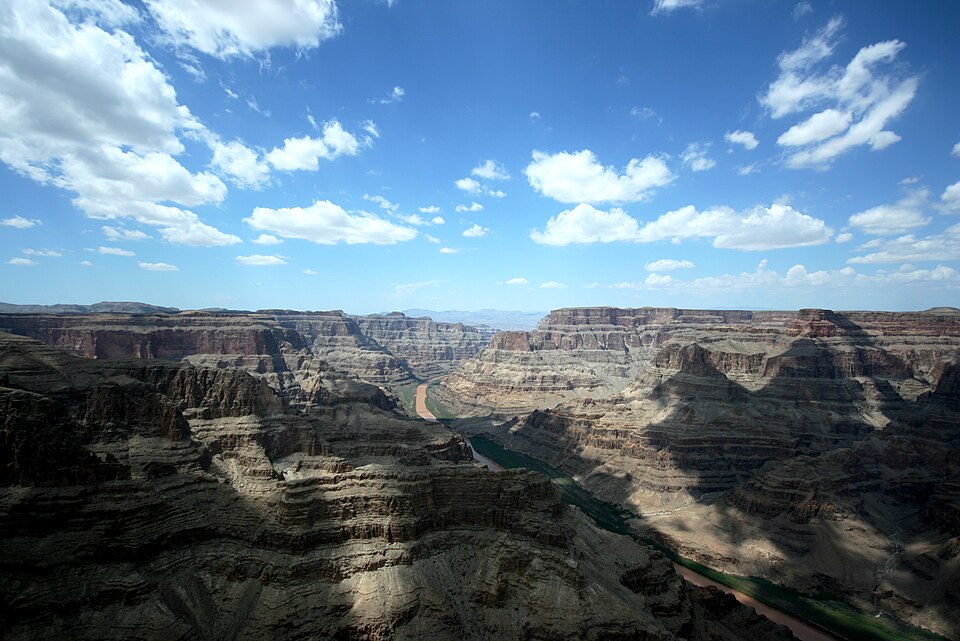
Grand Canyon West view from Guano Point, 2008 Balazs Barnucz / Wikimedia Commons · CC BY-SA 3.0
Photographer-identified Guano Point landscape at Grand Canyon West, which the Hualapai Tribe identifies as its enterprise. Dated public-place scenery, not every community, a boundary or current visitor permission. Complete available retrieved JPEG imported unchanged. Background/card CSS crops and overlays affect presentation; the opened page retains the complete available frame proportionally.
Image, association, and reuse record reviewed 2026-10-28.
Full photographs are displayed proportionally above. A translucent background copy may be cropped by the viewport; it does not replace the complete image or its record.
The visual treatment does not change the research status, evidence, or remaining gaps recorded in this profile.
Start reading here
A short purposeful path through selected actual-content works. Read annotations for community, period and inspection limits; this is not a complete history or community endorsement.
Follow the historical advocacy and evidence behind the railroad case.
These are selected starting points. The full annotated collection, source perspectives, inspection limits and remaining research questions follow below. A starting guide is not an exhaustive history or community endorsement.
01
Identity and context
The Hualapai Tribe has homelands in northwestern Arizona and the Grand Canyon region.
Focus the next stage of research on: Hualapai-authored history, language, land and contemporary institutions. The sources below are selected reading paths; their authorship, dates and community scope should guide how they are used.
The Tribe’s introduction identifies its northwestern Arizona setting and Peach Springs community. It also describes Grand Canyon West as a Tribal enterprise. The Guano Point photograph is a dated view of that named public landscape, rather than a picture of every Hualapai community or a territorial boundary.
The Federal Judicial Center account emphasizes Hualapai persistence in the railroad dispute, including Fred Mahone’s work with elders and the gathering of oral testimony. It follows the 1941 decision and later settlement. Read it as a historical interpretation that points toward original case records, rather than as a ruling on present rights.
The Cultural Department lists language-learning activities, arts education, a community garden and youth–elder programmes among its work. Its mission connects stewardship with future generations. The description opens a route into public learning without disclosing ceremonial knowledge or implying that programme aims have already been measured.
Read original litigation records and fuller Hualapai-authored histories before extending legal claims.
The linked master-plan report remains unread because its URL delivered a file-service shell.
Use dated Tribal publications for current figures, offices or programme outcomes.
Cohort12: selected actual-content reviews preserve their institutional/community scope. Existing source cards are upgraded at the same ID and URL where noted; repeated publications are not globally new works.
Follow the reading path
Sources & further reading
Open any title to read the original source. Annotations explain what each link can help you explore.
No Indigenous-led source is identified in this entry yet. This is a gap in this collection, and does not imply an absence of community knowledge or organization.
GovernmentChristine Lamberson / Federal Judicial CenterSource 1
Christine Lamberson traces Hualapai organizing, evidence gathering and the railroad dispute through the 1941 Supreme Court decision and 1947 settlement.
Inspection: Content reviewed for the stated scope
Scope: Actual complete main article from opening through 1947 settlement and conclusion, including Fred Mahone/elder advocacy and the discussion of oral testimony; author and notes read. Linked opinions and archival documents uninspected.
Review recorded: October 28, 2026
Access note: Normal HTTP 200 HTML/text read. This Federal Judicial Center historical interpretation is not legal advice or an independent present-boundary/title determination.
The original linked report is retained, but its current delivery is an HTML/JavaScript file-service shell rather than readable report content.
Inspection: Content review not recorded
Access recorded: October 28, 2026
Access note: Normal HTTP 200 response 7135 bytes, not a PDF. No report pages or figures were inspected. The separately read public planning page describes aspirations and does not establish completion.
The Tribe introduces northwestern Arizona and Peach Springs, public institutions and Grand Canyon West as a Tribal enterprise.
Inspection: Content reviewed for the stated scope
Scope: Actual public introduction, reader lines 159–168. Seal interpretation below that body is not reproduced. Older census figures and present office details are not adopted.
Review recorded: October 28, 2026
Access note: Normal HTTP 200 HTML/text read. The page includes 2000 census figures and undated institutional claims. Neither those figures nor a tourism description establish a current legal boundary.
The department connects cultural-resource stewardship with public education, language programmes, community gardening and youth–elder learning.
Inspection: Content reviewed for the stated scope
Scope: Actual Mission and Services body, reader lines 177–203. Listed activities were read as programme descriptions; linked images, classes and cultural materials not inspected.
Review recorded: October 28, 2026
Access note: Normal HTTP 200 HTML/text read. No ceremonial details, resource locations or private knowledge are reproduced. Programme listings do not prove participation, current scheduling or outcomes.