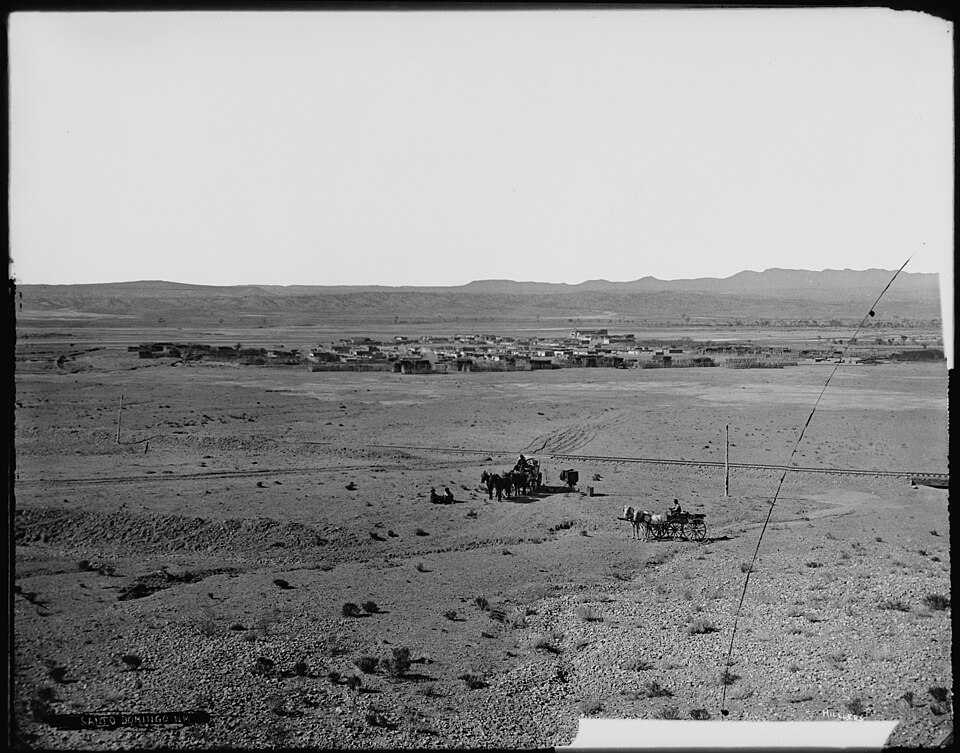
Distant Kewa/Santo Domingo view — Hillers historical photographJohn Karl Hillers / National Archives, Bureau of American Ethnology records; NAID 523760 · Public domain — U.S. federal-government work
Kewa, also recorded as Santo Domingo Pueblo, is a distinct Pueblo community. This path pairs selected outside historical context with an Indigenous cultural centre’s curatorial account of named jewelry makers and family teaching. It does not treat one artwork or artist as representative of everyone.
See each region’s evidence for historical or present-day scope.
Homeland / region
New Mexico / Rio Grande
Research depth
Source guide
Source collection
3 annotated resources · 1 Indigenous-led
Inspected sources
2 substantive works · selected content reviewed
Initial adequacy
Still unfinished
Source review
October 28, 2026
A source guide for a deeper dive.This entry provides a brief orientation and an organized reading path. A comprehensive deep dive has not yet been completed. Follow the annotated sources and distinguish primary community accounts from outside reference material.
Still unfinished
A bounded actual-content starting path and specifically scoped credited picture are available. Fuller history, source comparison and community review remain open; quantity does not establish completion.
Assessment recorded October 28, 2026. This is separate from research completion and community review.
Seek additional Kewa-published historical and educational works with explicit public access.
Read primary transport/flood records and fuller artist histories before extending chronology.
The Hillers photograph is a distant outside historical view; unidentified people, past consent, present access and precise exposure date are not established.
Backdrop photographs & credits
These photographs have individual, documented connections to this entry. Their captions and source records define the people, place, object, and period shown; no one photograph represents every community within a broader label.
Distant Kewa/Santo Domingo view — Hillers historical photograph John Karl Hillers / National Archives, Bureau of American Ethnology records; NAID 523760 · Public domain — U.S. federal-government work
The exact archival item identifies Santo Domingo/Kewa Pueblo. Its distant settlement, open landscape and horse-drawn wagons are an outside historical view, not present community conditions or an exact exposure date. No visible ceremony or identifiable sacred structure is interpreted. Unidentified figures are not named; original consent and present access are not established. Complete available retrieved JPEG imported unchanged. Background/card CSS crops and overlays affect presentation; the opened page retains the complete available frame proportionally.
Image, association, and reuse record reviewed 2026-10-28.
Full photographs are displayed proportionally above. A translucent background copy may be cropped by the viewport; it does not replace the complete image or its record.
The visual treatment does not change the research status, evidence, or remaining gaps recorded in this profile.
Start reading here
A short purposeful path through selected actual-content works. Read annotations for community, period and inspection limits; this is not a complete history or community endorsement.
Follow a named curator’s account of a collection, individual makers and intergenerational learning.
These are selected starting points. The full annotated collection, source perspectives, inspection limits and remaining research questions follow below. A starting guide is not an exhaustive history or community endorsement.
01
Identity and homelands
Kewa Pueblo, also known in historical sources as Santo Domingo Pueblo, is a Keres-speaking community between Albuquerque and Santa Fe.
Jewelry and pottery are prominent in public cultural accounts. The National Archives guide offers a separate route into records under both Kewa and Santo Domingo names.
The NPS account connects Kewa’s rebuilding after Rio Grande floods with later railway and highway tourism. Its discussion of pottery and jewelry trade provides historical context, while its ceremonial descriptions are outside the scope of this guide. A broad archival village view is not documentation of present access or boundaries.
Amy G. Johnson’s collection essay describes jewelry makers adapting materials during economic hardship and recounts Martine Lovato’s memories of family learning. Those memories are attributed to named people through the essay. The article is a reading source, not permission to reproduce its jewelry photographs or interpret designs as universal tradition.
Seek additional Kewa-published historical and educational works with explicit public access.
Read primary transport/flood records and fuller artist histories before extending chronology.
The Hillers photograph is a distant outside historical view; unidentified people, past consent, present access and precise exposure date are not established.
Cohort13: selected actual-content reviews preserve their institutional/community scope. Existing source cards are upgraded at the same ID and URL where noted; repeated publications are not globally new works.
Follow the reading path
Sources & further reading
Open any title to read the original source. Annotations explain what each link can help you explore.
No Indigenous-led source is identified in this entry yet. This is a gap in this collection, and does not imply an absence of community knowledge or organization.
The NPS connects Kewa/Santo Domingo naming with Rio Grande floods, rebuilding, transportation and craft trade. It is an outside historical account rather than community authority on ceremonial practice.
Inspection: Content reviewed for the stated scope
Scope: Actual main body: introductory name/place context; selected destructive-flood and rebuilding paragraph; nineteenth-century railway and twentieth-century Route 66 craft-trade paragraphs.
Review recorded: October 28, 2026
Access note: Normal HTTP200. Ceremonial/theological descriptions, kiva locations, generalized political alliances, present economy and visitor-event claims excluded. Original flood, railway, treaty and architectural records not reviewed. No outreach or access bypass. Linked media, original records and additional collections were not automatically inspected or licensed.
Curator Amy G. Johnson recounts a donated jewelry collection and relates makers’ adaptation to economic hardship and tourism. Attributed family memories show knowledge passed between individual artists, not a universal Kewa design rule.
Inspection: Content reviewed for the stated scope
Scope: Actual article body: collection donation and family account; selected railway/automobile-tourism and Depression-era adaptation paragraphs; Martine Lovato/Reyes Pacheco teaching recollection; author biography.
Review recorded: October 28, 2026
Access note: Normal HTTP200. No jewelry image, design interpretation, reproduction instruction or object rights adopted. Economic chronology and family recollections remain the author’s attributed account; collection-size totals and wider community uniformity not asserted. No outreach or access bypass. Linked media, original records and additional collections were not automatically inspected or licensed.
Related entries may represent alternate names, constituent communities, wider groupings, or historical connections. Read the naming notes before treating entries as equivalent.
Robey’s Atlas of Indigenous North America · Compiled October 19, 2026 · Kewa Pueblo