U’mista’s institutional history and Chief Waxawidi’s statement offer community voices on cultural continuity and artistic ownership. They connect the return of confiscated belongings with rights held by particular families and nations. This broader reading route does not collapse distinct Kwakwaka’wakw communities or authorize copying their designs.
See each region’s evidence for historical or present-day scope.
Homeland / region
Northeastern Vancouver Island / mainland British Columbia
Research depth
Source guide
Source collection
2 annotated resources · 2 Indigenous-led
Inspected sources
2 substantive works · selected content reviewed
Initial adequacy
Still unfinished
Source review
October 28, 2026
A source guide for a deeper dive.This entry provides a brief orientation and an organized reading path. A comprehensive deep dive has not yet been completed. Follow the annotated sources and distinguish primary community accounts from outside reference material.
Still unfinished
A bounded actual-content starting path and specifically scoped credited picture are available. Fuller history, source comparison and community review remain open; quantity does not establish completion.
Assessment recorded October 28, 2026. This is separate from research completion and community review.
Review individually named community histories and contemporary language publications without treating the broader label as one government.
Museum objects, family-held knowledge, designs and recordings require separate study and permissions.
Backdrop photographs & credits
These photographs have individual, documented connections to this entry. Their captions and source records define the people, place, object, and period shown; no one photograph represents every community within a broader label.
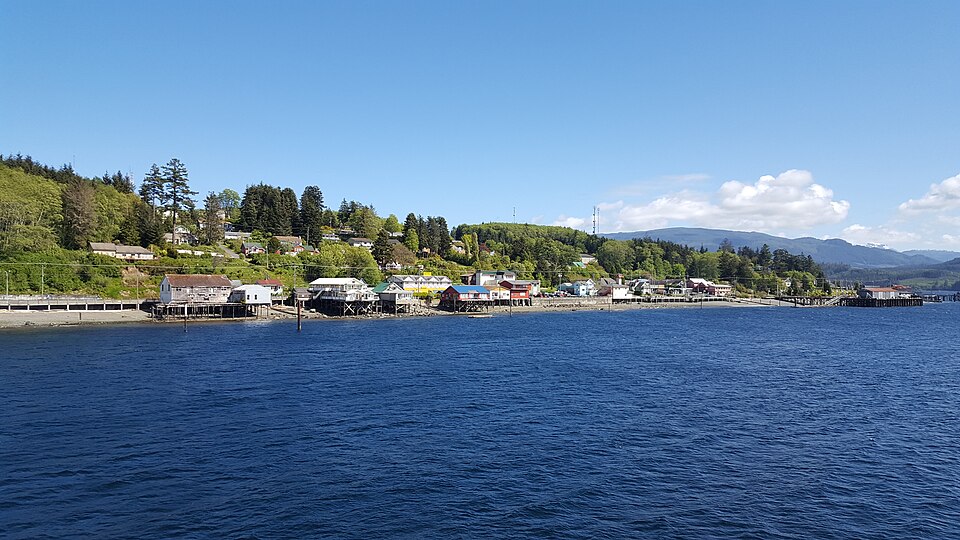
Alert Bay from a ferry,2016 Brian Burger(WireLizard), Flickr / Wikimedia Commons. CC BY 2.0.
A dated whole-settlement/coastal view of Alert Bay, where U’mista explicitly locates its cultural institution. It is one place context for this broader reading route, not every Kwakwaka’wakw nation, a government boundary, or permission to reproduce any separately owned focal design. Actual pixels show a distant waterfront settlement, wooded hillside and water. No focal carved pole, ceremonial art or private interior is adopted, and no specific building function is inferred. Complete available retrieved JPEG imported unchanged. Background/card CSS crops and overlays affect presentation; the opened page retains the complete available frame proportionally.
Image, association, and reuse record reviewed 2026-10-28.
Full photographs are displayed proportionally above. A translucent background copy may be cropped by the viewport; it does not replace the complete image or its record.
The visual treatment does not change the research status, evidence, or remaining gaps recorded in this profile.
Start reading here
A short purposeful path through selected actual-content works. Read annotations for community, period and inspection limits; this is not a complete history or community endorsement.
Read the named artist’s statement on mentorship, ownership and permission.
These are selected starting points. The full annotated collection, source perspectives, inspection limits and remaining research questions follow below. A starting guide is not an exhaustive history or community endorsement.
01
Identity and homelands
Kwakwa̱ka̱ʼwakw means Kwak̓wala-speaking people, encompassing distinct communities and nations rather than one interchangeable tribal identity.
U’mista explains that artistic rights and designs belong to particular families and nations; cultural learning requires attention to ownership and permission.
U’mista Cultural Society describes its establishment and the opening of its cultural facility in 1980. Its public account explains that belongings confiscated following a 1921 potlatch were dispersed to collections and that people pursued their return for decades. Read this as the Society’s institutional account, with individual families, belongings and records requiring their own histories and permissions.
Chief Waxawidi, identified by U’mista as a ʼNa̱mǥis artist, explains the role of mentorship, inherited family rights and permission in artistic practice. His statement asks readers to respect ownership across neighboring villages and nations. It is a source for learning about responsibility and authenticity, not permission to reproduce or generate ceremonial designs.
Review individually named community histories and contemporary language publications without treating the broader label as one government.
Museum objects, family-held knowledge, designs and recordings require separate study and permissions.
Cohort09: selected actual-content reviews preserve their institutional/community scope. Existing source cards are upgraded at the same ID and URL where noted; repeated publications are not globally new works.
Follow the reading path
Sources & further reading
Open any title to read the original source. Annotations explain what each link can help you explore.
No Indigenous-led source is identified in this entry yet. This is a gap in this collection, and does not imply an absence of community knowledge or organization.
The Society explains its origins, facility and the struggle to return confiscated ceremonial belongings. This is its own institutional account; particular families and nations retain their distinct histories and rights.
Inspection: Content reviewed for the stated scope
Scope: Complete substantive About Us, Meaning of U’mista and Society paragraphs, web lines 9–17. Operational staffing, admissions and shop listings were not adopted. Separate homepage location statement read only for the proposed Alert Bay photograph context.
Review recorded: October 28, 2026
Access note: Actual public HTML body read. No confiscation case file, complete museum catalogue, family-held knowledge or object-specific rights clearance inspected. The source does not authorize copying collection photographs, regalia, designs or ceremonies.
Chief Waxawidi explains how mentorship, inherited family rights and permission matter to artistic practice. This is an attributed statement on authenticity and ownership, not a stock catalogue of reusable motifs.
Inspection: Content reviewed for the stated scope
Scope: Complete signed main statement, web lines 11–23, with particular attention to mentorship, family-held designs and respecting neighboring villages/nations. The artist registry and other linked resources were not separately reviewed.
Review recorded: October 28, 2026
Access note: Actual public HTML statement read. No sacred instructions or motifs are reproduced, and no artwork permissions are inferred. This named artist’s statement is not treated as a universal rule for every Indigenous people or as an invitation to generate imitations.