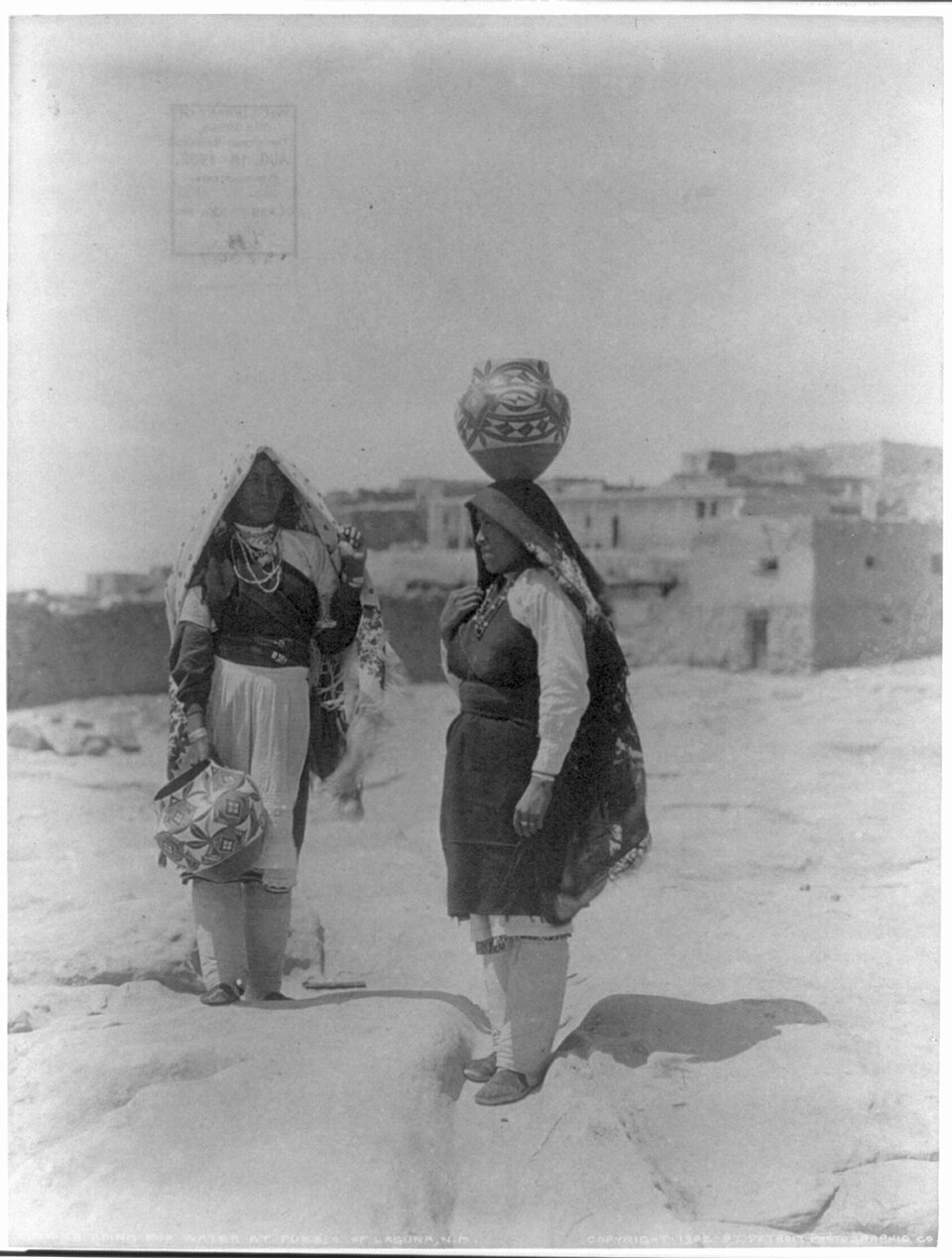
Laguna water-carrier photograph, 1902Detroit Photo Co. (copyright credit); individual photographer unidentified / Library of Congress Prints and Photographs, LCCN 2005691771, via Wikimedia Commons · Public domain — pre-1931 published/registered photograph; archive states no known publication restrictions
Laguna, or Kawaik, encompasses distinct village communities. This starting path compares selected NPS historical context with the Pueblo’s own preservation-office account. It keeps contemporary community stewardship separate from outside mission and highway narratives.
See each region’s evidence for historical or present-day scope.
Homeland / region
New Mexico
Research depth
Source guide
Source collection
3 annotated resources · 2 Indigenous-led
Inspected sources
2 substantive works · selected content reviewed
Initial adequacy
Still unfinished
Source review
October 28, 2026
A source guide for a deeper dive.This entry provides a brief orientation and an organized reading path. A comprehensive deep dive has not yet been completed. Follow the annotated sources and distinguish primary community accounts from outside reference material.
Still unfinished
A bounded actual-content starting path and specifically scoped credited picture are available. Fuller history, source comparison and community review remain open; quantity does not establish completion.
Assessment recorded October 28, 2026. This is separate from research completion and community review.
Develop separately scoped, community-verified reading routes for the named Laguna villages.
Read stronger community-led historical works and original records beyond the current navigation-only History page.
The 1902 water-carrier print is outside commercial photography; its unidentified subjects are not named or treated as current representatives, and original consent is unverified.
Backdrop photographs & credits
These photographs have individual, documented connections to this entry. Their captions and source records define the people, place, object, and period shown; no one photograph represents every community within a broader label.
Laguna water-carrier photograph, 1902 Detroit Photo Co. (copyright credit); individual photographer unidentified / Library of Congress Prints and Photographs, LCCN 2005691771, via Wikimedia Commons · Public domain — pre-1931 published/registered photograph; archive states no known publication restrictions
The catalogued 1902 cyanotype identifies women with water pots at Laguna. It is an outside commercial historical photograph; subjects are unidentified, not named or current representatives. Past consent is not inferred. Current Pueblo photography/privacy restrictions still apply and this reproduction conveys no permission to visit or capture. The jars are not extracted, separately licensed or used as Atlas motifs. Complete available retrieved JPEG imported unchanged. Background/card CSS crops and overlays affect presentation; the opened page retains the complete available frame proportionally.
Image, association, and reuse record reviewed 2026-10-28.
Full photographs are displayed proportionally above. A translucent background copy may be cropped by the viewport; it does not replace the complete image or its record.
The visual treatment does not change the research status, evidence, or remaining gaps recorded in this profile.
Start reading here
A short purposeful path through selected actual-content works. Read annotations for community, period and inspection limits; this is not a complete history or community endorsement.
Read the Pueblo’s public explanation of its own preservation responsibilities.
These are selected starting points. The full annotated collection, source perspectives, inspection limits and remaining research questions follow below. A starting guide is not an exhaustive history or community endorsement.
01
Identity and homelands
Laguna, or Kawaik, is a Keres-speaking Pueblo nation west of Albuquerque, encompassing six villages.
NPS connects the modern village’s establishment in 1699 with much older Kawaik presence and the upheavals of Spanish colonization and the Pueblo Revolt.
The NPS account distinguishes a much older Kawaik presence from the settlement changes associated with 1699 and identifies six villages. Its railway/highway perspective is useful context, but does not define the beginning of the people’s history or establish present boundaries.
The Pueblo’s preservation office explains advising leadership, recording cultural resources, consultation and coordinating repatriation. These are public responsibilities described by the institution. Protected surveys and locations are not reproduced, and its plans for additional museum or language work should not be treated as completed projects.
Develop separately scoped, community-verified reading routes for the named Laguna villages.
Read stronger community-led historical works and original records beyond the current navigation-only History page.
The 1902 water-carrier print is outside commercial photography; its unidentified subjects are not named or treated as current representatives, and original consent is unverified.
Cohort13: selected actual-content reviews preserve their institutional/community scope. Existing source cards are upgraded at the same ID and URL where noted; repeated publications are not globally new works.
Follow the reading path
Sources & further reading
Open any title to read the original source. Annotations explain what each link can help you explore.
No Indigenous-led source is identified in this entry yet. This is a gap in this collection, and does not imply an absence of community knowledge or organization.
The NPS distinguishes a much older Kawaik presence from the settlement changes associated with 1699 and lists six named villages. Its transport-focused history is an outside institutional perspective.
Inspection: Content reviewed for the stated scope
Scope: Actual main body: six-village and Keres/Kawaik introduction; selected older presence versus 1699 settlement discussion; village development and Route 66 realignment paragraphs; final privacy/photography caution.
Review recorded: October 28, 2026
Access note: Normal HTTP200. Largest-community claims, precise archaeological dating, contemporary economic summaries, current event schedules and mission interiors not adopted. Underlying archaeology and records uninspected; no present land-boundary inference. No outreach or access bypass. Linked media, original records and additional collections were not automatically inspected or licensed.
The retained History URL presently exposes headings and navigation rather than a substantive historical body. The separately inspected preservation-programme page provides a community-published counterpart to the NPS account.
Inspection: Supporting or limited review; see scope
Scope: Actual normal HTTP200 page text inspected: History headings, site navigation and page footer; no substantive historical narrative exposed in the delivered body.
Review recorded: October 28, 2026
Access note: No claim to reading linked church pages, images, embedded documents or a full Pueblo history. This landing route is excluded from substantive counts. No outreach or access bypass. Linked media, original records and additional collections were not automatically inspected or licensed.
The Pueblo explains its own preservation office’s advisory, recording, consultation and repatriation responsibilities. It gives a community institutional perspective without exposing protected inventories or treating plans as completed facilities.
Inspection: Content reviewed for the stated scope
Scope: Actual public Program Overview: mission, Scope of Work and Summary paragraphs on leadership advice, cultural surveys, interdepartmental work, consultation, repatriation and stated future ambitions.
Review recorded: October 28, 2026
Access note: Normal HTTP200. Individual advisors/staff, legal entitlements, survey locations, cultural inventories and underlying consultations not verified. No protected records or site coordinates reproduced. Hoped-for museum/language elements are not claimed as existing outcomes. No outreach or access bypass. Linked media, original records and additional collections were not automatically inspected or licensed.
Related entries may represent alternate names, constituent communities, wider groupings, or historical connections. Read the naming notes before treating entries as equivalent.
Robey’s Atlas of Indigenous North America · Compiled October 19, 2026 · Laguna Pueblo