Mashantucket Pequot sources here follow community continuity through colonial violence, later rebuilding and the work of a tribally owned museum. They offer a Nation-led historical starting point and an institutional research route while leaving original records and fuller family histories to inspect.
See each region’s evidence for historical or present-day scope.
Homeland / region
Connecticut
Research depth
Source guide
Source collection
2 annotated resources · 2 Indigenous-led
Inspected sources
2 substantive works · selected content reviewed
Initial adequacy
Still unfinished
Source review
October 28, 2026
A source guide for a deeper dive.This entry provides a brief orientation and an organized reading path. A comprehensive deep dive has not yet been completed. Follow the annotated sources and distinguish primary community accounts from outside reference material.
Still unfinished
A bounded actual-content starting path and specifically scoped credited picture are available. Fuller history, source comparison and community review remain open; quantity does not establish completion.
Assessment recorded October 28, 2026. This is separate from research completion and community review.
Add original historical records and community-directed scholarship across different periods.
Review selected public museum resources individually; institutional access is not blanket permission to reproduce collections.
Backdrop photographs & credits
These photographs have individual, documented connections to this entry. Their captions and source records define the people, place, object, and period shown; no one photograph represents every community within a broader label.
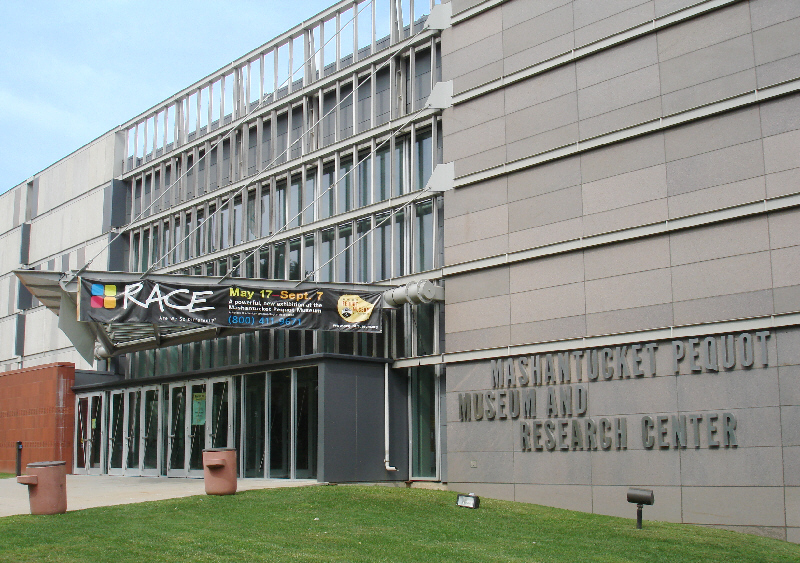
Mashantucket Pequot Museum exterior Stilfehler (Wikivoyage Shared) / Wikimedia Commons. CC BY-SA 3.0.
A dated exterior of the tribally owned Mashantucket Pequot Museum, identified by the item and the institution’s own Our Story publication. Not a reconstructed historical village, a portrait of all Pequot communities or permission to reuse interior exhibits. Complete available retrieved JPEG imported unchanged. Background/card CSS crops and overlays affect presentation; the opened page retains the complete available frame proportionally.
Image, association, and reuse record reviewed 2026-10-28.
Full photographs are displayed proportionally above. A translucent background copy may be cropped by the viewport; it does not replace the complete image or its record.
The visual treatment does not change the research status, evidence, or remaining gaps recorded in this profile.
Start reading here
A short purposeful path through selected actual-content works. Read annotations for community, period and inspection limits; this is not a complete history or community endorsement.
The tribally owned museum describes its mission, research collections and ways of interpreting Mashantucket Pequot and northeastern histories.
These are selected starting points. The full annotated collection, source perspectives, inspection limits and remaining research questions follow below. A starting guide is not an exhaustive history or community endorsement.
01
Identity and homelands
The Mashantucket Pequot Tribal Nation is a distinct contemporary Pequot government in southeastern Connecticut.
The tribally owned Pequot Museum and Research Center presents Pequot histories, cultural continuities, and educational programs through exhibitions and research resources.
The Nation’s history recounts colonial violence and dispersal while emphasizing that Pequot identity endured. It follows later efforts to sustain the Mashantucket community and describes people returning in the1970s to rebuild institutions and address housing and economic needs. These are the Nation’s own historical interpretations; original treaties, deeds and family records remain further research.
The Mashantucket Pequot Museum describes itself as tribally owned and operated, with exhibits, classrooms, collections, archives and research laboratories. Its mission places Pequot culture and relationships with community at the center of interpretation. This account introduces the institution; it does not substitute for inspecting an exhibit or grant permission to reproduce objects and commissioned art.
Add original historical records and community-directed scholarship across different periods.
Review selected public museum resources individually; institutional access is not blanket permission to reproduce collections.
Cohort12: selected actual-content reviews preserve their institutional/community scope. Existing source cards are upgraded at the same ID and URL where noted; repeated publications are not globally new works.
Follow the reading path
Sources & further reading
Open any title to read the original source. Annotations explain what each link can help you explore.
No Indigenous-led source is identified in this entry yet. This is a gap in this collection, and does not imply an absence of community knowledge or organization.
The Nation’s own account follows colonial violence, continued Pequot identity and the rebuilding of the Mashantucket community. Its particular community history is not a substitute for every Pequot experience.
Inspection: Content reviewed for the stated scope
Scope: Selected actual Our History body, web-reader lines 82–98: coastal setting, seventeenth-century war and dispersal, later community continuity, the1970s return and rebuilding efforts. Later business history, linked treaties and individual biographies uninspected.
Review recorded: October 28, 2026
Access note: Actual selected public prose read through the normal web reader. A separate automated public GET returned HTTP 403 and was not retried or bypassed. No original treaty, wartime record, land deed, census, biography or current legal instrument inspected. Acreage, casualty/population totals, legal conclusions, military motives and broad economic superlatives are not independently established or adopted.
The tribally owned museum describes its mission, research collections and ways of interpreting Mashantucket Pequot and northeastern histories. This is an institutional account, not a fresh inspection of its exhibits or holdings.
Inspection: Content reviewed for the stated scope
Scope: Our Story mission/value statements and Who We Are unit through the building description, web-reader lines65–78, before Our Team biographies.
Review recorded: October 28, 2026
Access note: Actual selected public prose read through the normal web reader. A separate automated public GET returned HTTP 403 and was not retried or bypassed. No interiors, commissioned artworks, archaeological objects, archival documents, conservation work or visitor programme inspected. Display does not grant reproduction rights, and architectural/environmental claims remain the museum’s own descriptions.
Related entries may represent alternate names, constituent communities, wider groupings, or historical connections. Read the naming notes before treating entries as equivalent.
Robey’s Atlas of Indigenous North America · Compiled October 19, 2026 · Mashantucket Pequot