The Massachusett Tribe at Ponkapoag publishes a community history connecting Neponset village life with displacement toward Ponkapoag and continuing cultural knowledge. This provides one community-led route within the broader Massachusett label, with historical geography kept separate from present membership and jurisdiction.
See each region’s evidence for historical or present-day scope.
Homeland / region
Eastern Massachusetts
Research depth
Source guide
Source collection
4 annotated resources · 4 Indigenous-led
Inspected sources
2 substantive works · selected content reviewed
Initial adequacy
Still unfinished
Source review
October 28, 2026
A source guide for a deeper dive.This entry provides a brief orientation and an organized reading path. A comprehensive deep dive has not yet been completed. Follow the annotated sources and distinguish primary community accounts from outside reference material.
Still unfinished
A bounded actual-content starting path and specifically scoped credited picture are available. Fuller history, source comparison and community review remain open; quantity does not establish completion.
Assessment recorded October 28, 2026. This is separate from research completion and community review.
Add selected original records and community-directed scholarship about Neponset and Ponkapoag.
Review other individually named Massachusett communities separately rather than treating linguistic, historical and present government categories as interchangeable.
Backdrop photographs & credits
These photographs have individual, documented connections to this entry. Their captions and source records define the people, place, object, and period shown; no one photograph represents every community within a broader label.
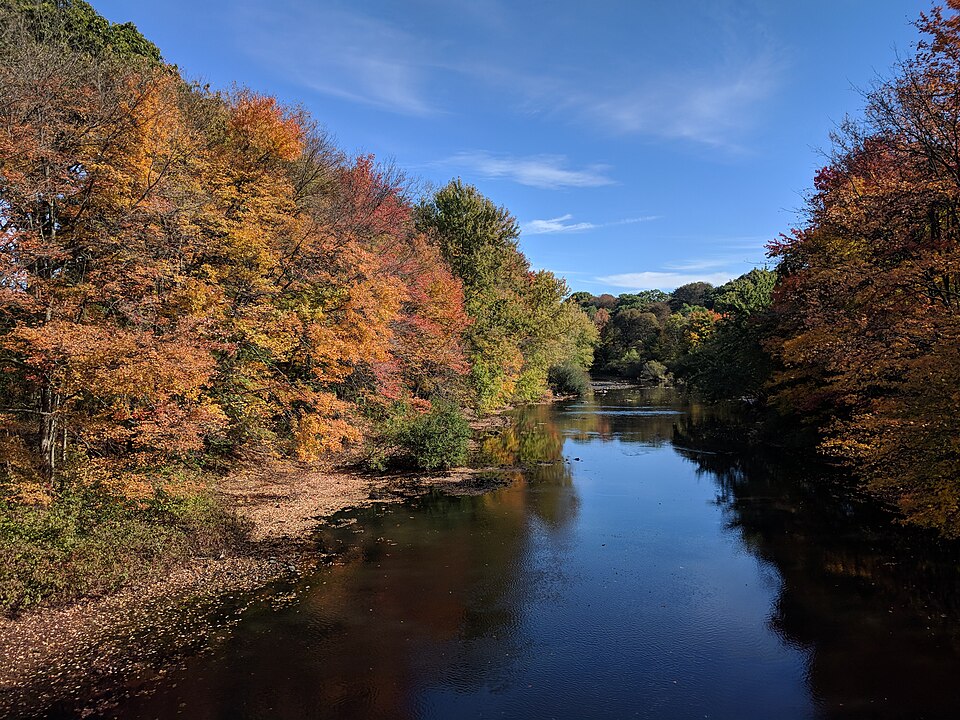
Neponset River in Dorchester ButteBag / Wikimedia Commons. CC BY-SA 4.0.
A modern Neponset River landscape in Dorchester. The Tribe at Ponkapoag’s own Neponset history and removal essay explicitly connect its community history with Neponset/Milton/Dorchester. Not a reconstructed precolonial scene, legal boundary, proof of ownership or image of current members. Complete available retrieved JPEG imported unchanged. Background/card CSS crops and overlays affect presentation; the opened page retains the complete available frame proportionally.
Image, association, and reuse record reviewed 2026-10-28.
Full photographs are displayed proportionally above. A translucent background copy may be cropped by the viewport; it does not replace the complete image or its record.
The visual treatment does not change the research status, evidence, or remaining gaps recorded in this profile.
Start reading here
A short purposeful path through selected actual-content works. Read annotations for community, period and inspection limits; this is not a complete history or community endorsement.
The community’s account relates movement from Neponset toward Ponkapoag to colonial pressure and the establishment of a praying town.
These are selected starting points. The full annotated collection, source perspectives, inspection limits and remaining research questions follow below. A starting guide is not an exhaustive history or community endorsement.
01
Identity and homelands
Massachusett communities historically extended along the coast and inland; the Massachusett Tribe at Ponkapoag presents a continuing community perspective.
Its history portal includes tribal life, mission and plantation-era experiences, and an account of continuing Massachusett identity rather than a narrative ending at colonization.
The Tribe’s account identifies Neponset within Massachusett histories and describes farming, fishing, quarry work and village life. It places colonial contact and disease within a period of major disruption. These are community-authored interpretations; the page’s numerical estimates and broad territorial descriptions are not treated here as independently established facts.
A second essay describes colonial pressure on Neponset lands and movement toward Ponkapoag, followed by the creation of a praying town. It relates changes in access to fields and coastal resources to constrained community choices. The account points toward original records still to inspect, while the Tribe’s short self-description affirms continuing intergenerational knowledge.
Add selected original records and community-directed scholarship about Neponset and Ponkapoag.
Review other individually named Massachusett communities separately rather than treating linguistic, historical and present government categories as interchangeable.
Cohort12: selected actual-content reviews preserve their institutional/community scope. Existing source cards are upgraded at the same ID and URL where noted; repeated publications are not globally new works.
Follow the reading path
Sources & further reading
Open any title to read the original source. Annotations explain what each link can help you explore.
No Indigenous-led source is identified in this entry yet. This is a gap in this collection, and does not imply an absence of community knowledge or organization.
Indigenous-ledThe Massachusett Tribe at PonkapoagSource 1
The Ponkapoag community’s account places Neponset within wider Massachusett histories of farming, fishing, village life and colonial disruption.
Inspection: Content reviewed for the stated scope
Scope: Complete short main Neponset historical prose after the heading and before Tribal History links; synthesis limited to community relationships and livelihoods. Numerical epidemic/migration estimates and images not used.
Review recorded: October 28, 2026
Access note: Normal public HTTP 200 body read. No colonial journal, archaeological object, census, map or original historical work cited by the page independently inspected. Epidemic percentages, exact territorial reach and universal political affiliation are not adopted. This is one community’s historical perspective, not a membership determination for all Massachusett people.
A useful route to the Tribe’s historical essays, retained as navigation rather than an additional inspected historical work.
Inspection: Supporting or limited review; see scope
Scope: Actual Our History heading and linked topic list; no independent historical prose appears in the main body. Historical-village image uninspected.
Review recorded: October 28, 2026
Access note: Normal public HTTP 200 body read. Excluded index; linked essays only count when their actual content is separately reviewed. The embedded historical map is neither inspected nor reproduced.
The community’s account relates movement from Neponset toward Ponkapoag to colonial pressure and the establishment of a praying town. It describes constrained choices rather than a voluntary disappearance.
Inspection: Content reviewed for the stated scope
Scope: Complete main essay from the post 1633 leadership paragraph through the praying-town comparison, before References/Tribal History links. Original works named in References uninspected.
Review recorded: October 28, 2026
Access note: Normal public HTTP 200 body read. No original Dorchester minutes, missionary writings, land allotment or genealogy inspected. Exact acreage, current legal rights and sole authorship of Bible translation are not inferred from this narrative. Colonial language is not adopted as an Atlas category.
A brief self-description links the Ponkapoag community with Neponset history and intergenerational knowledge. It supports present community context without becoming a separate substantive-history count.
Inspection: Supporting or limited review; see scope
Scope: Only opening self-description and broad intergenerational-storytelling statement, before the long 1620 town list. Ritual/medicine references and historical-town identifications not developed.
Review recorded: October 28, 2026
Access note: Normal public HTTP 200 body read. Excluded brief identity statement. No private knowledge, family genealogy, full town list or current land claim verified. Self-identification does not establish that this community represents every person using the broader Massachusett label.