Miami is a broader people name with distinct community and government routes. This small path concentrates on the Miami Tribe of Oklahoma’s Myaamia Center partnership, archival language work and the Removal Project’s introduction to the 1846 Wabash Valley removal; it is not a guide to every Miami community.
See each region’s evidence for historical or present-day scope.
Homeland / region
Great Lakes / Indiana / Oklahoma
Research depth
Source guide
Source collection
5 annotated resources · 2 Indigenous-led
Inspected sources
4 substantive works · selected content reviewed
Initial adequacy
Still unfinished
Source review
October 28, 2026
A source guide for a deeper dive.This entry provides a brief orientation and an organized reading path. A comprehensive deep dive has not yet been completed. Follow the annotated sources and distinguish primary community accounts from outside reference material.
Still unfinished
A bounded actual-content starting path and specifically scoped credited picture are available. Fuller history, source comparison and community review remain open; quantity does not establish completion.
Assessment recorded October 28, 2026. This is separate from research completion and community review.
Read selected complete removal letters against their manuscript or microfilm images.
Add community-authored histories from distinct Miami governments, preserving their separate voices and names.
Verify the authority of the older miami-oxford.org lead before treating it as a source.
Backdrop photographs & credits
These photographs have individual, documented connections to this entry. Their captions and source records define the people, place, object, and period shown; no one photograph represents every community within a broader label.
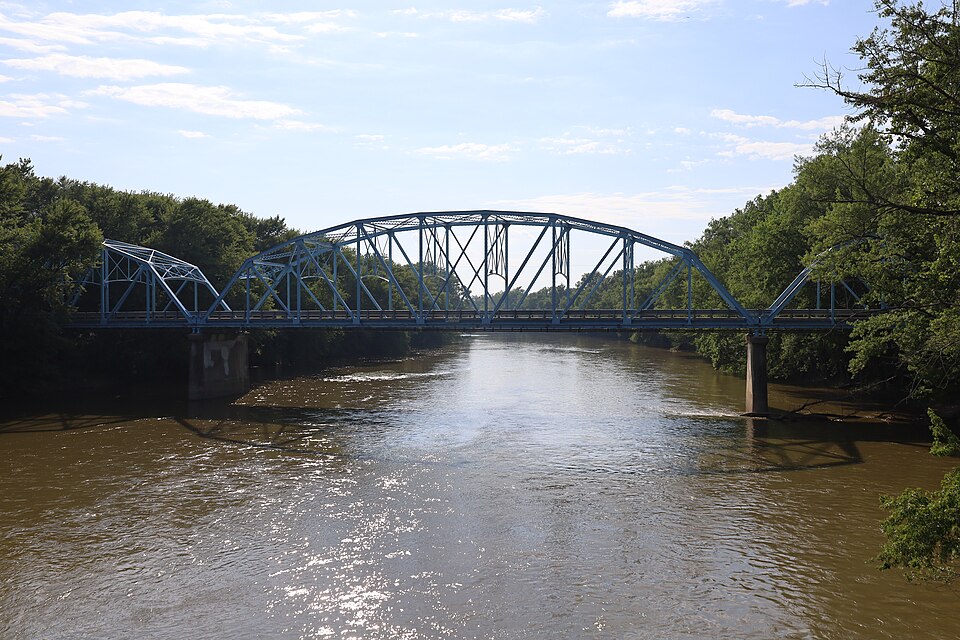
Wabash River and steel-truss bridge at Peru, Indiana, 2022 Antony-22 / Wikimedia Commons · CC BY-SA 4.0
Photographer-identified modern Wabash River bridge at Peru, Indiana. The Myaamia Removal Project’s actual introduction supplies the Wabash Valley historical connection. Regional context only, not an identified 1846 crossing, a reserve, a present government portrait or proof of territory. Commons coordinate fields disagree; no exact camera location or boundary is inferred. Complete available retrieved JPEG imported unchanged. Background/card CSS crops and overlays affect presentation; the opened page retains the complete available frame proportionally.
Image, association, and reuse record reviewed 2026-10-28.
Full photographs are displayed proportionally above. A translucent background copy may be cropped by the viewport; it does not replace the complete image or its record.
The visual treatment does not change the research status, evidence, or remaining gaps recorded in this profile.
Start reading here
A short purposeful path through selected actual-content works. Read annotations for community, period and inspection limits; this is not a complete history or community endorsement.
Use the dated institutional timeline for partnership milestones, rather than as a complete people’s history.
These are selected starting points. The full annotated collection, source perspectives, inspection limits and remaining research questions follow below. A starting guide is not an exhaustive history or community endorsement.
01
Identity and homelands
Myaamia people have homelands in the Great Lakes and Miami river systems, with communities continuing in Indiana and Oklahoma.
The Myaamia Center identifies itself as an initiative of the Miami Tribe of Oklahoma within Miami University. The University’s timeline records the Project’s creation in 2001 and its later development into a Center. This institutional relationship belongs within a broader history that also includes separately represented Miami communities.
The Center’s Language Research Office explains how analysis and digitization of older dictionaries and notes feed community language programmes. Its Education Office describes a portal and curriculum intended to reach learners in different places. These are explanations of methods and educational aims, not measurements of every learner’s experience.
The Removal Project’s introduction describes forced movement from the Wabash River Valley to Kansas in 1846. It explains how student and Center work produced transcriptions of correspondence. Begin with that context before treating an individual document as representative. The modern Wabash bridge image introduces a regional setting, not a documented removal crossing.
Read selected complete removal letters against their manuscript or microfilm images.
Add community-authored histories from distinct Miami governments, preserving their separate voices and names.
Verify the authority of the older miami-oxford.org lead before treating it as a source.
Cohort10: selected actual-content reviews preserve their institutional/community scope. Existing source cards are upgraded at the same ID and URL where noted; repeated publications are not globally new works.
Follow the reading path
Sources & further reading
Open any title to read the original source. Annotations explain what each link can help you explore.
No Indigenous-led source is identified in this entry yet. This is a gap in this collection, and does not imply an absence of community knowledge or organization.
Miami University’s timeline records milestones in its relationship with the Miami Tribe of Oklahoma. The selected entries concern this institutional partnership, not a complete history of the broader Miami people.
Inspection: Content reviewed for the stated scope
Scope: Actual timeline entries from 1991–2022, reader lines120–193: heritage students, creation of the Myaamia Project, later Center and commemorations.
Review recorded: October 28, 2026
Access note: Public HTML body read normally. Earlier portions, underlying agreements, interviews and programme outcomes were not independently reviewed; an institutional anniversary is not evidence of universal community agreement.
The previously listed domain has not been verified as the Center’s publishing channel. Retained as an uninspected lead; use the separately reviewed Miami University-hosted Center page for the institution’s account.
Inspection: Content review not recorded
Access recorded: October 28, 2026
Access note: Normal retrieval timed out; no actual body or ownership evidence inspected. The old ID and URL are retained, without asserting that the domain is official or compromised.
The Center describes itself as a Miami Tribe of Oklahoma initiative within an academic setting, developing language and cultural resources for community use. This is a specific partnership’s own description.
Inspection: Content reviewed for the stated scope
Scope: Actual mission, community-learning and support body, reader lines117–130. Logo explanation was encountered but no logo or claimed traditional motif is reproduced.
Review recorded: October 28, 2026
Access note: Public HTML body read. Linked classes, visits, educational materials, participant experiences and outcomes were not inspected. The Center’s institutional voice does not stand for every Miami government or person.
Selected office descriptions explain how archival language research supports learning, and how educational materials reach a geographically dispersed community. Read these as the Center’s project explanations, not independent outcome evaluations.
Inspection: Content reviewed for the stated scope
Scope: Actual Language Research body lines140–153 and Education body159–174: dictionary/ILDA work, education portal, heritage curriculum and land-record research introduction.
Review recorded: October 28, 2026
Access note: Public HTML body read normally. Original dictionaries, manuscripts, ILDA records, login-based lessons, linked maps and underlying land records were not inspected. Project goals, quantities and upload status are not independently verified.
The project introduces the 1846 forced removal from the Wabash River Valley and explains its work making correspondence more accessible. The project introduction is distinct from the original letters it links.
Inspection: Content reviewed for the stated scope
Scope: Actual substantial indexed main body: removal introduction, month-long movement to Kansas, and explanation of student/Center transcription from Office of Indian Affairs microfilm roll418.
Review recorded: October 28, 2026
Access note: Substantial indexed page body was read; a later ordinary reader request returned502. No complete individual letter, microfilm image, treaty or full archive was inspected. The modern Wabash photograph provides regional context, not proof of a historical crossing point.