Narragansett Indian Tribe publications connect seasonal community life, survival through state interference, later institutions and cultural-resource protection. This starting path retains the Tribe’s perspective while keeping unverified archaeological ages, present totals and legal conclusions separate.
See each region’s evidence for historical or present-day scope.
Homeland / region
Northeast / Rhode Island
Research depth
Source guide
Source collection
5 annotated resources · 4 Indigenous-led
Inspected sources
3 substantive works · selected content reviewed
Initial adequacy
Still unfinished
Source review
October 28, 2026
A source guide for a deeper dive.This entry provides a brief orientation and an organized reading path. A comprehensive deep dive has not yet been completed. Follow the annotated sources and distinguish primary community accounts from outside reference material.
Still unfinished
A bounded actual-content starting path and specifically scoped credited picture are available. Fuller history, source comparison and community review remain open; quantity does not establish completion.
Assessment recorded October 28, 2026. This is separate from research completion and community review.
Review original colonial, state and community records and named scholarship before extending precise chronology or legal claims.
Inspect appropriate public language and institutional resources without disclosing culturally sensitive locations.
Backdrop photographs & credits
These photographs have individual, documented connections to this entry. Their captions and source records define the people, place, object, and period shown; no one photograph represents every community within a broader label.
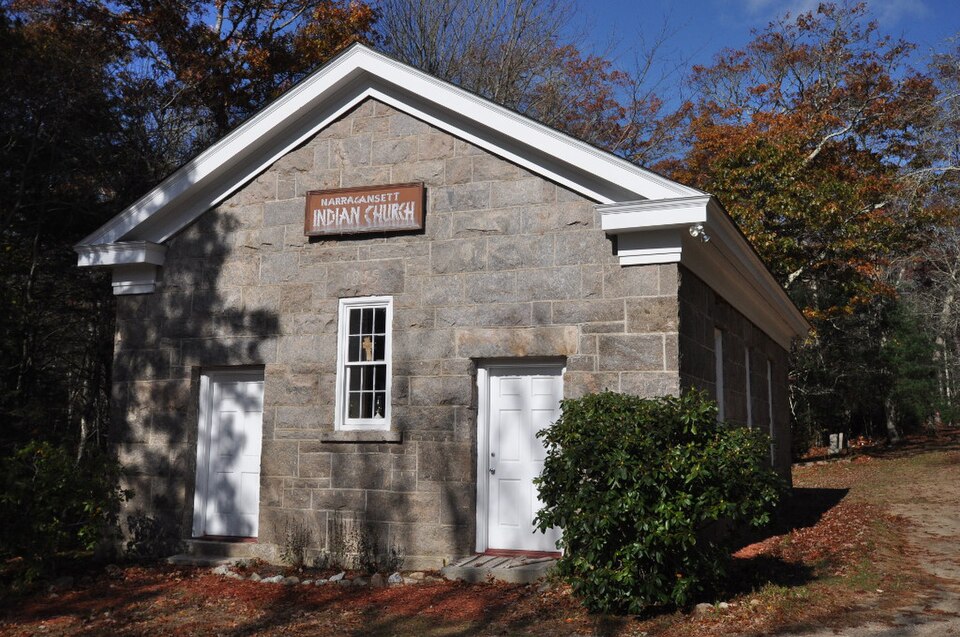
Narragansett Indian Church in Charlestown Magicpiano / Wikimedia Commons. CC BY-SA 4.0.
A dated exterior of the stone church in the Narragansett historic village. The Tribe’s perseverance history specifically identifies the Indian Meeting House/Church as a former setting for community meetings. Not an image of a ceremony, all Narragansett religious practice or a current boundary/title claim. Complete available retrieved JPEG imported unchanged. Background/card CSS crops and overlays affect presentation; the opened page retains the complete available frame proportionally.
Image, association, and reuse record reviewed 2026-10-28.
Full photographs are displayed proportionally above. A translucent background copy may be cropped by the viewport; it does not replace the complete image or its record.
The visual treatment does not change the research status, evidence, or remaining gaps recorded in this profile.
Start reading here
A short purposeful path through selected actual-content works. Read annotations for community, period and inspection limits; this is not a complete history or community endorsement.
The Tribe recounts continuing meetings and recognized leaders despite state interference, later organization and publishing, and a Longhouse that brought community activities together..
The office explains why archaeological places are finite cultural resources and how consultation and performance standards can protect them.
These are selected starting points. The full annotated collection, source perspectives, inspection limits and remaining research questions follow below. A starting guide is not an exhaustive history or community endorsement.
01
Identity and context
The Narragansett Indian Tribe has enduring relationships with Rhode Island and southern New England.
Focus the next stage of research on: Narragansett-authored history, language, land and sovereignty. The sources below are selected reading paths; their authorship, dates and community scope should guide how they are used.
The Tribe’s early-history account describes seasonal movement between winter homes and shore settings and recalls the violence of the Great Swamp Massacre in 1675. It presents community history from a Narragansett perspective. Numerical capacity estimates, claims about other peoples’ historical obligations and precise archaeological ages are not used to determine present identities or boundaries.
The perseverance account explains that community members continued recognizing leaders and holding meetings despite state efforts to dismantle tribal institutions. It later describes organizing, publishing The Narragansett Dawn and building a Longhouse in the1940s. The earlier Indian Meeting House also appears as a community meeting place. Original minutes, magazine issues and land records remain to inspect.
The historic-preservation office explains that excavation and construction can irreversibly alter cultural places. Its public account describes consultation and performance standards intended to protect them. These are stated responsibilities and concerns, not an invitation to investigate sensitive sites or a legal assessment of a particular project.
Review original colonial, state and community records and named scholarship before extending precise chronology or legal claims.
Inspect appropriate public language and institutional resources without disclosing culturally sensitive locations.
Cohort12: selected actual-content reviews preserve their institutional/community scope. Existing source cards are upgraded at the same ID and URL where noted; repeated publications are not globally new works.
Follow the reading path
Sources & further reading
Open any title to read the original source. Annotations explain what each link can help you explore.
No Indigenous-led source is identified in this entry yet. This is a gap in this collection, and does not imply an absence of community knowledge or organization.
The Tribe’s historical perspective describes seasonal community life and the violence of King Philip’s War. Its account should be read with original colonial records and community scholarship still to inspect.
Inspection: Content reviewed for the stated scope
Scope: Complete Early History body after the heading, with synthesis confined to seasonal home/shore activity and the 1675 Great Swamp Massacre/dispersion paragraphs. Age-of-occupation estimates, tributary lists and first-contact superlatives excluded.
Review recorded: October 28, 2026
Access note: Normal public HTTP 200 body read. No archaeological report, colonial journal, treaty, casualty list or village evidence inspected. The page’s30, 000-year statement, numerical household/canoe capacity, legal land-use claims and current affiliation inferences are not adopted.
Community or Indigenous-organization perspective linked for this entry. Use “A Brief History – Narragansett Historical Society” to begin with the publisher’s own account; check whether its scope is one community or a wider people.
Community or Indigenous-organization perspective linked for this entry. Use “Early History | Narragansett, RI - Official Website” to begin with the publisher’s own account; check whether its scope is one community or a wider people.
The Tribe recounts continuing meetings and recognized leaders despite state interference, later organization and publishing, and a Longhouse that brought community activities together.
Inspection: Content reviewed for the stated scope
Scope: Selected Reservations and Wompesu, Illegal Detribalization, Perseverance, and The Longhouse units, web-reader lines108–124. Later land claims, federal recognition, present totals and membership rules not used.
Review recorded: October 28, 2026
Access note: Normal public HTTP 200 body read. No state statute, court file, meeting minutes, Narragansett Dawn issue, title deed or church interior inspected. Descriptions of illegality and land tenure remain attributed rather than independent legal conclusions; gathering schedules and current membership conditions are not repeated.
The office explains why archaeological places are finite cultural resources and how consultation and performance standards can protect them. The public programme description does not authorize access to sensitive sites.
Inspection: Content reviewed for the stated scope
Scope: Complete NITHPO and Archaeological Administration main prose, web-reader lines108–115, before repeated Save/footer text.
Review recorded: October 28, 2026
Access note: Normal public HTTP 200 body read. No site inventories, ancestral remains, archaeological excavations, consultation files or legal instruments inspected. The programme’s stated authority and statutory summary are not current legal advice; sensitive places and practical excavation details are not published.