Nipmuc is a broader reading label involving multiple community histories. This guide pairs Cheryll Toney Holley’s museum history with university scholarship on James the Printer, while retaining a Council presentation as supporting context. Historical relationships do not settle contemporary leadership, membership or recognition disputes.
See each region’s evidence for historical or present-day scope.
Homeland / region
Northeast / Massachusetts
Research depth
Source guide
Source collection
5 annotated resources · 4 Indigenous-led
Inspected sources
2 substantive works · selected content reviewed
Initial adequacy
Still unfinished
Source review
October 28, 2026
A source guide for a deeper dive.This entry provides a brief orientation and an organized reading path. A comprehensive deep dive has not yet been completed. Follow the annotated sources and distinguish primary community accounts from outside reference material.
Still unfinished
A bounded actual-content starting path and specifically scoped credited picture are available. Fuller history, source comparison and community review remain open; quantity does not establish completion.
Assessment recorded October 28, 2026. This is separate from research completion and community review.
Seek additional directly attributed community histories and inspect original records behind historical claims.
Current leadership and recognition disputes remain outside this guide; do not adopt faction allegations or infer affiliation from shared names.
Backdrop photographs & credits
These photographs have individual, documented connections to this entry. Their captions and source records define the people, place, object, and period shown; no one photograph represents every community within a broader label.
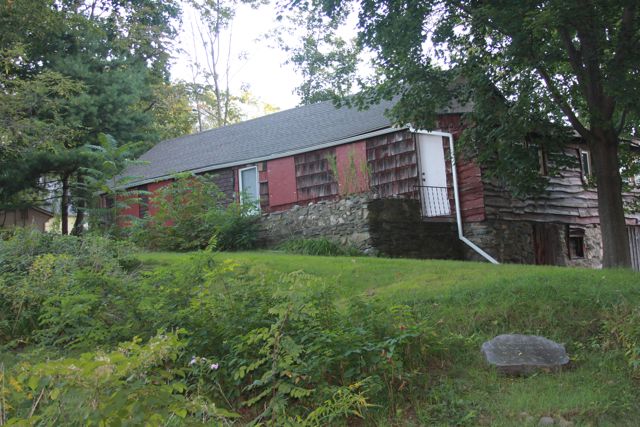
A building on the Hassanamisco property SusanGorius / Wikimedia Commons. CC BY-SA 3.0.
A dated building exterior at the Hassanamisco property, as individually identified by its Commons item. The building’s function is not supplied and is not guessed. Museum and Council histories specifically situate Hassanamisco community activity here; the photo neither resolves leadership differences nor represents every Nipmuc community. Complete available retrieved JPEG imported unchanged. Background/card CSS crops and overlays affect presentation; the opened page retains the complete available frame proportionally.
Image, association, and reuse record reviewed 2026-10-28.
Full photographs are displayed proportionally above. A translucent background copy may be cropped by the viewport; it does not replace the complete image or its record.
The visual treatment does not change the research status, evidence, or remaining gaps recorded in this profile.
Start reading here
A short purposeful path through selected actual-content works. Read annotations for community, period and inspection limits; this is not a complete history or community endorsement.
Holley’s detailed account describes village networks, colonial praying towns and later cultural work, including collaboration involving Hassanamisco and Chaubunagungamaug participants.
A university exhibit highlights Native translators and James the Printer’s skilled work between Cambridge and Hassenamesit.
These are selected starting points. The full annotated collection, source perspectives, inspection limits and remaining research questions follow below. A starting guide is not an exhaustive history or community endorsement.
01
Identity and context
Nipmuc communities have enduring relationships with central New England and publish their own accounts.
Focus the next stage of research on: Distinct Nipmuc communities, language, land and continuity. The sources below are selected reading paths; their authorship, dates and community scope should guide how they are used.
Holley’s museum history describes village networks linked through kinship, trade and seasonal livelihoods. It also explains that Nipmuc people entered colonial praying towns for varied reasons, under pressures that cannot be reduced to one shared choice. This is a named community historian’s account, with original colonial records still to inspect.
Harvard’s exhibit identifies James the Printer as Nipmuc and describes his skilled typesetting work and travel between Cambridge and Hassenamesit. Its interpretation places printing within missionary projects and complex Native–colonial relationships. It also cautions against equating literacy with straightforward progress. The historical person’s identity does not establish a present family or government affiliation.
Holley describes collaborative language classes involving Chaubunagungamaug instructor David White and the Hassanamisco Indian Museum. This is a specific example of cultural work crossing community relationships. It should not be converted into a claim that all Nipmuc people share one government or that one website resolves current leadership differences.
Seek additional directly attributed community histories and inspect original records behind historical claims.
Current leadership and recognition disputes remain outside this guide; do not adopt faction allegations or infer affiliation from shared names.
Cohort12: selected actual-content reviews preserve their institutional/community scope. Existing source cards are upgraded at the same ID and URL where noted; repeated publications are not globally new works.
Follow the reading path
Sources & further reading
Open any title to read the original source. Annotations explain what each link can help you explore.
No Indigenous-led source is identified in this entry yet. This is a gap in this collection, and does not imply an absence of community knowledge or organization.
Indigenous-led / supporting community perspectiveHassanamisco Nipmuc Tribal Council websiteSource 1Supporting reference · outside substantive inspected count
Retained as one Council’s presentation of Hassanamisco/Nipmuc history. Its own reference list names the longer museum history reviewed separately; overlapping history is not counted twice.
Inspection: Supporting or limited review; see scope
Scope: Historical homeland and Praying Towns/War/Survival units before modern leadership material, plus the references list. Current leadership allegations, recognition/membership interpretations and Splinter Group pages not adopted.
Review recorded: October 28, 2026
Access note: Normal public HTTP 200 body read. Excluded from the substantive-work count to avoid counting overlapping history derived in part from the museum account twice. The website presents a leadership dispute; no faction’s claim to exclusive authority, current recognition determination or membership conclusion is endorsed. Source use is confined to identified historical context.
Community or Indigenous-organization perspective linked for this entry. Use “Understanding Splinter Groups, Hassanamisco Nipmuc Nation” to begin with the publisher’s own account; check whether its scope is one community or a wider people.
Community or Indigenous-organization perspective linked for this entry. Use “The Dialectology of” to begin with the publisher’s own account; check whether its scope is one community or a wider people.
Holley’s detailed account describes village networks, colonial praying towns and later cultural work, including collaboration involving Hassanamisco and Chaubunagungamaug participants. Its author and December 2024 revision are explicit.
Inspection: Content reviewed for the stated scope
Scope: Selected actual body: opening homeland/village/subsistence paragraphs;1640s Eliot/praying-town paragraph; later paragraph on collaborative language classes with David White and the museum; author/revision credit. Other long political, legal and ceremonial passages not used.
Review recorded: October 28, 2026
Access note: Normal public HTTP 200 body read. No original colonial files, petitions, recognition records, private genealogies, oral-history interviews or classroom records inspected. Historical maps and source photographs are not licensed or reproduced by this reading. Population/epidemic totals, lineage or exclusive-government claims and leadership disputes are not adopted. Collaboration is attributed to Holley’s dated account, not a claim that all Nipmuc share one government.
A university exhibit highlights Native translators and James the Printer’s skilled work between Cambridge and Hassenamesit. It also cautions against equating literacy with simple progress.
Inspection: Content reviewed for the stated scope
Scope: Actual public interpretive prose on literacy, translators, James the Printer and written/oral communication, web-reader lines49–58. Excavated-object captions seen only as context; no objects or images reproduced.
Review recorded: October 28, 2026
Access note: Actual selected public prose read through the normal web reader. A separate automated public GET returned HTTP 403 and was not retried or bypassed. No original Bible, press record, typesetting artefact, excavation report or linked manuscript inspected. The page’s first-printing-in-North-America wording is not adopted; the synthesis does not turn a historical person’s label into proof of present descent or affiliation.