Nisg̱a’a Lisims Government’s public materials connect its account of the treaty with ongoing language and archival work. The treaty introduction and a selected 2024 departmental report provide a starting path. Government, village and house responsibilities need their own context; neither source is a present legal opinion or a complete history.
See each region’s evidence for historical or present-day scope.
Homeland / region
British Columbia
Research depth
Source guide
Source collection
4 annotated resources · 2 Indigenous-led
Inspected sources
2 substantive works · selected content reviewed
Initial adequacy
Still unfinished
Source review
October 28, 2026
A source guide for a deeper dive.This entry provides a brief orientation and an organized reading path. A comprehensive deep dive has not yet been completed. Follow the annotated sources and distinguish primary community accounts from outside reference material.
Still unfinished
A bounded actual-content starting path and specifically scoped credited picture are available. Fuller history, source comparison and community review remain open; quantity does not establish completion.
Assessment recorded October 28, 2026. This is separate from research completion and community review.
Add fuller Nisg̱a’a-authored historical accounts and distinct village perspectives beyond central-government material.
Follow later language and archives updates; inspect underlying public resources before describing their contents or availability.
Backdrop photographs & credits
These photographs have individual, documented connections to this entry. Their captions and source records define the people, place, object, and period shown; no one photograph represents every community within a broader label.
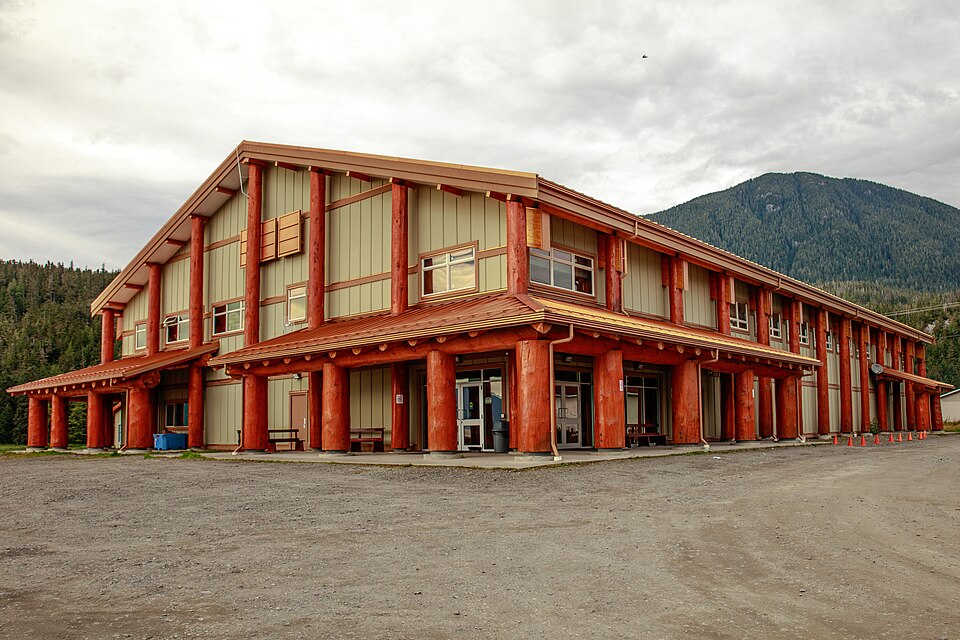
Building and hillside at Gingolx, 2015 Murray Foubister; Wikimedia Commons / original Murray Foubister Flickr photograph. CC BY-SA 2.0 Generic.
A dated place view of Gingolx, one Nisg̱a’a village-government setting, not all Nisg̱a’a people, present conditions, land ownership or surveyed territory. No smaller artwork in the scene may be extracted or adopted as Atlas branding. The record identifies Gingolx, but the building’s function is not established. No school, community-centre or government-office use is guessed, and no Kincolith River is claimed to be visible. This is a dated place view in one village setting, not all Nisg̱a’a communities or present land rights. Complete available retrieved JPEG imported unchanged. Background/card CSS crops and overlays affect presentation; the opened page retains the complete available frame proportionally.
Image, association, and reuse record reviewed 2026-10-28.
Full photographs are displayed proportionally above. A translucent background copy may be cropped by the viewport; it does not replace the complete image or its record.
The visual treatment does not change the research status, evidence, or remaining gaps recorded in this profile.
Start reading here
A short purposeful path through selected actual-content works. Read annotations for community, period and inspection limits; this is not a complete history or community endorsement.
Read the selected departmental pages for a dated account of language/archives work.
These are selected starting points. The full annotated collection, source perspectives, inspection limits and remaining research questions follow below. A starting guide is not an exhaustive history or community endorsement.
01
Identity and context
Nisg̱a’a people have homelands in the Nass River region.
Focus the next stage of research on: Nisg̱a’a-authored history, language, treaty history and contemporary institutions. The sources below are selected reading paths; their authorship, dates and community scope should guide how they are used.
Nisg̱a’a Lisims Government presents the treaty’s May 2000 effective date as a turning point after a long campaign. Its linked milestones describe initiatives involving village governments and urban locals. These pages offer the Government’s interpretation and program account. The agreement itself and its later implementation require separate reading before making current legal claims.
In the 2024 Special Assembly report, Esther K’yo’o Adams describes language planning, archival preservation and work to digitize educational resources. The report separates completed projects from ongoing work and proposals, and recognizes responsibilities of Elders and houses. This dated account provides a useful route into the work; it does not establish that every proposed resource or activity is now available.
Add fuller Nisg̱a’a-authored historical accounts and distinct village perspectives beyond central-government material.
Follow later language and archives updates; inspect underlying public resources before describing their contents or availability.
Cohort08: selected actual-content reviews preserve their institutional/community scope. Existing source cards are upgraded at the same ID and URL where noted; repeated publications are not globally new works.
Follow the reading path
Sources & further reading
Open any title to read the original source. Annotations explain what each link can help you explore.
No Indigenous-led source is identified in this entry yet. This is a gap in this collection, and does not imply an absence of community knowledge or organization.
Read the Government’s substantive introductory treaty account and linked selected milestones. It explains the May 2000 effective date and the Government’s interpretation of change. Treaty/law originals were not reviewed.
Inspection: Content reviewed for the stated scope
Scope: Complete introductory treaty prose, web lines 386–390, with linked Milestones main bullet list read as an undated government program account; footer not counted as another work.
Review recorded: October 28, 2026
Access note: Public actual HTML bodies read. This is a government’s interpretation and selected program history, not a review of the full agreement, implementation audit or current rights/jurisdiction. Undated monetary/achievement claims in Milestones not adopted.
A language reference linked for this entry. Read “Nisgaa-Gitksan Language and the Nisga'a-Gitxsan First Nations (Nass, Nisgha, Niska)” for terminology and documentation, and distinguish linguistic labels from the names of political communities.
Historical context for this entry. Read “Full Multi - Nisg̱a'a Final Agreement Act” with attention to the author, period covered, and communities named; compare with community-published accounts where available.
Esther K’yo’o Adams’s selected report distinguishes completed, ongoing and proposed work. It describes resource preservation and language planning while recognizing Elders’ and house responsibilities. No underlying recordings or traditional knowledge reproduced.
Inspection: Content reviewed for the stated scope
Scope: Printedpp62–63/PDF pp. 63–64 of95: complete Directorate of Language & Culture report, background, initiatives, archives and closing. Cover identifies May6–10, 2024 assembly.
Review recorded: October 28, 2026
Access note: Normal public PDF 200; actual selected text read using pypdf. It is a dated departmental self-report, not verified later implementation, funding outcome, public-library opening or present fluency measure. Other departments and underlying collections not reviewed.