Nlaka’pamux connects distinct communities and representative organizations. This path introduces the Nation Tribal Council’s language and cultural-care work, a dated personal reflection, and the particular Lytton First Nation–BC Parks planning history of Stein Valley.
See each region’s evidence for historical or present-day scope.
Homeland / region
British Columbia
Research depth
Source guide
Source collection
5 annotated resources · 2 Indigenous-led
Inspected sources
3 substantive works · selected content reviewed
Initial adequacy
Still unfinished
Source review
October 28, 2026
Names & relationshipsThe original list preserves this name as an access point. Compare the related entries and community-preferred spellings; overlapping names do not always mean identical political communities.
A source guide for a deeper dive.This entry provides a brief orientation and an organized reading path. A comprehensive deep dive has not yet been completed. Follow the annotated sources and distinguish primary community accounts from outside reference material.
Still unfinished
A bounded actual-content starting path and specifically scoped credited picture are available. Fuller history, source comparison and community review remain open; quantity does not establish completion.
Assessment recorded October 28, 2026. This is separate from research completion and community review.
Develop separate community-authored histories and verify names/representation before adding political relationships.
Read original park agreements and selected public historical records without exposing protected cultural places.
The modern Lytton landscape is contextual; it does not map the broader Nation’s territory or prove present rights.
Backdrop photographs & credits
These photographs have individual, documented connections to this entry. Their captions and source records define the people, place, object, and period shown; no one photograph represents every community within a broader label.
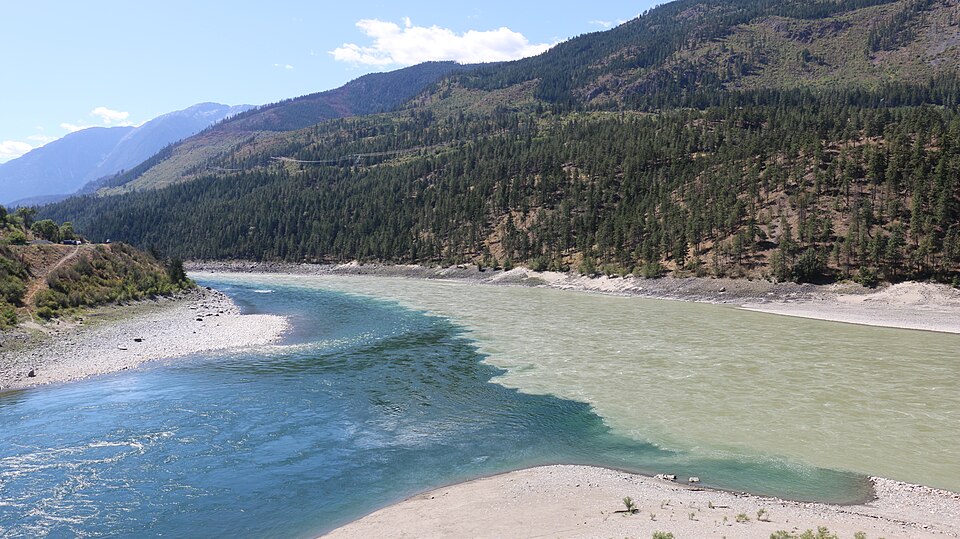
Fraser and Thompson river confluence at Lytton, 2015 The Interior / Wikimedia Commons · CC BY-SA 4.0
Photographer-identified river confluence at Lytton. Lytton First Nation’s own About Us locates its communities along the Fraser River and describes Kumsheen as where the rivers cross. The Stein plan identifies the specific Lytton Nlaka’pamux partnership. Regional named-place context, not all Nlaka’pamux communities, a photographed reserve boundary or a present-rights determination. Complete available retrieved JPEG imported unchanged. Background/card CSS crops and overlays affect presentation; the opened page retains the complete available frame proportionally.
Image, association, and reuse record reviewed 2026-10-28.
Full photographs are displayed proportionally above. A translucent background copy may be cropped by the viewport; it does not replace the complete image or its record.
The visual treatment does not change the research status, evidence, or remaining gaps recorded in this profile.
Start reading here
A short purposeful path through selected actual-content works. Read annotations for community, period and inspection limits; this is not a complete history or community endorsement.
Add a dated, attributed reflection rather than assume one response to colonial institutions.
These are selected starting points. The full annotated collection, source perspectives, inspection limits and remaining research questions follow below. A starting guide is not an exhaustive history or community endorsement.
01
Identity and context
Nlaka’pamux is a people’s name also encountered under the historical outside name Thompson.
Focus the next stage of research on: Language, Fraser and Thompson river homelands and community-specific institutions. The sources below are selected reading paths; their authorship, dates and community scope should guide how they are used.
The provincial listing distinguishes communities and representative organizations. The Tribal Council’s Cultural Resources account describes its own work in language and education. These sources should not be collapsed into a claim that a single organization speaks for every Nlaka’pamux person.
The 2000 Stein Valley plan describes a process involving BC Parks, Lytton First Nation and a shared Management Board. It recounts advocacy and the 1995 park designation. The selected planning history offers a concrete institutional example; its agreements and present management arrangements need separate review.
In the Council’s 2022 newsletter, Matt Pasco reflects on his Vatican trip and argues that apology must be accompanied by meaningful action. He also questions approaches that treat distinct Indigenous peoples as one undifferentiated group. This is an attributed personal and political account, not a universal community response.
Develop separate community-authored histories and verify names/representation before adding political relationships.
Read original park agreements and selected public historical records without exposing protected cultural places.
The modern Lytton landscape is contextual; it does not map the broader Nation’s territory or prove present rights.
Cohort11: selected actual-content reviews preserve their institutional/community scope. Existing source cards are upgraded at the same ID and URL where noted; repeated publications are not globally new works.
Follow the reading path
Sources & further reading
Open any title to read the original source. Annotations explain what each link can help you explore.
No Indigenous-led source is identified in this entry yet. This is a gap in this collection, and does not imply an absence of community knowledge or organization.
Historical context for this entry. Read “Nlaka’pamux Nation Tribal Council - Province of British Columbia” with attention to the author, period covered, and communities named; compare with community-published accounts where available.
A provincial administrative listing distinguishes several communities and representative organizations. Supporting identification only, not a substantive Nlaka’pamux history.
Inspection: Supporting or limited review; see scope
Scope: Actual indexed body, displayed December2, 2025 update, community/group listing and Fraser Canyon/south-interior location field.
Review recorded: October 28, 2026
Access note: Indexed body read; a later direct reader request returned502. Current membership/representation, counts and legal scope are not independently verified. Administrative listing is not homeland evidence.
A jointly coordinated planning process describes Lytton First Nation participation and the park’s preservation history. This particular partnership does not represent all Nlaka’pamux communities.
Inspection: Content reviewed for the stated scope
Scope: Actual PDF p.8 acknowledgments and pp.11–14 / printed1–4:plan highlights, process, cooperative management and 1995 designation background.74 pages obtained; no whole-file reading claimed.
Review recorded: October 28, 2026
Access note: Normal HTTP200 PDF/text read. Prepared by BC Parks with consultants, coordinated through the Management Board and informed by Elders. Original agreements, laws, maps, site records, ceremonial practices and current visitor rules uninspected.
The Council connects language, education and cultural stewardship, crediting the people who developed language resources. Read as its institutional account rather than every community’s experience.
Inspection: Content reviewed for the stated scope
Scope: Actual complete one-page PDF text, with synthesis limited to language-group, school-support and cultural-care explanations. Stories, archaeological locations and underlying interviews not inspected.
Review recorded: October 28, 2026
Access note: Normal HTTP200 PDF/text read. The body references January 2023; upload path does not establish publication date. Underlying dictionary, curriculum, heritage law and outcomes uninspected. Public summaries do not grant reuse of cultural materials.
A dated personal reflection distinguishes apology from material action and questions treating distinct Indigenous peoples as interchangeable. It is Pasco’s stated interpretation, not a unanimous response.
Inspection: Content reviewed for the stated scope
Scope: Actual complete Chair’s Reflections on PDF/printed pp.2–3; cover title, issue period and byline also read.12-page issue obtained, not fully read.
Review recorded: October 28, 2026
Access note: Normal HTTP200 PDF/text read after slow retrieval; web reader rejected14MB size. No underlying testimony, Church record or other newsletter article inspected. Personal/family details and ceremonial descriptions are not reproduced.
Related entries may represent alternate names, constituent communities, wider groupings, or historical connections. Read the naming notes before treating entries as equivalent.
Robey’s Atlas of Indigenous North America · Compiled October 19, 2026 · Nlaka'pamux