Nooksack public history connects communities with the Nooksack River watershed and describes continuity through changes in settlement and landholding. This guide pairs the Nooksack Indian Tribe’s historical account with its natural-resource department’s public responsibilities and goals. Those institutional accounts are not a current population census, legal determination or every family’s perspective.
See each region’s evidence for historical or present-day scope.
Homeland / region
Pacific Northwest / Washington
Research depth
Source guide
Source collection
4 annotated resources · 4 Indigenous-led
Inspected sources
2 substantive works · selected content reviewed
Initial adequacy
Still unfinished
Source review
October 28, 2026
A source guide for a deeper dive.This entry provides a brief orientation and an organized reading path. A comprehensive deep dive has not yet been completed. Follow the annotated sources and distinguish primary community accounts from outside reference material.
Still unfinished
A bounded actual-content starting path and specifically scoped credited picture are available. Fuller history, source comparison and community review remain open; quantity does not establish completion.
Assessment recorded October 28, 2026. This is separate from research completion and community review.
Read selected linguistic and historical scholarship with the original records cited by the Tribe.
Inspect technical monitoring and habitat reports before reporting measurable environmental outcomes.
Review distinct family/community perspectives and contemporary governance questions carefully; introductory institutional history is not an enrollment or legal determination.
Backdrop photographs & credits
These photographs have individual, documented connections to this entry. Their captions and source records define the people, place, object, and period shown; no one photograph represents every community within a broader label.
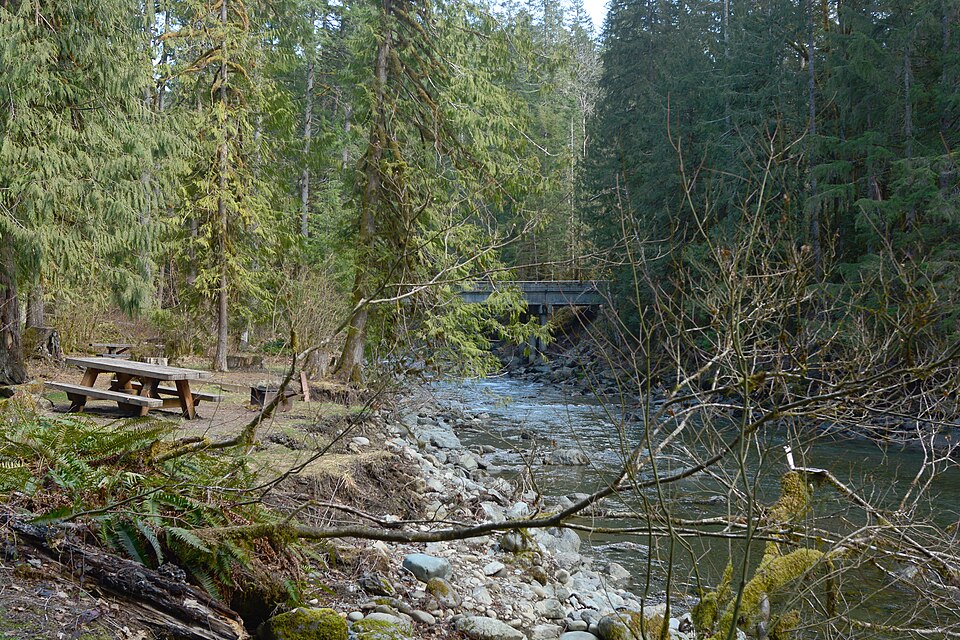
North Fork Nooksack River from Douglas Fir Campground, 2023 Joe Mabel / Wikimedia Commons · CC BY-SA 4.0
Exact record identifies the North Fork Nooksack River upstream view from Douglas Fir Campground. The Tribe’s actual historical account describes Nooksack River watershed relationships, including the upper North Fork as a shared-use area. A public modern river landscape, not an identified village, sacred location, exclusive-use claim or present boundary. Commons file history explicitly describes the current source revision as shadows lightened; no additional Atlas retouching is proposed. Unchanged complete 960×640 JPEG delivered by the exact provider-listed 960px preview link, retrieved normally HTTP 200 by root and independently viewed locally by this agent. The larger record-linked original and camera original were not inspected. No new crop, resizing, compression, retouching, colorization or generation applied; CSS display crops and overlays may affect presentation. Image remains CC BY-SA 4.0 with creator, source and license credits. The Commons file history identifies the current source revision as shadows lightened; the Atlas adds no further retouching. Complete available retrieved JPEG imported unchanged. Background/card CSS crops and overlays affect presentation; the opened page retains the complete available frame proportionally.
Image, association, and reuse record reviewed 2026-10-28.
Full photographs are displayed proportionally above. A translucent background copy may be cropped by the viewport; it does not replace the complete image or its record.
The visual treatment does not change the research status, evidence, or remaining gaps recorded in this profile.
Start reading here
A short purposeful path through selected actual-content works. Read annotations for community, period and inspection limits; this is not a complete history or community endorsement.
Then read the natural-resource department’s mission, work categories and explicitly stated goals.
These are selected starting points. The full annotated collection, source perspectives, inspection limits and remaining research questions follow below. A starting guide is not an exhaustive history or community endorsement.
01
Identity and context
The Nooksack Indian Tribe has homelands in northwestern Washington.
Focus the next stage of research on: Nooksack-authored history, language, treaty context and government. The sources below are selected reading paths; their authorship, dates and community scope should guide how they are used.
The Tribe’s public historical account places Nooksack life within the river watershed and explains shared access through kin relationships with neighboring communities. It describes a transition from winter villages to small homesteads while fishing, hunting and gathering continued at familiar places. This is the Tribe’s historical interpretation, rather than a directory ruling on land ownership or current affiliation. Original ethnographies, patents and legal records still need separate inspection.
The Natural Resources Department connects its mission with current and future generations. Its public account organizes work through fisheries, habitat restoration and watershed planning, monitoring, and resource protection. The department’s vision includes sustainable fish populations and resilient ecosystems. Those are goals and responsibilities; this introductory reading does not independently establish fish abundance, restoration success or the content of present treaty rights.
Read selected linguistic and historical scholarship with the original records cited by the Tribe.
Inspect technical monitoring and habitat reports before reporting measurable environmental outcomes.
Review distinct family/community perspectives and contemporary governance questions carefully; introductory institutional history is not an enrollment or legal determination.
Cohort09: selected actual-content reviews preserve their institutional/community scope. Existing source cards are upgraded at the same ID and URL where noted; repeated publications are not globally new works.
Follow the reading path
Sources & further reading
Open any title to read the original source. Annotations explain what each link can help you explore.
No Indigenous-led source is identified in this entry yet. This is a gap in this collection, and does not imply an absence of community knowledge or organization.
Community or Indigenous-organization perspective linked for this entry. Use “NOOKSACK TRIBAL CULTURAL COMMITTEE BYLAWS” to begin with the publisher’s own account; check whether its scope is one community or a wider people.
The actual mission, vision and work categories explain fisheries, habitat restoration, watershed planning, monitoring and resource protection. These are the department’s responsibilities and goals; the guide does not claim that desired ecosystem conditions have been achieved.
Inspection: Content reviewed for the stated scope
Scope: Actual Natural Resources body, reader lines 98–122: mission, five vision outcomes, four staff work categories and program organization. Staff directory, RFP notices, fishing rules, historic images and linked technical studies not used for factual outcomes or image clearance.
Review recorded: October 28, 2026
Access note: Actual selected public HTML body read through the web reader; no login or paywall encountered. Linked publications, underlying archives, video/audio and photographs were not thereby fully inspected or cleared for reproduction.
Community or Indigenous-organization perspective linked for this entry. Use “Gallery - Nooksack” to begin with the publisher’s own account; check whether its scope is one community or a wider people.
The substantial public History and Territory tab text describes river communities, kin-based shared use and the transition from villages to homesteads while fishing, hunting and gathering continued. Historical and legal interpretations are attributed; population totals, sensitive site details and present ownership claims are not adopted.
Inspection: Content reviewed for the stated scope
Scope: Actual public HTML About, Nooksack Territory and History bodies, including text retained in hidden tabs in the normally retrieved HTML. Selected synthesis uses river relationships, joint-use/kin ties, settlement change and continuing land-based activities. Original ethnographies, cases, patents and underlying archaeological records not inspected.
Review recorded: October 28, 2026
Access note: Web-reader rendering exposed only the short About tab. Ordinary Python urllib retrieval returned HTTP 200 and contained the full public Territory and History tab bodies, which were read and saved privately. No challenge/login/paywall or bypass. Underlying citations and precise historical village/site locations not reproduced.