Nuxalk public accounts connect Bella Coola Valley with wider ancestral homelands, language and responsibilities to future generations. These readings pair the Nation’s visitor guide with a stewardship account, retaining their public cultural context while distinguishing plans, ancestral interpretation and contemporary administrative work.
See each region’s evidence for historical or present-day scope.
Homeland / region
British Columbia / Central Coast
Research depth
Source guide
Source collection
4 annotated resources · 4 Indigenous-led
Inspected sources
2 substantive works · selected content reviewed
Initial adequacy
Still unfinished
Source review
October 28, 2026
A source guide for a deeper dive.This entry provides a brief orientation and an organized reading path. A comprehensive deep dive has not yet been completed. Follow the annotated sources and distinguish primary community accounts from outside reference material.
Still unfinished
A bounded actual-content starting path and specifically scoped credited picture are available. Fuller history, source comparison and community review remain open; quantity does not establish completion.
Assessment recorded October 28, 2026. This is separate from research completion and community review.
Seek fuller community-authorized histories and public language resources beyond the visitor-guide selection.
Establish the guide’s precise publication/adoption history; its filename labels it2022_DRAFT and old population totals are not current figures.
Inspect the marine plans and dated programme reports before assessing implementation or ecological outcomes.
Review Q’umk’uts and Snxlhh as individually named community candidates separately, including current preferred spelling and kind; no automatic separate-government claim.
Backdrop photographs & credits
These photographs have individual, documented connections to this entry. Their captions and source records define the people, place, object, and period shown; no one photograph represents every community within a broader label.
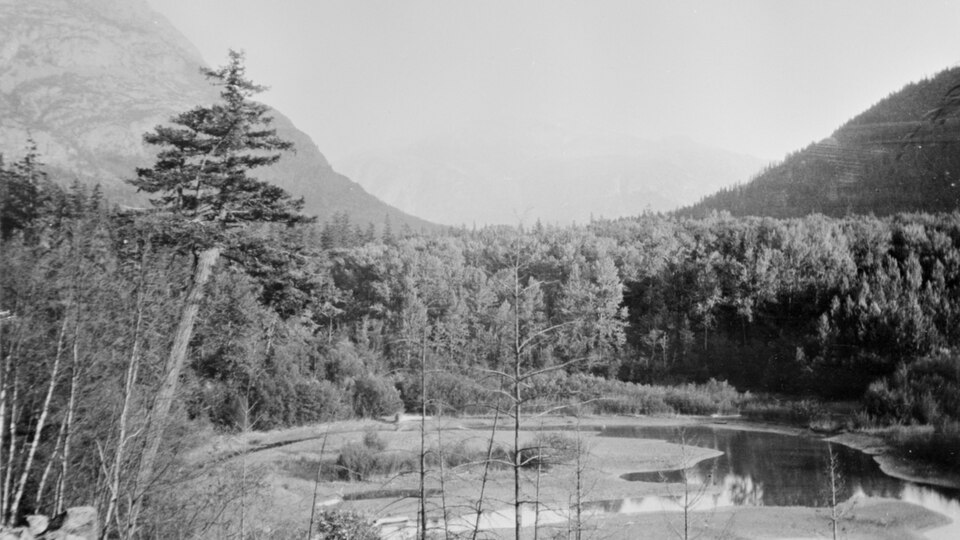
Bella Coola Valley,1923 Harlan Ingersoll Smith / Canadian Museum of History / Wikimedia Commons · CC BY-SA 4.0
Museum-sourced exact record58782 identifies a1923 view east up Bella Coola Valley toward a mountain beyond Stewie. Nation’s visitor guide explicitly names Bella Coola Valley within Nuxalk ancestral context. An outside historical landscape photograph, not a portrait of Nuxalk members, exact reserve shoreline, complete homeland depiction or a claim about present land ownership. No sacred-site location is supplied. Credit photographer and Canadian Museum of History source together. The media-specific Commons file license is CC BY-SA4.0, not metadataCC0 or an invented museum permission letter. Unchanged complete provider-listed960px full-frame preview, retrieved normally200 and locally inspected. The larger record original was not inspected or copied by this agent. No new crop, resizing, retouching or generation. CSS display crops/overlays may affect presentation. Image remains CC BY-SA 4.0 with creator/source/license credit. Harlan Ingersoll Smith’s1923 outside landscape photograph is credited with its Canadian Museum of History source; no modern community portrait or source-negative inspection is claimed. Complete available retrieved JPEG imported unchanged. Background/card CSS crops and overlays affect presentation; the opened page retains the complete available frame proportionally.
Image, association, and reuse record reviewed 2026-10-28.
Full photographs are displayed proportionally above. A translucent background copy may be cropped by the viewport; it does not replace the complete image or its record.
The visual treatment does not change the research status, evidence, or remaining gaps recorded in this profile.
Start reading here
A short purposeful path through selected actual-content works. Read annotations for community, period and inspection limits; this is not a complete history or community endorsement.
Then read how the Nation describes its own stewardship and Guardian responsibilities.
These are selected starting points. The full annotated collection, source perspectives, inspection limits and remaining research questions follow below. A starting guide is not an exhaustive history or community endorsement.
01
Identity and context
Nuxalk people have homelands in the central coast region of British Columbia.
Focus the next stage of research on: Nuxalk-authored history, language, territory and contemporary community government. The sources below are selected reading paths; their authorship, dates and community scope should guide how they are used.
The Nation’s visitor guide places Bella Coola Valley within a wider account of Nuxalk ancestral homelands and identifies Q’umk’uts and Snxlhh as community places. Its Nuxalk Today text connects language, stories and cultural life with responsibility to future generations. The general visitor guidance asks readers to respect boundaries and seek permission before photographing people and places. The linked filename says DRAFT, so its publication history and formal status remain open questions.
The Nation’s stewardship page describes an office supporting ancestral leadership and decision-making about land and water. Its Marine Use section connects fisheries, shipping, conservation and planning, while the Guardian Watchmen account emphasizes patrols, monitoring and marine-species studies. The page says Nuxalk Guardians participate in a wider coastal network while functioning according to Nuxalk protocols. These programme descriptions provide starting routes; they do not independently establish outcomes or territorial boundaries.
Seek fuller community-authorized histories and public language resources beyond the visitor-guide selection.
Establish the guide’s precise publication/adoption history; its filename labels it2022_DRAFT and old population totals are not current figures.
Inspect the marine plans and dated programme reports before assessing implementation or ecological outcomes.
Review Q’umk’uts and Snxlhh as individually named community candidates separately, including current preferred spelling and kind; no automatic separate-government claim.
Cohort08: selected actual-content reviews preserve their institutional/community scope. Existing source cards are upgraded at the same ID and URL where noted; repeated publications are not globally new works.
Follow the reading path
Sources & further reading
Open any title to read the original source. Annotations explain what each link can help you explore.
No Indigenous-led source is identified in this entry yet. This is a gap in this collection, and does not imply an absence of community knowledge or organization.
Community or Indigenous-organization perspective linked for this entry. Use “Nuxalk Smayusta: Nuxalkmc: the Nuxalk People” to begin with the publisher’s own account; check whether its scope is one community or a wider people.
Community or Indigenous-organization perspective linked for this entry. Use “Nuxalk | Smayusta” to begin with the publisher’s own account; check whether its scope is one community or a wider people.
The six-page public guide was retrieved normally200. Selected PDFpp3–5 identify the Bella Coola Valley context, discuss continuing cultural life and set visitor responsibilities. The URL labels the file2022_DRAFT; no formal adoption or current statistics are inferred. Sacred-site directions, ceremonial images and disputed historical-causation claims are not reproduced.
Inspection: Content reviewed for the stated scope
Scope: Text extracted from all six PDF pages; selected review is PDFp3 place context, complete Nuxalk Today text onp4 and general Visitor Protocols onp5. Page4 rendered and visually checked; its Izzy Jean Hans2021 line is a photograph caption, not an author byline. No full-image reuse, private teachings or original historical-record review.
Review recorded: October 28, 2026
Access note: Public PDF downloaded normally200 and selected text read with pypdf; page4 rendered with Poppler and inspected with view_image. Filename contains DRAFT; the guide’s precise publication/adoption date is unconfirmed. Larger linked site material and underlying records not inspected.
Read the substantial Stewardship, Marine Use, Guardian Watchmen and Lands body, excluding staff contact lists. It explains how programmes support ancestral leadership, marine planning and monitoring. These are the Nation’s descriptions of roles and goals, not an independent assessment of compliance, ecological outcomes or legal boundaries. Linked plans and scientific studies were not inspected.
Inspection: Content reviewed for the stated scope
Scope: Main programme paragraphs under Stewardship, Marine Use, Guardian Watchmen and Lands; staff listings, Coming Soon subsections and linked plans are outside the substantive review.
Review recorded: October 28, 2026
Access note: Actual selected public HTML body read through the web reader. No login or paywall encountered. Linked publications, original records, videos and site photographs were not independently inspected or licensed through this source review.