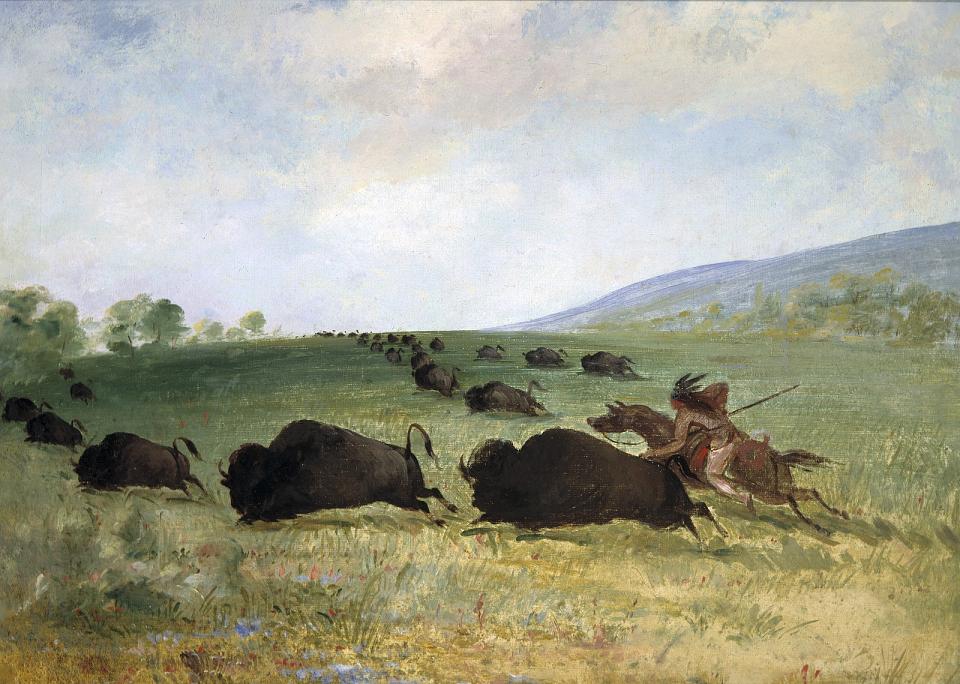
An Osage Indian Lancing a Buffalo, 1846–1848George Catlin / Smithsonian American Art Museum, Gift of Mrs. Joseph Harrison, Jr., 1985.66.567 · Free to use
This starting guide centers the Osage Nation’s language work, its Museum and its educational account of seasonal farming and hunting. An outside federal historical interpretation offers a comparison. These selected works introduce continuing institutions and historical lifeways without treating one painting as a complete view of Osage life.
See each region’s evidence for historical or present-day scope.
Homeland / region
Great Plains / Oklahoma
Research depth
Source guide
Source collection
7 annotated resources · 5 Indigenous-led
Inspected sources
4 substantive works · selected content reviewed
Initial adequacy
Still unfinished
Source review
October 28, 2026
A source guide for a deeper dive.This entry provides a brief orientation and an organized reading path. A comprehensive deep dive has not yet been completed. Follow the annotated sources and distinguish primary community accounts from outside reference material.
Still unfinished
A bounded actual-content starting path and specifically scoped credited picture are available. Fuller history, source comparison and community review remain open; quantity does not establish completion.
Assessment recorded October 28, 2026. This is separate from research completion and community review.
Develop a fuller Osage-authored historical and removal chronology.
Compare underlying records and scholarship, including the period represented by the painting.
Review present institutional changes separately; goals and dated descriptions are not current outcome statistics.
Backdrop images & credits
These images have individual, documented connections to this entry. Their captions and source records define the people, place, object, and period shown; no one image represents every community within a broader label.
An Osage Indian Lancing a Buffalo, 1846–1848 George Catlin / Smithsonian American Art Museum, Gift of Mrs. Joseph Harrison, Jr., 1985.66.567 · Free to use
An outside artist’s oil painting, dated 1846–1848 and catalogued with an Osage subject. Not an Osage-made artwork, documentary photograph, named current member or territory map. The complete960px museum-delivered preview was inspected, not the physical canvas or a larger digital original. Complete available retrieved JPEG imported unchanged. Background/card CSS crops and overlays affect presentation; the opened page retains the complete available frame proportionally.
Image, association, and reuse record reviewed 2026-10-28.
Full images are displayed proportionally above. A translucent background copy may be cropped by the viewport; it does not replace the complete image or its record.
The visual treatment does not change the research status, evidence, or remaining gaps recorded in this profile.
Start reading here
A short purposeful path through selected actual-content works. Read annotations for community, period and inspection limits; this is not a complete history or community endorsement.
Compare a dated federal-site interpretation and its framing.
These are selected starting points. The full annotated collection, source perspectives, inspection limits and remaining research questions follow below. A starting guide is not an exhaustive history or community endorsement.
01
Identity and context
The Osage Nation has a contemporary government in Oklahoma and wider historical homelands.
Focus the next stage of research on: Osage-authored history, language, removal, land and contemporary institutions. The sources below are selected reading paths; their authorship, dates and community scope should guide how they are used.
The Osage Nation Museum traces its 1938 opening to efforts by John Joseph Mathews, the Tribal Council and Chief Fred Lookout. Its institutional history emphasizes stewardship and telling Osage experience from an Osage perspective. The collection brings historical materials into dialogue with later and contemporary work.
The Language Department dates the original programme to 2003 and connects its work with the 2006 constitutional commitment to the language. It describes research into recorded Osage, teaching materials and digital access. These are the department’s stated methods and priorities, not an independent measure of present proficiency.
A Nation-published 2018 classroom factsheet relates crop cultivation near villages, summer hunting, harvest and storage, and a fall hunt. Read it alongside the more general Fort Scott interpretation. Catlin’s 1846–1848 painting is an outsider’s historical depiction of a named Osage subject; it does not represent every family, period or contemporary practice.
Develop a fuller Osage-authored historical and removal chronology.
Compare underlying records and scholarship, including the period represented by the painting.
Review present institutional changes separately; goals and dated descriptions are not current outcome statistics.
Cohort10: selected actual-content reviews preserve their institutional/community scope. Existing source cards are upgraded at the same ID and URL where noted; repeated publications are not globally new works.
Follow the reading path
Sources & further reading
Open any title to read the original source. Annotations explain what each link can help you explore.
No Indigenous-led source is identified in this entry yet. This is a gap in this collection, and does not imply an absence of community knowledge or organization.
A dated announcement for a 2025 museum lecture series, with biographical and collections context. The lectures/recordings were not viewed; excluded from substantive history counts.
Inspection: Supporting or limited review; see scope
Scope: Actual selected public HTML body: introductory series/biographical paragraphs and museum description, lines5–8, 28–29.
Review recorded: October 28, 2026
Access note: No linked recordings, underlying archives, photographs, current events or legal records inspected.
Osage County Tourism’s visitor-oriented county history, rather than an established Osage Nation publication. Excluded from the starting path pending detailed source comparison; legal/mineral-rights and numerical claims are not adopted.
Inspection: Supporting or limited review; see scope
Scope: Actual selected public HTML body: footer publisher identification and selected county-history body, lines23, 45, 76–128.
Review recorded: October 28, 2026
Access note: No linked recordings, underlying archives, photographs, current events or legal records inspected.
Community or Indigenous-organization perspective linked for this entry. Use “2022 OSAGE NATION” to begin with the publisher’s own account; check whether its scope is one community or a wider people.
The department connects its 2003 beginnings and 2006 constitutional commitment with research, teaching and digital access. Its direction describes intended renewal, not measured proficiency.
Inspection: Content reviewed for the stated scope
Scope: Actual selected public body: Mission, Our Foundation and Our Direction, web lines93–120.
Review recorded: October 28, 2026
Access note: Audio, dictionaries, staff details, enrolled learners and present speaker totals were not inspected or independently measured.
The Museum explains John Joseph Mathews’s advocacy, the 1938 opening, its collections and a commitment to representing Osage experience through an Osage perspective.
Inspection: Content reviewed for the stated scope
Scope: Actual introductory history and Collection paragraphs, web lines73–80.
Review recorded: October 28, 2026
Access note: Video, collection objects, exhibit images and linked visitor information uninspected. The oldest-museum superlative is the Museum’s description, not an independently audited ranking.
This two-page classroom factsheet relates farming, summer and fall bison hunting, harvest and storage within a seasonal historical account.
Inspection: Content reviewed for the stated scope
Scope: Selected nonceremonial body on PDFpp1–2: farming and harvest, preparations and travel, summer and fall hunting. Printed compilation/source line on p2 read.
Review recorded: October 28, 2026
Access note: Ceremonial instructions are not reproduced. Embedded illustrations were not copied or rights-cleared. The cited 2004 book and underlying observations were not separately inspected; this is one factsheet, not multiple source works.
A federal-site interpretation introduces river-valley villages, farming and bison hunting, and a relocation narrative. Its colonial framing and quoted outsider descriptions require comparison with Osage publications.
Inspection: Content reviewed for the stated scope
Scope: Actual selected body lines24–31 and displayed update date.
Review recorded: October 28, 2026
Access note: Creation narratives, physical stereotypes, gender generalizations and numerical totals are not adopted. Broad relocation chronology is not independently resolved here; maps and suggested books were not inspected.