Passamaquoddy/Peskotomuhkati includes distinct communities across the present Maine–New Brunswick border. This path prioritizes Sipayik’s community and language accounts and compares them with outside Saint Croix Island historical interpretation. A broad people label should not erase the differences among communities and institutions.
See each region’s evidence for historical or present-day scope.
Homeland / region
Northeast / Maine / New Brunswick
Research depth
Source guide
Source collection
5 annotated resources · 3 Indigenous-led
Inspected sources
3 substantive works · selected content reviewed
Initial adequacy
Still unfinished
Source review
October 28, 2026
A source guide for a deeper dive.This entry provides a brief orientation and an organized reading path. A comprehensive deep dive has not yet been completed. Follow the annotated sources and distinguish primary community accounts from outside reference material.
Still unfinished
A bounded actual-content starting path and specifically scoped credited picture are available. Fuller history, source comparison and community review remain open; quantity does not establish completion.
Assessment recorded October 28, 2026. This is separate from research completion and community review.
Develop independently verified individual-community routes, using exact names, supported aliases and deduplication.
Inspect community-authored historical scholarship, original records and modern dictionary work before extending the chronology.
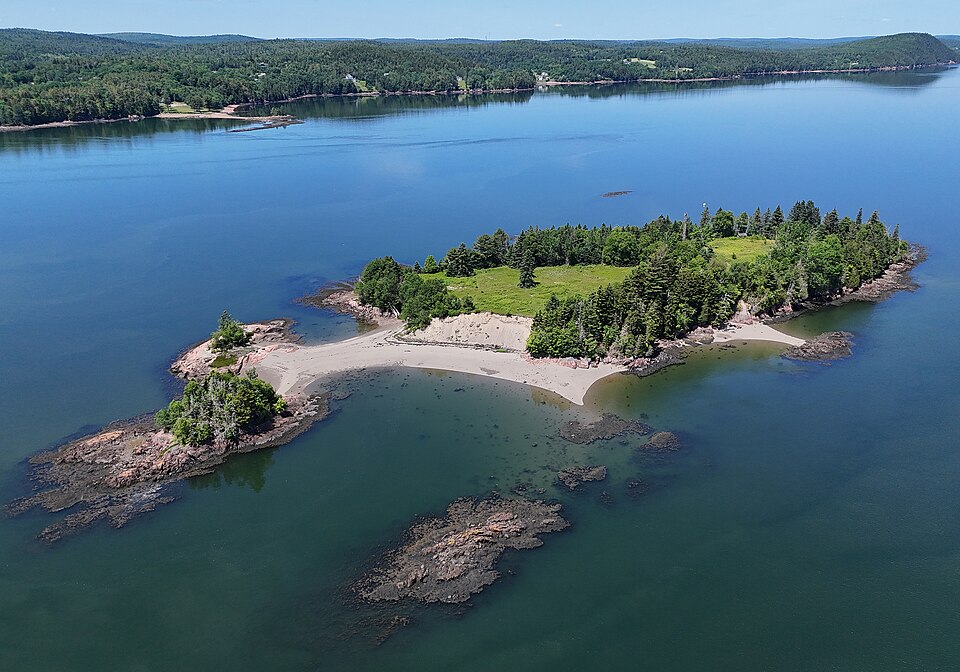
The supplied island picture is a modern place view, not a reconstruction of 1604, a living-village portrait or a legal boundary.
Backdrop photographs & credits
These photographs have individual, documented connections to this entry. Their captions and source records define the people, place, object, and period shown; no one photograph represents every community within a broader label.
Saint Croix Island, Maine, June 27, 2025 Quintin Soloviev / Wikimedia Commons · CC BY 4.0
Photographer-identified aerial view of Saint Croix Island, Maine. The selected NPS history specifically connects this place with Passamaquoddy history and the 1604–1605 French settlement. A 2025 place photograph, not a reconstruction, portrait of a modern community, political boundary or permission to enter or fly a drone. Complete available retrieved JPEG imported unchanged. Background/card CSS crops and overlays affect presentation; the opened page retains the complete available frame proportionally.
Image, association, and reuse record reviewed 2026-10-28.
Full photographs are displayed proportionally above. A translucent background copy may be cropped by the viewport; it does not replace the complete image or its record.
The visual treatment does not change the research status, evidence, or remaining gaps recorded in this profile.
Start reading here
A short purposeful path through selected actual-content works. Read annotations for community, period and inspection limits; this is not a complete history or community endorsement.
Compare outside public-history interpretation of a specifically identified island.
These are selected starting points. The full annotated collection, source perspectives, inspection limits and remaining research questions follow below. A starting guide is not an exhaustive history or community endorsement.
01
Identity and context
Passamaquoddy communities have homelands across the modern U.S.–Canada border.
Focus the next stage of research on: Peskotomuhkati naming, language, Wabanaki relationships and distinct communities. The sources below are selected reading paths; their authorship, dates and community scope should guide how they are used.
Sipayik’s overview names Pleasant Point, Indian Township and a New Brunswick community separately, while emphasizing continuing relationships. It also describes Sipayik’s coastal fishing setting. This is one government’s account of community connections, not an independent determination that all communities share one present government or legal status.
The Sipayik language account describes dictionary-making, school teaching and multimedia projects. Some passages refer to an envisioned CD-ROM and an unpublished digital version. Those legacy descriptions should guide further checking rather than be repeated as current software availability, speaker totals or proven teaching outcomes.
National Park Service interpretation recounts the 1604–1605 French settlement and Passamaquoddy assistance after a difficult winter. It supplies context for the island photograph. Read this outside historical account alongside community publications; its broader ecological and land-ownership generalizations are not adopted here.
Develop independently verified individual-community routes, using exact names, supported aliases and deduplication.
Inspect community-authored historical scholarship, original records and modern dictionary work before extending the chronology.
The supplied island picture is a modern place view, not a reconstruction of 1604, a living-village portrait or a legal boundary.
Cohort12: selected actual-content reviews preserve their institutional/community scope. Existing source cards are upgraded at the same ID and URL where noted; repeated publications are not globally new works.
Follow the reading path
Sources & further reading
Open any title to read the original source. Annotations explain what each link can help you explore.
No Indigenous-led source is identified in this entry yet. This is a gap in this collection, and does not imply an absence of community knowledge or organization.
Indigenous-ledPassamaquoddy Tribe at Indian TownshipSource 1Supporting reference · outside substantive inspected count
An inherited tribal-hosted historical text supplies a seasonal river/coastal context, but also contains older outside framing. Its universal kinship, organization and jurisdiction statements are not adopted.
Inspection: Supporting or limited review; see scope
Scope: Actual Culture & History body lines76–85, selected seasonal context and colonial-contact discussion; reviewed for scope and framing rather than promoted to the new substantive reading path.
Review recorded: October 28, 2026
Access note: Actual selected public ordinary web-reader body independently read by the drafting researcher on 2026-10-28. No access bypass, outreach or automatic permission for linked media. No original author/date or underlying sources established. Kinship-system assertions, claim of no colonial tribes, jurisdiction narrative, current population/location generalizations and numerical mortality statements excluded.
Historical context for this entry. Read “- The Passamaquoddy Tribe; and” with attention to the author, period covered, and communities named; compare with community-published accounts where available.
The Sipayik government describes coastal fishing relationships and separately names Pleasant Point, Indian Township and a New Brunswick community. Its account provides a route into distinct communities rather than one undifferentiated present government.
Inspection: Content reviewed for the stated scope
Scope: Actual About body lines249–254 and263: selected coastal resources, Sipayik fishing-village context, historical adaptation and explicitly named communities.
Review recorded: October 28, 2026
Access note: Actual selected public ordinary web-reader body independently read by the drafting researcher on 2026-10-28. No access bypass, outreach or automatic permission for linked media. Glacial/occupancy numbers, citizenship totals, ecological superlatives and present legal status/authority of every named community are not independently verified. Linked dictionary, history videos, photos and community websites were not automatically inspected.
This institutional account describes dictionary-making, school teaching and multimedia language work. References to an envisioned CD-ROM and an unpublished digital version mark parts of the narrative as legacy material.
Inspection: Content reviewed for the stated scope
Scope: Actual language body lines250–261: school instruction, dictionary-production work, digital audio/database and proposed CD-ROM, preservation-office role, named dictionary editors and Language Keepers link.
Review recorded: October 28, 2026
Access note: Actual selected public ordinary web-reader body independently read by the drafting researcher on 2026-10-28. No access bypass, outreach or automatic permission for linked media. The page has no reliable narrative publication date. No current speaker count, fluency outcome, software availability, entry total, dictionary content or recording was independently checked. Do not turn historical Today/new/unpublished wording into a current status claim.
The park’s interpretation places Saint Croix Island within Passamaquoddy history and recounts the 1604–1605 French settlement and Passamaquoddy assistance. It is an outside public-history account to compare with community publications.
Inspection: Content reviewed for the stated scope
Scope: Actual selected body lines26–38: island/community connection; seasonal river/coast context; French settlement, trade, difficult winter and assistance account.
Review recorded: October 28, 2026
Access note: Actual selected public ordinary web-reader body independently read by the drafting researcher on 2026-10-28. No access bypass, outreach or automatic permission for linked media. Numerical mortality/ecological totals, broad claims that Indigenous people did not own land, legal conclusions, universal harmony and first-contact absolutes are not adopted. Original journals, archaeology, sculptures, photos and linked collections uninspected.