Pawnee Nation publications introduce four bands and continuing Oklahoma institutions alongside histories of removal from the central Plains. These readings connect that history with council responsibilities and a dated example of garden education.
See each region’s evidence for historical or present-day scope.
Homeland / region
Great Plains / Oklahoma
Research depth
Source guide
Source collection
3 annotated resources · 2 Indigenous-led
Inspected sources
3 substantive works · selected content reviewed
Initial adequacy
Still unfinished
Source review
October 28, 2026
A source guide for a deeper dive.This entry provides a brief orientation and an organized reading path. A comprehensive deep dive has not yet been completed. Follow the annotated sources and distinguish primary community accounts from outside reference material.
Still unfinished
A bounded actual-content starting path and specifically scoped credited picture are available. Fuller history, source comparison and community review remain open; quantity does not establish completion.
Assessment recorded October 28, 2026. This is separate from research completion and community review.
Add Pawnee-authored language/history scholarship and family voices.
Inspect original removal, school and allotment records.
Verify current council provisions and building uses separately.
Agency exterior is institutional history, not traditional architecture; no interior/sensitive material shown.
Backdrop photographs & credits
These photographs have individual, documented connections to this entry. Their captions and source records define the people, place, object, and period shown; no one photograph represents every community within a broader label.
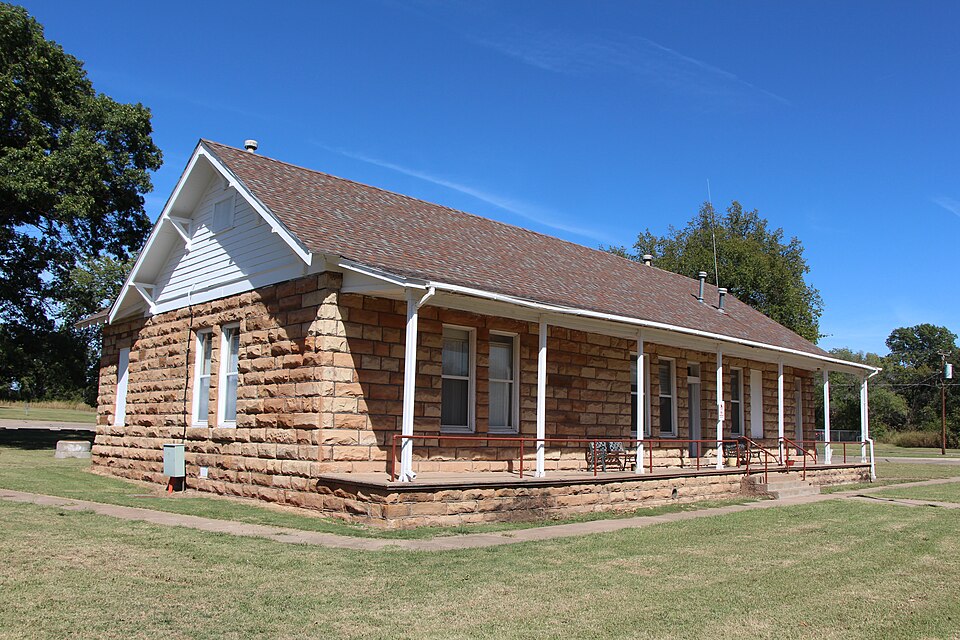
Original Pawnee Indian Agency Building Steven C. Price / Wikimedia Commons — CC BY-SA 3.0
Identified historic agency exterior in the Pawnee agency/school institutional landscape. Not traditional Pawnee housing, endorsement of school policy or verification of current building use. Complete available retrieved JPEG imported unchanged. Background/card CSS crops and overlays affect presentation; the opened page retains the complete available frame proportionally.
Image, association, and reuse record reviewed 2026-10-28.
Full photographs are displayed proportionally above. A translucent background copy may be cropped by the viewport; it does not replace the complete image or its record.
The visual treatment does not change the research status, evidence, or remaining gaps recorded in this profile.
Start reading here
A short purposeful path through selected actual-content works. Read annotations for community, period and inspection limits; this is not a complete history or community endorsement.
These are selected starting points. The full annotated collection, source perspectives, inspection limits and remaining research questions follow below. A starting guide is not an exhaustive history or community endorsement.
01
Identity and context
The Pawnee Nation of Oklahoma has ancestral homelands on the central plains.
Focus the next stage of research on: Pawnee-authored history, constituent bands, language and removal. The sources below are selected reading paths; their authorship, dates and community scope should guide how they are used.
The Nation identifies four bands and explains a council history connected with them. Its Rêsâru’karu account distinguishes that council from the Business Council associated with the 1938 constitution. These are routes into political history, not grounds to invent additional nations or assume every governing rule remains current.
The Nation describes removal to Indian Territory, allotment and the agency/Industrial School complex at Pawnee. It also describes later tribal and educational reuse of former institutional buildings. This picture identifies one historic agency building, not traditional Pawnee housing or approval of school-system policies.
The 2021 report describes the college’s garden-education collaboration with partner universities. Kim Murie connects the effort with interrupted intergenerational learning; Deb Echo-Hawk discusses seed preservation. These attributed perspectives show one educational effort, not health outcomes or every Pawnee family’s experience.
Add Pawnee-authored language/history scholarship and family voices.
Inspect original removal, school and allotment records.
Verify current council provisions and building uses separately.
Agency exterior is institutional history, not traditional architecture; no interior/sensitive material shown.
Cohort10: selected actual-content reviews preserve their institutional/community scope. Existing source cards are upgraded at the same ID and URL where noted; repeated publications are not globally new works.
Follow the reading path
Sources & further reading
Open any title to read the original source. Annotations explain what each link can help you explore.
No Indigenous-led source is identified in this entry yet. This is a gap in this collection, and does not imply an absence of community knowledge or organization.
The Nation introduces four bands and discusses removal, allotment and the agency/school landscape. Selected paragraphs offer a community-led route; early population estimates and ceremonial detail are not adopted.
Inspection: Content reviewed for the stated scope
Scope: Actual body read, especially four-band introduction and removal/allotment/agency-Industrial School paragraphs, including later institutional use. Prophetic narratives, ceremonial detail and early population estimates excluded.
Review recorded: October 28, 2026
Access note: Actual selected public body inspected 2026-10-28 through normal HTTP200 retrieval, web reader or stated PDF pages. No bypass or outreach. Linked works, original records, audio and pictures were not automatically inspected or licensed. Undated retrospective, not current enrollment, building use or legal status verification. Source photographs, original records and archaeological material not inspected/reused.
The Nation explains the historical council and its relationship to later constitutional government. This clarifies institutions without presenting each council as another people.
Inspection: Content reviewed for the stated scope
Scope: Actual explanatory body: earlier band/Tribal Councils, 1938 constitution/Business Council account, four-band representation and described review responsibilities. Linked legal provisions not reviewed.
Review recorded: October 28, 2026
Access note: Actual selected public body inspected 2026-10-28 through normal HTTP200 retrieval, web reader or stated PDF pages. No bypass or outreach. Linked works, original records, audio and pictures were not automatically inspected or licensed. Institutional history, not full/current legal advice on governing powers, membership or claims. No inference that all rules remain unchanged.
A dated report describes Pawnee Nation College collaboration with OSU/Langston and attributes perspectives to Kim Murie and seed keeper Deb Echo-Hawk. Not a clinical or whole-community study.
Inspection: Content reviewed for the stated scope
Scope: Complete actual article datedAugust3, 2021. Selected garden-learning collaboration and attributed comments on interrupted learning/seed preservation. No health prevalence claims, growing instructions or ceremonial/food-preparation details republished.
Review recorded: October 28, 2026
Access note: Actual selected public body inspected 2026-10-28 through normal HTTP200 retrieval, web reader or stated PDF pages. No bypass or outreach. Linked works, original records, audio and pictures were not automatically inspected or licensed. CorrectURL ends.html; earlier URL without.html403. Media contact not assumed author. Project outcomes, medical claims and photos not independently evaluated/licensed.