This path follows the Prairie Band Potawatomi Nation’s own historical narrative and its explanations of language renewal and food sovereignty. It treats the Nation as a particular Potawatomi community and distinguishes institutional goals, reported activities and future plans from independently verified outcomes.
See each region’s evidence for historical or present-day scope.
Homeland / region
Great Plains / Kansas
Research depth
Source guide
Source collection
5 annotated resources · 5 Indigenous-led
Inspected sources
3 substantive works · selected content reviewed
Initial adequacy
Still unfinished
Source review
October 28, 2026
A source guide for a deeper dive.This entry provides a brief orientation and an organized reading path. A comprehensive deep dive has not yet been completed. Follow the annotated sources and distinguish primary community accounts from outside reference material.
Still unfinished
A bounded actual-content starting path and specifically scoped credited picture are available. Fuller history, source comparison and community review remain open; quantity does not establish completion.
Assessment recorded October 28, 2026. This is separate from research completion and community review.
Read selected original removal/allotment and termination-era documents alongside community historical accounts.
Locate dated language-programme publications before adding current speaker or class information.
Confirm facility completion and programme outcomes from later dated Nation publications rather than assuming plans were fulfilled.
Backdrop photographs & credits
These photographs have individual, documented connections to this entry. Their captions and source records define the people, place, object, and period shown; no one photograph represents every community within a broader label.
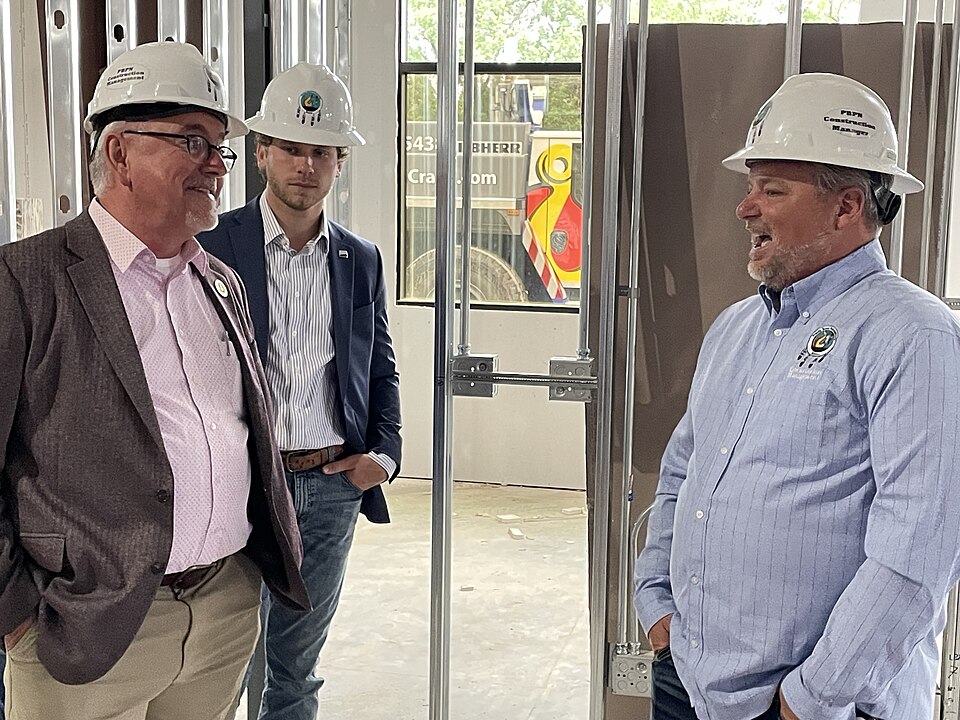
USDA public visit to the Prairie Band Food Sovereignty Building construction site, 2026 David S.Doctorian / USDA-NRCS · Public Domain
USDA caption identifies the dated visit to the Prairie Band Potawatomi Nation Food Sovereignty Building. The Commons author field is USDAgov; available EXIF credits NRCS, David S.Doctorian. The full available dated frame is a public visit, not evidence that the facility opened, an endorsement or a claim about programme outcomes. Complete available retrieved JPEG imported unchanged. Background/card CSS crops and overlays affect presentation; the opened page retains the complete available frame proportionally.
Image, association, and reuse record reviewed 2026-10-28.
Full photographs are displayed proportionally above. A translucent background copy may be cropped by the viewport; it does not replace the complete image or its record.
The visual treatment does not change the research status, evidence, or remaining gaps recorded in this profile.
Start reading here
A short purposeful path through selected actual-content works. Read annotations for community, period and inspection limits; this is not a complete history or community endorsement.
Explore community food-system aims and reported activities while separating plans from completion.
These are selected starting points. The full annotated collection, source perspectives, inspection limits and remaining research questions follow below. A starting guide is not an exhaustive history or community endorsement.
01
Identity and context
The Prairie Band Potawatomi Nation is a distinct contemporary Potawatomi government.
Focus the next stage of research on: Nation-published history, removal, land and language. The sources below are selected reading paths; their authorship, dates and community scope should guide how they are used.
The Nation’s history traces movement from the Great Lakes through Missouri and Iowa to Kansas. It connects later allotment pressures with debates over collective landholding and describes community resistance to termination. This account is an introduction to the Nation’s interpretation; original treaties, laws and petitions remain a separate research task.
Language teaching as an organized community effort
The Language Department describes a revitalization plan and teaching for adults and families. Its explanation of a phrase-recording device shows one method used to make recorded language easier to retrieve. The page’s undated speaker totals and predictions are not current assessments and do not define whether a people continues to exist.
The Nation frames food sovereignty through community decisions about its food system. Its programme account reports garden and orchard work while describing spaces planned for food preparation and learning. The accompanying USDA photograph records a dated public construction-site visit; it does not prove that the building opened or that every planned service is operating.
Read selected original removal/allotment and termination-era documents alongside community historical accounts.
Locate dated language-programme publications before adding current speaker or class information.
Confirm facility completion and programme outcomes from later dated Nation publications rather than assuming plans were fulfilled.
Cohort10: selected actual-content reviews preserve their institutional/community scope. Existing source cards are upgraded at the same ID and URL where noted; repeated publications are not globally new works.
Follow the reading path
Sources & further reading
Open any title to read the original source. Annotations explain what each link can help you explore.
No Indigenous-led source is identified in this entry yet. This is a gap in this collection, and does not imply an absence of community knowledge or organization.
An overlapping version of the Nation’s history page. Retained for provenance and comparison but excluded from the work count; the separately reviewed canonical Nation-domain history supplies the reading route.
Inspection: Supporting or limited review; see scope
Scope: Actual staging-page historical body read and compared with the canonical history; both recount the same removal, allotment and termination-resistance history.
Review recorded: October 28, 2026
Access note: Public reader body read. This staging hostname is not used to establish current authority, laws or programmes; overlapping text is not another independent work. No underlying treaties or laws inspected.
An About navigation panel linking further pages. It is useful for navigation but is excluded because the inspected body does not itself offer substantial historical content.
Inspection: Supporting or limited review; see scope
Scope: Actual About page navigation/body inspected; no substantive historical account on this index.
Review recorded: October 28, 2026
Access note: Public reader body read. Linked pages are separately reviewed only where explicitly listed; the index is not counted as a history.
The Nation traces removal from the Great Lakes, tensions over allotment and collective landholding, and resistance to termination. This is the Nation’s historical interpretation, distinct from original treaty and legislative records.
Inspection: Content reviewed for the stated scope
Scope: Actual substantial historical body, reader lines67–96: Great Lakes context, 1830s–1840s removals, Kansas/allotment pressures and twentieth-century organization/termination resistance.
Review recorded: October 28, 2026
Access note: Public reader body read. Direct script retrieval returned403; no challenge bypass. Original treaties, laws, petitions and Illinois land records were not inspected. Sweeping property-generalizations, population figures and current legal/boundary assertions are not adopted.
The department explains a revitalization strategy, family/adult teaching and a phrase-recording tool. Read the programme’s aims and methods separately from undated, unverified speaker-count predictions on the same page.
Inspection: Content reviewed for the stated scope
Scope: Actual body, reader lines68–84, with synthesis limited to planning/teaching paragraphs72–75 and the Phraselator explanation77–84.
Review recorded: October 28, 2026
Access note: Public reader body read; direct script retrieval returned403. The undated page’s numerical speaker estimates, predicted extinction deadline and claim that identity would vanish with language loss are not adopted. Classes, device operation, recordings and learner outcomes were not inspected.
The Nation explains food sovereignty through community control and describes gardens, collaborative work and a planned food facility. Plans and reported activities are kept distinct from verified completion or measured outcomes.
Inspection: Content reviewed for the stated scope
Scope: Actual substantive body, reader lines75–126: definition, planned building uses, collaboration, garden/orchard and elder-garden reports.
Review recorded: October 28, 2026
Access note: Public reader body read; direct script retrieval returned403. Page contains both fall and December 2026 opening expectations; no opening/completion is asserted. Licensing, hiring, yields, quantities, food/health claims and present access are not independently verified.
Related entries may represent alternate names, constituent communities, wider groupings, or historical connections. Read the naming notes before treating entries as equivalent.
Robey’s Atlas of Indigenous North America · Compiled October 19, 2026 · Prairie Band Potawatomi