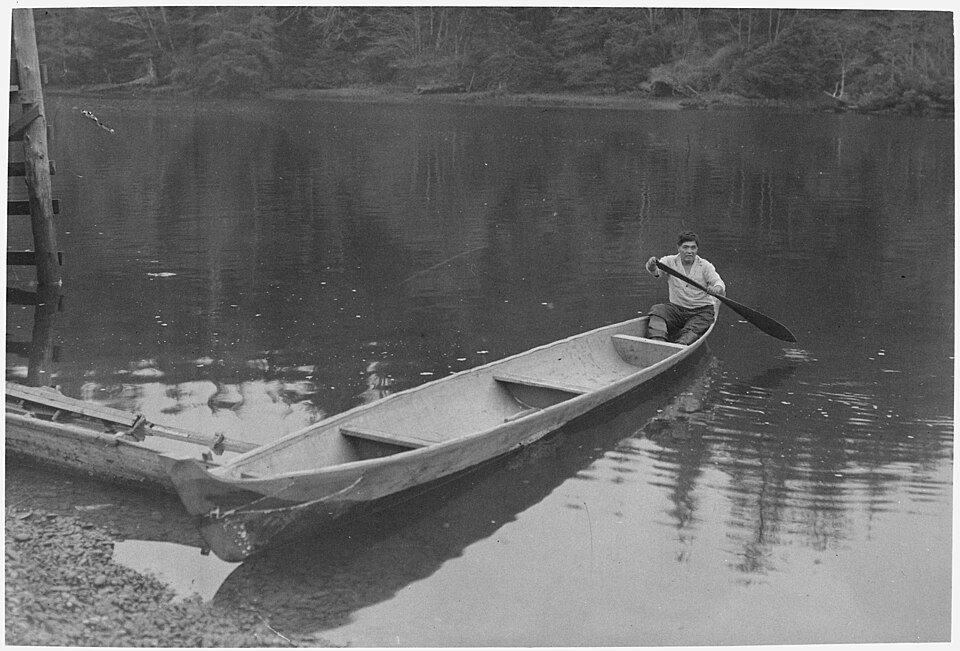
Frank Tlyasman in a new dugout canoe at Taholah,1936Unknown photographer; National Archives, NAID 519173(75-N-TAH-26). Public domain U.S. federal work / PDM 1.0.
Quinault Indian Nation’s Taholah planning account and Gary S. Morishima’s 2017 essay provide different routes into community decisions and stewardship. One describes a village-relocation planning phase; the other is an attributed argument for reciprocal relationships with public-land agencies. Neither is a current construction report or universal statement for all constituent communities.
See each region’s evidence for historical or present-day scope.
Homeland / region
Pacific Northwest / Washington
Research depth
Source guide
Source collection
4 annotated resources · 3 Indigenous-led
Inspected sources
2 substantive works · selected content reviewed
Initial adequacy
Still unfinished
Source review
October 28, 2026
A source guide for a deeper dive.This entry provides a brief orientation and an organized reading path. A comprehensive deep dive has not yet been completed. Follow the annotated sources and distinguish primary community accounts from outside reference material.
Still unfinished
A bounded actual-content starting path and specifically scoped credited picture are available. Fuller history, source comparison and community review remain open; quantity does not establish completion.
Assessment recorded October 28, 2026. This is separate from research completion and community review.
Review later community-led Taholah updates, constituent-community histories and language works.
Later construction status, hazard studies and present agency policies remain unverified.
Backdrop photographs & credits
These photographs have individual, documented connections to this entry. Their captions and source records define the people, place, object, and period shown; no one photograph represents every community within a broader label.
Frank Tlyasman in a new dugout canoe at Taholah,1936 Unknown photographer; National Archives, NAID 519173(75-N-TAH-26). Public domain U.S. federal work / PDM 1.0.
The archive’s historical caption identifies Frank Tlyasman, using the period spelling Quinaielt, with his new dugout canoe at Taholah in 1936. This is one named person and moment, not all Quinault people, present membership, a government portrait or a claim about the canoe’s maker. The photographer is not identified; the record-creating agency is not falsely named as an individual photographer. Actual pixels show one person holding a paddle in a canoe, shoreline and trees; the full white archival print border remains visible. Complete available retrieved JPEG imported unchanged. Background/card CSS crops and overlays affect presentation; the opened page retains the complete available frame proportionally.
Image, association, and reuse record reviewed 2026-10-28.
Full photographs are displayed proportionally above. A translucent background copy may be cropped by the viewport; it does not replace the complete image or its record.
The visual treatment does not change the research status, evidence, or remaining gaps recorded in this profile.
Start reading here
A short purposeful path through selected actual-content works. Read annotations for community, period and inspection limits; this is not a complete history or community endorsement.
Compare Morishima’s dated argument about knowledge and stewardship relationships.
These are selected starting points. The full annotated collection, source perspectives, inspection limits and remaining research questions follow below. A starting guide is not an exhaustive history or community endorsement.
01
Identity and context
The Quinault Indian Nation has homelands on the Pacific coast of Washington and includes distinct community histories.
Focus the next stage of research on: Nation-published history, language, land and government. The sources below are selected reading paths; their authorship, dates and community scope should guide how they are used.
The Nation explains that flooding and tsunami concerns motivated planning for Taholah’s lower village. Its project page records adoption of a master plan in June 2017 and describes community meetings, services and infrastructure choices. This reading concerns the planning rationale and participation; it does not claim that the page’s construction-stage statements remain current.
In his 2017 essay, Gary S. Morishima argues that stewardship of federal public lands needs substantive Native participation, mutual respect and reciprocity. He distinguishes engagement in decisions from merely gathering cultural information. Read this as a named author’s argument at a particular date, alongside Nation publications and later policy records.
Review later community-led Taholah updates, constituent-community histories and language works.
Later construction status, hazard studies and present agency policies remain unverified.
Cohort09: selected actual-content reviews preserve their institutional/community scope. Existing source cards are upgraded at the same ID and URL where noted; repeated publications are not globally new works.
Follow the reading path
Sources & further reading
Open any title to read the original source. Annotations explain what each link can help you explore.
No Indigenous-led source is identified in this entry yet. This is a gap in this collection, and does not imply an absence of community knowledge or organization.
Community or Indigenous-organization perspective linked for this entry. Use “Quinault Indian Nation, WA | Official Website” to begin with the publisher’s own account; check whether its scope is one community or a wider people.
Morishima argues for substantive Native participation, reciprocity and respect in stewardship of federal public lands. Read it as his 2017 argument, distinct from both Nation legislation and a current NPS policy statement.
Inspection: Content reviewed for the stated scope
Scope: Author/date framing lines 19–29; selected opening argument 35–41 and stewardship/collaboration discussion 67–89, including the concluding recommendations. Other article sections and linked footnote works were not reviewed independently.
Review recorded: October 28, 2026
Access note: Actual public HTML body read. The NPS says printed with the author’s permission; that is not permission to reuse his portrait. Historical policy references are treated as the author’s dated argument; underlying laws, reports, current agency policy and all footnotes were not checked. No disputed generalization about all Indigenous settlement patterns is adopted.
Community or Indigenous-organization perspective linked for this entry. Use “QUINAULT INDIAN NATION DISASTER DECLARATION HISTORY” to begin with the publisher’s own account; check whether its scope is one community or a wider people.
The Nation explains the relocation-planning rationale for Taholah, community involvement and the master plan adopted in June 2017. This project account should be read as a planning phase, with later construction status checked separately.
Inspection: Content reviewed for the stated scope
Scope: Complete substantive Project Background, The Plan, Process and Outcome prose, web lines 20–55. Staff contact details, population figures, maps and linked master-plan/environmental-assessment files were not adopted or separately inspected.
Review recorded: October 28, 2026
Access note: Actual public HTML read. The undated page describes a historical planning phase and expressly records June 2017 master-plan adoption; no assertion that its construction statements remain current in 2026. No independent hazard assessment, engineering advice, geographic boundary or project-completion claim.