Seminole reading here brings together a Florida historical account, public architectural history and an Oklahoma account of band organization. The sources distinguish wider community histories from particular governments. They do not establish modern membership rules, merge Florida and Oklahoma institutions, or make one photographed chickee typical of every household.
See each region’s evidence for historical or present-day scope.
Homeland / region
Southeast / Florida / Oklahoma
Research depth
Source guide
Source collection
7 annotated resources · 6 Indigenous-led
Inspected sources
3 substantive works · selected content reviewed
Initial adequacy
Still unfinished
Source review
October 28, 2026
A source guide for a deeper dive.This entry provides a brief orientation and an organized reading path. A comprehensive deep dive has not yet been completed. Follow the annotated sources and distinguish primary community accounts from outside reference material.
Still unfinished
A bounded actual-content starting path and specifically scoped credited picture are available. Fuller history, source comparison and community review remain open; quantity does not establish completion.
Assessment recorded October 28, 2026. This is separate from research completion and community review.
Develop appropriately distinct Oklahoma, Florida, Miccosukee and Freedmen community histories without inferring identity from a shared label.
Read original war/removal records and named community publications before extending numerical or legal claims.
Legacy university/newspaper leads remain preserved and uninspected; the selected FAQ paragraphs are supporting identity context only.
Backdrop photographs & credits
These photographs have individual, documented connections to this entry. Their captions and source records define the people, place, object, and period shown; no one photograph represents every community within a broader label.
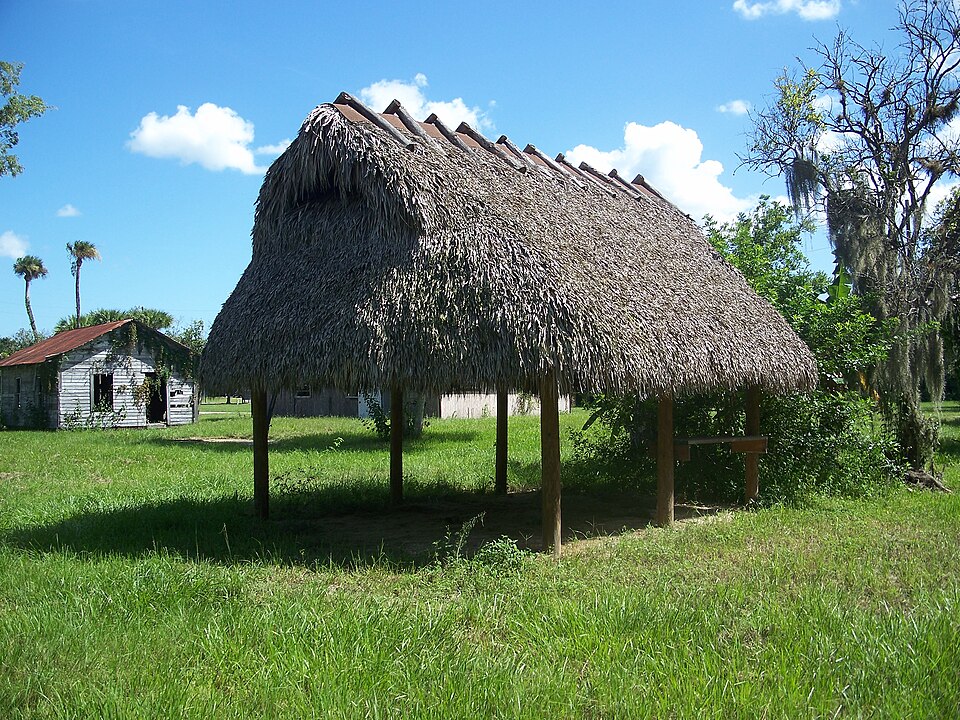
Chickee at Brighton Seminole Indian Reservation, 2010 Ebyabe / Wikimedia Commons. CC BY-SA 3.0 Unported.
One photographer-identified Brighton Reservation exterior inFlorida, not all Seminole people, the Oklahoma Nation, a ceremony, private household or a claim about who constructed the building. The Florida Tribe’s public architectural account supplies specific cultural/practice context. No separate artwork or restricted knowledge is adopted. Complete available retrieved JPEG imported unchanged. Background/card CSS crops and overlays affect presentation; the opened page retains the complete available frame proportionally.
Image, association, and reuse record reviewed 2026-10-28.
Full photographs are displayed proportionally above. A translucent background copy may be cropped by the viewport; it does not replace the complete image or its record.
The visual treatment does not change the research status, evidence, or remaining gaps recorded in this profile.
Start reading here
A short purposeful path through selected actual-content works. Read annotations for community, period and inspection limits; this is not a complete history or community endorsement.
Compare a distinct Oklahoma government’s account of historical band organization.
These are selected starting points. The full annotated collection, source perspectives, inspection limits and remaining research questions follow below. A starting guide is not an exhaustive history or community endorsement.
01
Identity and context
Seminole people continue through distinct contemporary nations and communities in Florida and Oklahoma.
Focus the next stage of research on: Community-authored history, resistance, removal, languages and individual governments. The sources below are selected reading paths; their authorship, dates and community scope should guide how they are used.
The Seminole Tribe of Florida’s first-person introduction describes communities gathering together, resistance to removal and adaptation as Florida changed. This is that government’s own historical framing. Ancient ancestry generalizations, demographic totals and present legal claims require separate evidence and are not adopted here.
The Tribe’s public architecture page and Ernie Tiger’s account describe changes in shelter forms and the continuing craft of chickee building. They connect palmetto-thatch and cypress structures with historical circumstances and later uses. The dated Brighton photograph shows one public exterior, without identifying a ceremony, private household practice or the people who built it.
The Seminole Nation of Oklahoma describes bands as important centers of social, political and economic life. Its retrospective explains that names could change with chiefs and that band relationships had their own histories. This helps readers avoid turning every historical name into a separate present government or treating the account as current membership instructions.
Develop appropriately distinct Oklahoma, Florida, Miccosukee and Freedmen community histories without inferring identity from a shared label.
Read original war/removal records and named community publications before extending numerical or legal claims.
Legacy university/newspaper leads remain preserved and uninspected; the selected FAQ paragraphs are supporting identity context only.
Cohort10: selected actual-content reviews preserve their institutional/community scope. Existing source cards are upgraded at the same ID and URL where noted; repeated publications are not globally new works.
Maps with context
Historical maps
Explore authentic historical documents connected to this entry. Their names and boundaries reflect their makers and periods.
1837–1838 (archive date range) · Historical military-conflict context
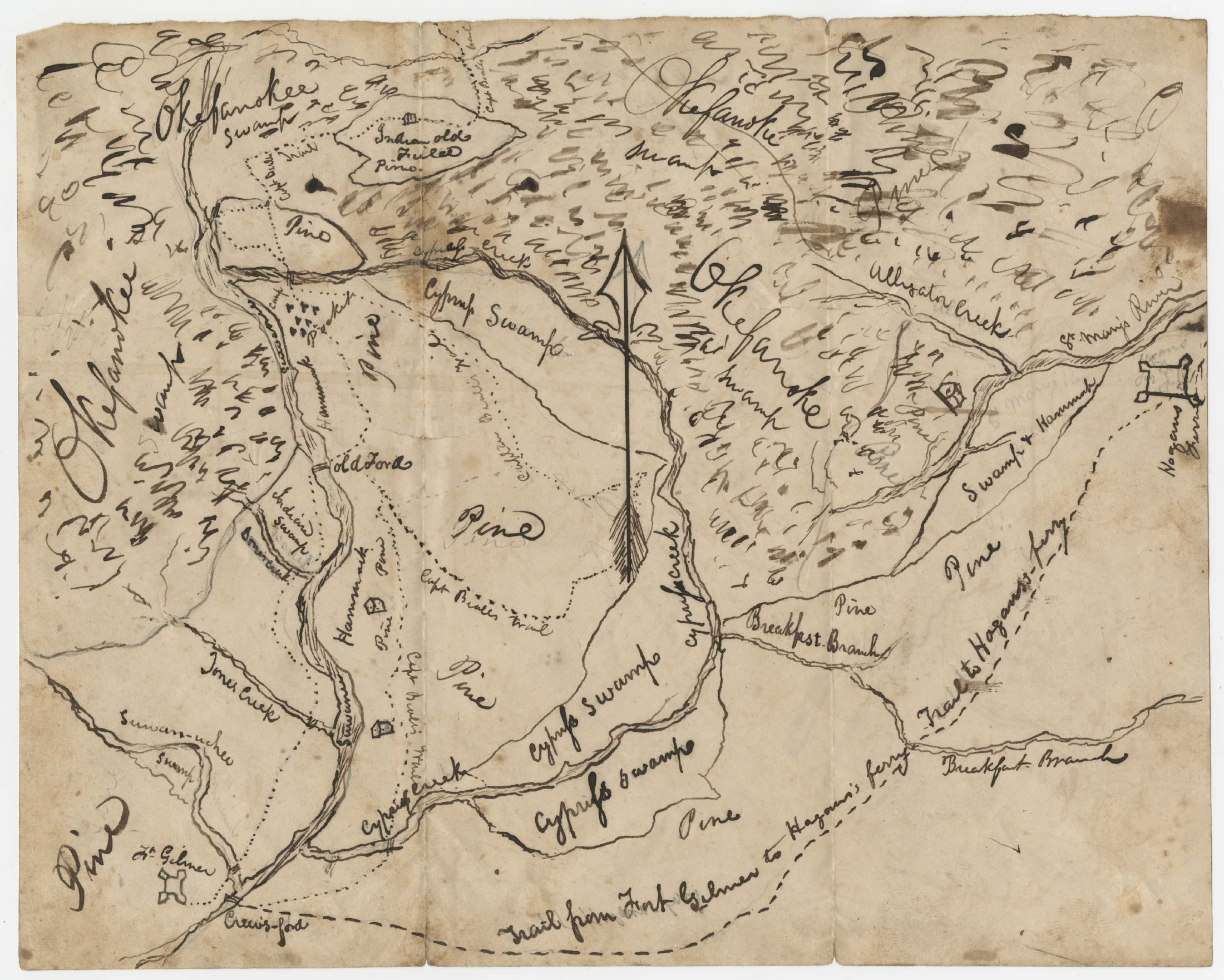
Second Seminole War: Okefenokee region manuscript map
Greenleaf Dearborn (attributed by the archive)
The archive dates this military map to 1837–1838 during the Second Seminole War. It depicts forts and routes around the Okefenokee, providing historical context rather than Seminole-authored territorial information.
Second Seminole War, Okefenokee region manuscript map, ms4209, Box1 Folder1, Hargrett Rare Book and Manuscript Library, University of Georgia Libraries; presented by the Digital Library of Georgia. No Copyright — United States ↗
[1902] · Named historical subject in archival guide
Creek & Seminole Nations, Indian Territory
C. H. Dana; U.S. Department of the Interior, Commission to the Five Civilized Tribes
The archive identifies the Creek and Seminole Nations as the map’s historical subjects. No current boundaries or particular modern government are inferred.
Library of Congress, Geography and Map Division; compiled and drawn by C. H. Dana. Rights record ↗
These map connections are a growing selection. Historical depictions do not establish current boundaries, and a link does not imply community authorship or endorsement.
Follow the reading path
Sources & further reading
Open any title to read the original source. Annotations explain what each link can help you explore.
No Indigenous-led source is identified in this entry yet. This is a gap in this collection, and does not imply an absence of community knowledge or organization.
Historical context for this entry. Read “History of the Seminole Tribe of Florida | Florida State University” with attention to the author, period covered, and communities named; compare with community-published accounts where available.
Community or Indigenous-organization perspective linked for this entry. Use “2A • The Seminole Tribune • November 30, 2020” to begin with the publisher’s own account; check whether its scope is one community or a wider people.
Community or Indigenous-organization perspective linked for this entry. Use “Seminole Tribe of Florida” to begin with the publisher’s own account; check whether its scope is one community or a wider people.
The Tribe’s first-person narrative emphasizes continuity, gathering from different communities, resistance to removal and adaptation. It is a Florida-government account rather than every Seminole community’s history.
Inspection: Content reviewed for the stated scope
Scope: Complete introductory historical narrative, web lines 9–18. The synthesis uses gathering, removal pressure and adaptation; ancient ancestry claims, demographic totals, business rankings and current legal statements not adopted.
Review recorded: October 28, 2026
Access note: Normal public HTTP 200 body read. Original war records, archaeology, treaties, biographies, current membership and business data uninspected. Statements about all ancestors/other named peoples do not establish present affiliation or collapse distinct governments.
Two public accounts describe changing shelter forms and the continuing role of chickee building. Ernie Tiger’s article is individually attributed; the page is not a claim that all Seminole people live in one housing type.
Inspection: Content reviewed for the stated scope
Scope: Complete introductory Chickee prose and ChickeesProvidedEarlyHousing account by Ernie Tiger, before Culture navigation/footer. Comparative superiority claims, construction instructions, lifespan figures and current business status not adopted.
Review recorded: October 28, 2026
Access note: Normal public HTTP 200 text read. No private residence, builder interview, construction standard, source photograph or restricted practice inspected. This public architectural history provides context, not permission to copy separately owned art or presume household customs.
The Oklahoma Nation’s retrospective explains bands’ social, political and economic roles and why names could change. This helps readers handle historical band labels without automatically treating every name as a distinct current government.
Inspection: Content reviewed for the stated scope
Scope: Complete three-paragraph historical body under BANDCHIEFSOFTHESEMINOLENATION, before ContactUs. The synthesis uses community organization and changing names, not ceremonial details, current band totals or present enrollment rules.
Review recorded: October 28, 2026
Access note: Normal public HTTP 200 body read. No band constitution, council record, Freedmen genealogy or current membership adjudication inspected. A historical explanation is not an application guide or proof of every present band’s ethnicity/political identity. No source ceremonial description is reproduced.
Selected answers distinguish the Florida political entity from the wider people and identify separate Oklahoma/Florida governments. This is supporting identity context, not an additional full historical work.
Inspection: Supporting or limited review; see scope
Scope: Selected actual paragraphs under Where did the Seminole Tribe come from? and the removal answer naming separate governments, especially web lines 18 and 38. Other returned answers, family/ceremonial material and definitions not adopted.
Review recorded: October 28, 2026
Access note: Normal public HTTP 200 body read. Broad ancestry/linguistic generalizations, current totals, genealogy and legal/membership statements not independently resolved. No ceremonial instructions or burial locations reproduced. The limited identity selection is excluded from the substantive-work count.
Related entries may represent alternate names, constituent communities, wider groupings, or historical connections. Read the naming notes before treating entries as equivalent.
Robey’s Atlas of Indigenous North America · Compiled October 19, 2026 · Seminole