Sheguiandah First Nation’s public history presents community naming through an explicitly attributed family account. A 2026 interview provides a second, dated view of work on public community places. These sources concern the First Nation; the nearby municipality and archaeological site require their own distinct context.
See each region’s evidence for historical or present-day scope.
Homeland / region
Ontario, Canada — Lake Huron region member listing
Research depth
Source guide
Source collection
2 annotated resources · 1 Indigenous-led
Inspected sources
2 substantive works · selected content reviewed
Initial adequacy
Still unfinished
Source review
October 28, 2026
Names & relationshipsListed as an Anishinabek Nation member First Nation. Membership alone is not treated as proof of Ojibwe, Anishinaabe or other ethnic identity.
A source guide for a deeper dive.This entry provides a brief orientation and an organized reading path. A comprehensive deep dive has not yet been completed. Follow the annotated sources and distinguish primary community accounts from outside reference material.
Still unfinished
A small actual-content starting path and specifically scoped credited photograph are available. Fuller history, source comparison and community review remain open; quantity does not establish completion.
Assessment recorded October 28, 2026. This is separate from research completion and community review.
Add fuller community-published histories and educational sources beyond this short naming account.
Keep the present First Nation distinct from adjacent municipal history and archaeological interpretations; do not infer ancient-to-present descent from proximity.
Backdrop photographs & credits
These photographs have individual, documented connections to this entry. Their captions and source records define the people, place, object, and period shown; no one photograph represents every community within a broader label.
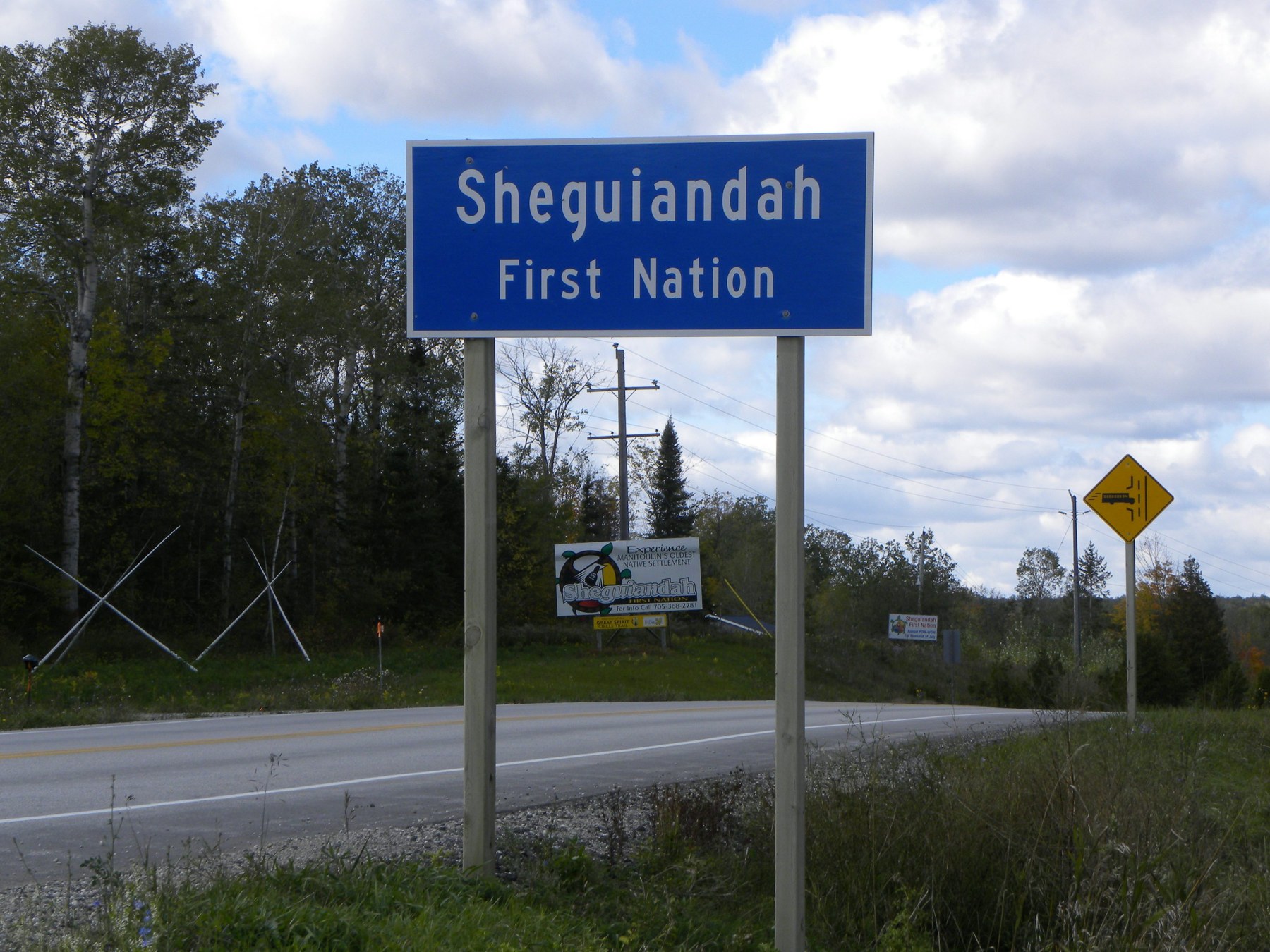
Sheguiandah First Nation roadside sign; capture date unverified Photo by Doug R. W. Dunigan / Unsplash. Unsplash License.
Conditional association only after actual pixels confirm the photographed Sheguiandah First Nation place name. Sign slogans are photographed claims, not verified antiquity, territorial extent or present operations. Incidental logos are place identification, not separately licensed artwork or endorsement. Actual pixels clearly name Sheguiandah First Nation. Smaller promotional signage remains incidental: its oldest-settlement slogan is not verified or adopted as historical fact. No boundary, current operations or endorsement is inferred, and underlying small graphics are not separately licensed or used as Atlas artwork. Complete available3000×2250 frame proportionally resized/recompressed as1800×1350JPEG; no pixel crop, retouching or generated content. CSS display crops/overlays affect background/card copies only; the page displays the complete frame proportionally.
Image, association, and reuse record reviewed 2026-10-28.
Full photographs are displayed proportionally above. A translucent background copy may be cropped by the viewport; it does not replace the complete image or its record.
The visual treatment does not change the research status, evidence, or remaining gaps recorded in this profile.
Start reading here
A short purposeful path through selected actual-content works. Read annotations for community, period and inspection limits; this is not a complete history or community endorsement.
Follow with a dated interview about public places and community priorities.
These are selected starting points. The full annotated collection, source perspectives, inspection limits and remaining research questions follow below. A starting guide is not an exhaustive history or community endorsement.
01
An attributed account of the community name
Sheguiandah’s own history preserves a naming story written by Clara Kageshegongai, granddaughter of David Ogemah, and identifies his teaching as its source. The account connects the name with the cove, travel and exchange. It is a valuable community voice; further linguistic or archival work should retain that attribution rather than turn it into an unquestioned etymology.
In a September 2026 interview, Pearl Waindubence describes work on the First Nation’s village park and beach and plans for its cultural grounds. Her account makes community improvement visible in everyday places beside the bay. The report distinguishes the First Nation from the neighbouring village of Sheguiandah. Proposed projects need later verification before being described as finished.
Develop a community-directed history and annotated reading collection.
Review community-specific imagery and reuse terms before substantive profile publication.
Review detailed relationships, naming changes and historical regional connections.
Add fuller community-published histories and educational sources beyond this short naming account.
Keep the present First Nation distinct from adjacent municipal history and archaeological interpretations; do not infer ancient-to-present descent from proximity.
Cohort07: selected actual-content sources and specifically scoped cleared imagery provide a starting guide. Comprehensive history and community review remain open.
Follow the reading path
Sources & further reading
Open any title to read the original source. Annotations explain what each link can help you explore.
No Indigenous-led source is identified in this entry yet. This is a gap in this collection, and does not imply an absence of community knowledge or organization.
Community history attributes a naming account to Clara Kageshegongai, drawing on David Ogemah’s teaching. It is presented as that account, not a settled linguistic derivation.
Inspection: Content reviewed for the stated scope
Scope: Complete Our Story main body, from community description through attributed naming story and closing community statement.
Review recorded: October 28, 2026
Access note: Normal HTML200 retrieved and actual text read after web-tool timeouts. Population, area totals, logo artwork and ritual details are not reproduced; no archival or linguistic verification claimed.
Sam Laskaris interviews Pearl Waindubence about work on public community places and future projects. Plans remain attributed and dated; they are not reported here as completed.
Inspection: Content reviewed for the stated scope
Scope: Complete main article, web lines 3–64; synthesis selects village park/beach and cultural-grounds discussion, lines 23–48.
Review recorded: October 28, 2026
Access note: Public actual-content article read. Interview claims are attributed; no project/site inspection or later-completion check. Cemetery detail, population figures and sensitive-place information excluded. Photo rights not cleared, so article image not reused.