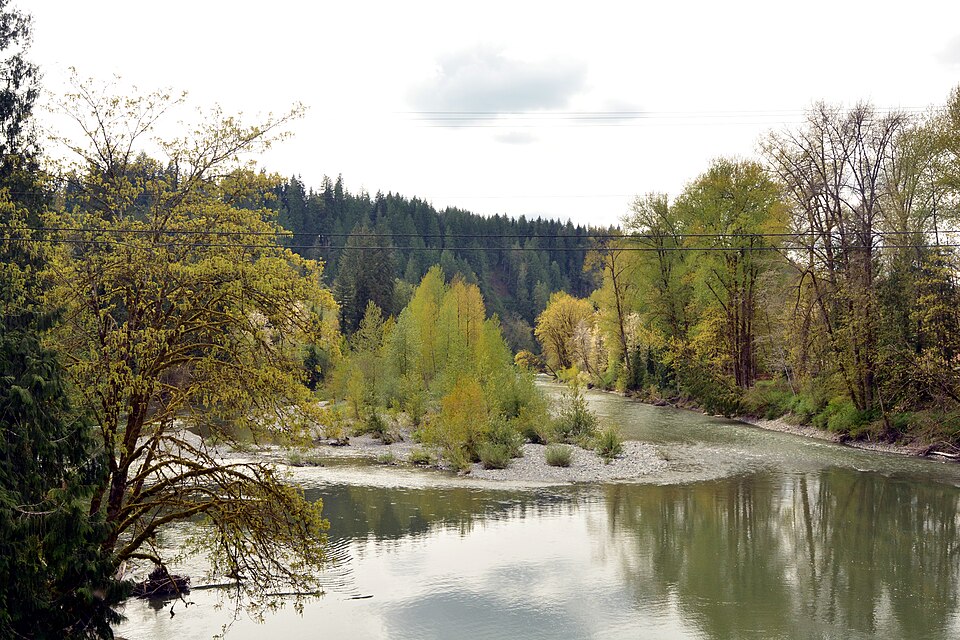
The Stillaguamish Tribe’s own history centers on its river and the north and south forks. Its historical and cultural-department accounts offer a starting path into continuing community relationships, government and the care of cultural knowledge.
See each region’s evidence for historical or present-day scope.
Homeland / region
Pacific Northwest / Washington
Research depth
Source guide
Source collection
4 annotated resources · 3 Indigenous-led
Inspected sources
2 substantive works · selected content reviewed
Initial adequacy
Still unfinished
Source review
October 28, 2026
A source guide for a deeper dive.This entry provides a brief orientation and an organized reading path. A comprehensive deep dive has not yet been completed. Follow the annotated sources and distinguish primary community accounts from outside reference material.
Still unfinished
A bounded actual-content starting path and specifically scoped credited picture are available. Fuller history, source comparison and community review remain open; quantity does not establish completion.
Assessment recorded October 28, 2026. This is separate from research completion and community review.
Read original acknowledgement and land records before extending recognition chronology, jurisdiction or boundary claims.
Broaden Stillaguamish-authored language, family and environmental history, retaining individual speakers and periods.
Check later departmental accounts before reporting current activities or measured outcomes.
The Chief Seattle-attributed quotation on the department page was not used; its provenance needs separate verification.
South Fork river image is a modern landscape setting, not a reconstruction of a named historical village or a present reservation boundary.
Backdrop photographs & credits
These photographs have individual, documented connections to this entry. Their captions and source records define the people, place, object, and period shown; no one photograph represents every community within a broader label.
Downstream from Jordan Bridge (Snohomish County) 02.jpg Joe Mabel / Wikimedia Commons · CC BY-SA 4.0
Modern South Fork Stillaguamish River landscape. Tribe history specifically names main river and both forks; not a reservation boundary or reconstructed village. Provider says current file was white balanced before our reuse. Complete available retrieved JPEG imported unchanged. Background/card CSS crops and overlays affect presentation; the opened page retains the complete available frame proportionally.
Image, association, and reuse record reviewed 2026-10-28.
Full photographs are displayed proportionally above. A translucent background copy may be cropped by the viewport; it does not replace the complete image or its record.
The visual treatment does not change the research status, evidence, or remaining gaps recorded in this profile.
Start reading here
A short purposeful path through selected actual-content works. Read annotations for community, period and inspection limits; this is not a complete history or community endorsement.
Then read its dated account of cultural care and learning.
These are selected starting points. The full annotated collection, source perspectives, inspection limits and remaining research questions follow below. A starting guide is not an exhaustive history or community endorsement.
01
Identity and context
The Stillaguamish Tribe has enduring relationships with its river homeland in western Washington.
Focus the next stage of research on: Tribe-published history, language, land and contemporary institutions. Start with the annotated sources and compare each publisher’s scope and perspective.
The Tribe’s history describes ancestors living along the Stillaguamish River and both forks. It explains that some families moved to Tulalip while others remained in the river area, and records federal acknowledgement in 1976. This account helps distinguish Stillaguamish continuity from a simple story of relocation or disappearance. Original governmental records remain a separate research task.
The Cultural Resources Department’s 2022 account links archive keeping and protection of cultural places with community learning activities, including language workshops. It presents these as responsibilities of a living community institution. The directory has not assessed later programme availability or outcomes, and its public description does not make every cultural record unrestricted.
Read original acknowledgement and land records before extending recognition chronology, jurisdiction or boundary claims.
Broaden Stillaguamish-authored language, family and environmental history, retaining individual speakers and periods.
Check later departmental accounts before reporting current activities or measured outcomes.
The Chief Seattle-attributed quotation on the department page was not used; its provenance needs separate verification.
South Fork river image is a modern landscape setting, not a reconstruction of a named historical village or a present reservation boundary.
Cohort09: selected actual-content reviews preserve their institutional/community scope. Existing source cards are upgraded at the same ID and URL where noted; repeated publications are not globally new works.
Follow the reading path
Sources & further reading
Open any title to read the original source. Annotations explain what each link can help you explore.
No Indigenous-led source is identified in this entry yet. This is a gap in this collection, and does not imply an absence of community knowledge or organization.
Indigenous-ledStillaguamish Tribe of IndiansSource 1
The March5,2026-updated account names the Stillaguamish River and both forks, describes families remaining near the river, and narrates governmental acknowledgement. Tracey Boser is credited for its cultural-history section.
Inspection: Content reviewed for the stated scope
Scope: Read complete historical body: introductory paragraphs, Land Acknowledgement Example and Tribal History by Tracey Boser, web lines35–66. Synthesis uses river relationships and the stated 1976 acknowledgement, not precise village sites or restricted practices.
Review recorded: October 28, 2026
Access note: Public source body inspected through the web reader and/or a normal HTTP200 local copy. Linked recordings, original records, objects and photographs were not automatically inspected or licensed. No login, paywall bypass or outreach. Original acknowledgement files, land records and current legal powers were not reviewed. Geological dates, current acreage/totals and ceremonial/medicinal particulars are not adopted. No source photographs copied.
Community or Indigenous-organization perspective linked for this entry. Use “FAQs - Stillaguamish Tribe” to begin with the publisher’s own account; check whether its scope is one community or a wider people.
Historical context for this entry. Read “Stillaguamish - ILS Reentry” with attention to the author, period covered, and communities named; compare with community-published accounts where available.
The January11,2022-updated departmental account describes archive keeping, cultural-landscape protection and community learning activities. It records institutional responsibilities, not measured present outcomes.
Inspection: Content reviewed for the stated scope
Scope: Overview and department functions/activities, web lines35–57. The separate Chief Seattle-attributed quotation is excluded from synthesis and not verified or reproduced.
Review recorded: October 28, 2026
Access note: Public source body inspected through the web reader and/or a normal HTTP200 local copy. Linked recordings, original records, objects and photographs were not automatically inspected or licensed. No login, paywall bypass or outreach. A dated institutional statement, not a current events calendar. No ceremonial content, underlying archives, workshops, recordings, photographs or historical quotation provenance inspected.
Related entries may represent alternate names, constituent communities, wider groupings, or historical connections. Read the naming notes before treating entries as equivalent.
Robey’s Atlas of Indigenous North America · Compiled October 19, 2026 · Stillaguamish