Thessalon First Nation’s public account describes an Anishinaabe seasonal relationship with the Great Lakes landscape. Its education pages also explain support for students at named local schools. These sources offer a focused beginning while leaving treaty chronology, land claims and fuller community history for further verification.
See each region’s evidence for historical or present-day scope.
Homeland / region
Ontario, Canada — Lake Huron region member listing
Research depth
Source guide
Source collection
2 annotated resources · 2 Indigenous-led
Inspected sources
2 substantive works · selected content reviewed
Initial adequacy
Still unfinished
Source review
October 28, 2026
Names & relationshipsListed as an Anishinabek Nation member First Nation. Membership alone is not treated as proof of Ojibwe, Anishinaabe or other ethnic identity.
A source guide for a deeper dive.This entry provides a brief orientation and an organized reading path. A comprehensive deep dive has not yet been completed. Follow the annotated sources and distinguish primary community accounts from outside reference material.
Still unfinished
A small actual-content starting path and specifically scoped credited photograph are available. Fuller history, source comparison and community review remain open; quantity does not establish completion.
Assessment recorded October 28, 2026. This is separate from research completion and community review.
Check treaty chronology and original instruments independently; the public history page contains a problematic Niagara Congress date.
Review community-authored history and language sources beyond the two short selected accounts.
Seek newly dated programme descriptions before using schedules, staff lists or outcomes as current information.
Backdrop photographs & credits
These photographs have individual, documented connections to this entry. Their captions and source records define the people, place, object, and period shown; no one photograph represents every community within a broader label.
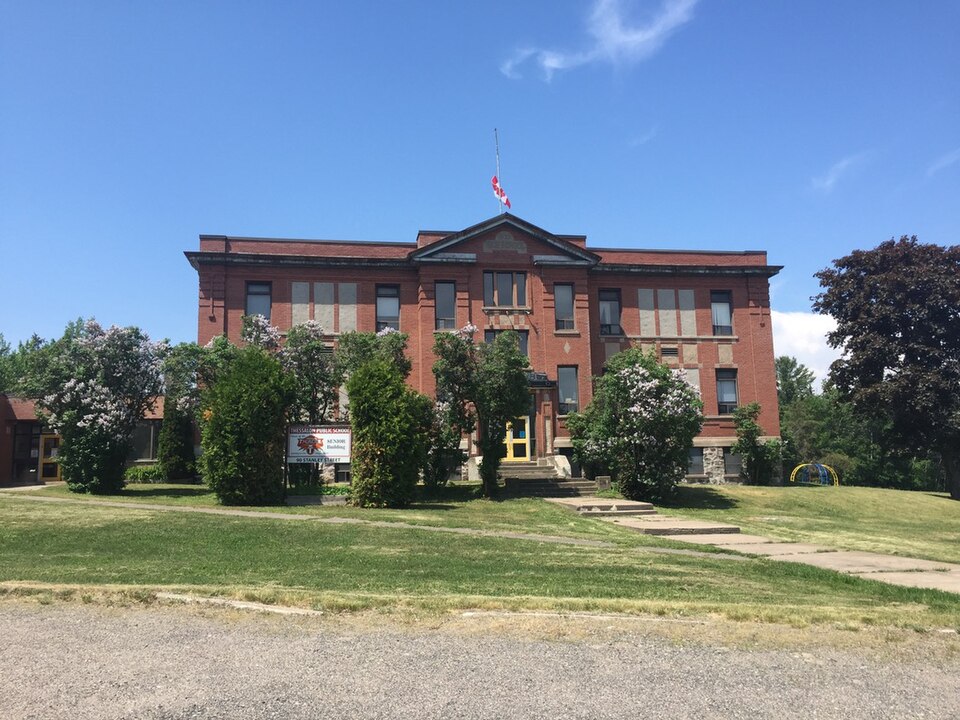
Thessalon Public School senior building, June2021 Fungus Guy / Wikimedia Commons · CC BY-SA 4.0
Exact photographer record identifies Thessalon Public School’s senior building. Nation’s Student Cultural Rooms account names this school as one setting for support for Thessalon First Nation students. Public education-setting context, not a Nation-owned school, school governance, a portrait of members, current service outcome or territory. Complete available960×720 JPEG imported unchanged. CSS display crops/overlays affect background/card copies only; the page displays the complete frame proportionally.
Image, association, and reuse record reviewed 2026-10-28.
Full photographs are displayed proportionally above. A translucent background copy may be cropped by the viewport; it does not replace the complete image or its record.
The visual treatment does not change the research status, evidence, or remaining gaps recorded in this profile.
Start reading here
A short purposeful path through selected actual-content works. Read annotations for community, period and inspection limits; this is not a complete history or community endorsement.
Then see how the Nation describes support for students at specifically named schools.
These are selected starting points. The full annotated collection, source perspectives, inspection limits and remaining research questions follow below. A starting guide is not an exhaustive history or community endorsement.
01
Seasonal life in a public community account
Thessalon First Nation’s history page describes a year involving late-winter maple work, spring fish runs and autumn moose hunting. It connects the community with Lake Huron’s shore and presents movement between places as part of living well on the land. This is a public community account rather than an exhaustive statement about every household or period. Its inconsistent treaty date and unresolved land-area assertions require separate verification and are not repeated as established facts.
The Nation’s Student Cultural Rooms page identifies spaces at Central Algoma Secondary School and Thessalon Public School. It describes quiet study areas, computers, guest activities and Education Support Workers helping students with reading and assignments. The stated aim combines cultural confidence with educational support. These descriptions establish a specific community connection to those school settings; they do not establish Nation ownership, current opening hours or independently measured student outcomes.
Develop a community-directed history and annotated reading collection.
Review community-specific imagery and reuse terms before substantive profile publication.
Review detailed relationships, naming changes and historical regional connections.
Check treaty chronology and original instruments independently; the public history page contains a problematic Niagara Congress date.
Review community-authored history and language sources beyond the two short selected accounts.
Seek newly dated programme descriptions before using schedules, staff lists or outcomes as current information.
Cohort07: selected actual-content sources and specifically scoped cleared imagery provide a starting guide. Comprehensive history and community review remain open.
Follow the reading path
Sources & further reading
Open any title to read the original source. Annotations explain what each link can help you explore.
No Indigenous-led source is identified in this entry yet. This is a gap in this collection, and does not imply an absence of community knowledge or organization.
Read the complete short body, using its public description of seasonal movement and Lake Huron shoreline connections. The page prints July1974 for the Niagara Congress and combines unresolved land-area assertions; neither is adopted as verified chronology or a legal conclusion. Old house counts and service descriptions are not current statistics.
Inspection: Content reviewed for the stated scope
Scope: Complete short Our Community & History body; synthesis is limited to the attributed public seasonal-round description and named waterbody connection.
Review recorded: October 28, 2026
Access note: Actual public HTML body read. Linked documents, photographs and underlying records were not reviewed or licensed through this text inspection. No login or reader paywall was encountered for the selected body.
Read the complete programme body explaining Cultural Rooms at Central Algoma Secondary School and Thessalon Public School. It describes quiet study space, computers, guest activities and Education Support Workers’ assistance. Undated schedules are not presented as current guarantees; no measured educational outcomes or Nation ownership of either school is inferred.
Inspection: Content reviewed for the stated scope
Scope: Complete Student Cultural Rooms main body, including named schools, purposes and support activities; linked policies, photographs and individual student records not inspected.
Review recorded: October 28, 2026
Access note: Actual public HTML body read. Linked documents, photographs and underlying records were not reviewed or licensed through this text inspection. No login or reader paywall was encountered for the selected body.