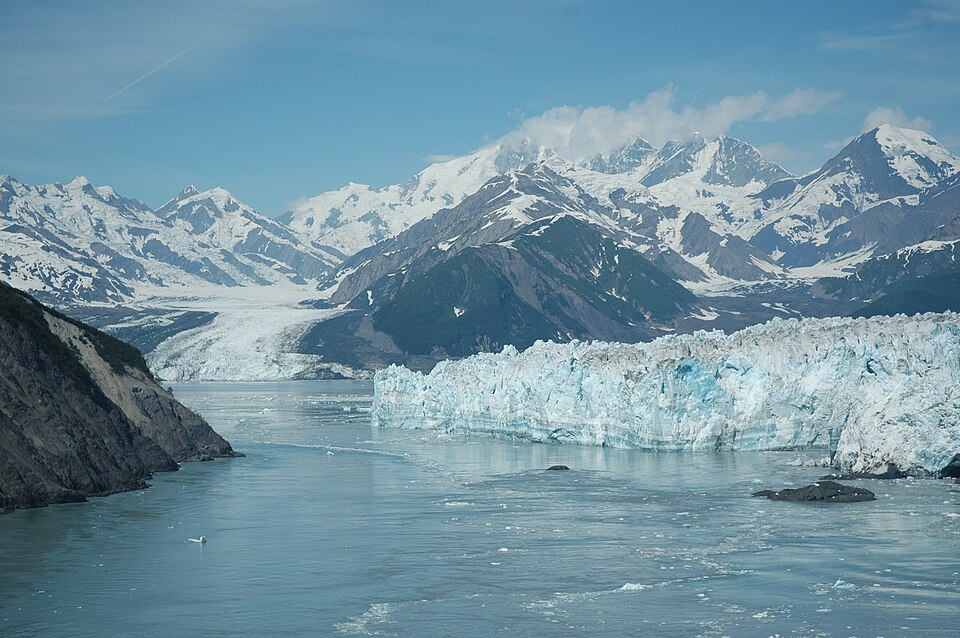
Hubbard Glacier and Yakutat Bay; record dated 2010Alaska ShoreZone Program, NOAA/NMFS/AKFSC; courtesy of Mandy Lindeberg; Wikimedia Commons / NOAA Photo Library. CC BY 2.0; also described as public-domain NOAA official-duty material.
Tlingit people sustain living communities in Alaska, British Columbia and Yukon. This reading path brings together a tribal political history, a collaborative Yakutat study, Teslin Tlingit Council’s Inland community accounts and Hoonah’s Glacier Bay collaboration. Language education and an editorial conversation about Raven narratives add contemporary voices and public cultural perspectives. Each account has its own community, institutional or scholarly scope; no single government, story or landscape represents every Tlingit person.
See each region’s evidence for historical or present-day scope.
Homeland / region
Alaska / British Columbia / Yukon
Research depth
Source guide
Source collection
11 annotated resources · 8 Indigenous-led
Inspected sources
10 substantive works · selected content reviewed
Initial adequacy
Still unfinished
Source review
October 30, 2026
A source guide for a deeper dive.This entry provides a brief orientation and an organized reading path. A comprehensive deep dive has not yet been completed. Follow the annotated sources and distinguish primary community accounts from outside reference material.
Still unfinished
A bounded actual-content starting path and specifically scoped credited picture are available. Fuller history, source comparison and community review remain open; quantity does not establish completion.
Assessment recorded October 28, 2026. This is separate from research completion and community review.
Review additional Tlingit-authored histories and language resources from distinct coastal and inland communities.
Read further Yakutat chapters and community-directed studies before discussing particular clan histories, places or resource practices.
Backdrop photographs & credits
These photographs have individual, documented connections to this entry. Their captions and source records define the people, place, object, and period shown; no one photograph represents every community within a broader label.
Hubbard Glacier and Yakutat Bay; record dated 2010 Alaska ShoreZone Program, NOAA/NMFS/AKFSC; courtesy of Mandy Lindeberg; Wikimedia Commons / NOAA Photo Library. CC BY 2.0; also described as public-domain NOAA official-duty material.
Landscape context specifically for the Yakutat regional case, not all Tlingit homelands or a community portrait. The study places Hubbard Glacier within its Yakutat study region and records Yakutat Tlingit concerns about cruise traffic at Hubbard/Disenchantment Bay. No exclusive territory or independently verified wildlife claim inferred. This is landscape context for the Yakutat regional study. Its introduction and selected interview discussion identify Hubbard Glacier and adjacent waters as a Yakutat Tlingit concern. It is not all Tlingit homelands, a community portrait, a boundary or evidence of current glacier extent, climate trends or seal distributions. Complete available retrieved JPEG imported unchanged. Background/card CSS crops and overlays affect presentation; the opened page retains the complete available frame proportionally.
Image, association, and reuse record reviewed 2026-10-28.
Full photographs are displayed proportionally above. A translucent background copy may be cropped by the viewport; it does not replace the complete image or its record.
The visual treatment does not change the research status, evidence, or remaining gaps recorded in this profile.
Start reading here
A short purposeful path through selected actual-content works. Read annotations for community, period and inspection limits; this is not a complete history or community endorsement.
Read selected introductory/method pages for a carefully scoped Yakutat regional case.
These are selected starting points. The full annotated collection, source perspectives, inspection limits and remaining research questions follow below. A starting guide is not an exhaustive history or community endorsement.
01
Identity and context
Tlingit people have homelands along the northwest coast and into adjoining inland regions.
Focus the next stage of research on: Lingít language, clans and houses, territorial histories and distinct contemporary governments. The sources below are selected reading paths; their authorship, dates and community scope should guide how they are used.
The Central Council’s timeline connects its institutional development with Alaska Native Brotherhood advocacy and efforts to seek redress for land withdrawals. It begins by recognizing Tlingit and Haida as distinct peoples. Read this as the government’s own historical account, alongside local histories; the statutes and cases it names require separate inspection.
Deur and colleagues’2015 study combines written records with interviews and guidance from Yakutat Tlingit representatives. Its opening pages challenge the idea that park landscapes are empty of human history and explain the report’s regional focus and limits. Yakutat relationships with coastal and glacial places should not be generalized to every Tlingit community.
Tlingit life continues in Alaska, British Columbia and Yukon. Teslin Tlingit Council identifies its people as Inland Tlingit and describes continuing connections with coastal relatives. Its account brings together oral history, movement inland, harvest camps and contemporary artists. Teslin is one distinct community example, not a government speaking for all Tlingit people.
Teslin’s public governance account describes deliberation through clan representation, with Elders advising institutions and youth contributing through their council. Its stated values connect care for land and community with personal responsibility. These descriptions show how cultural relationships enter a contemporary government; they should not be generalized into one political structure for every Tlingit community.
Teslin’s language department describes classroom and video-conference classes, a resource centre, early-childhood teaching and school support. These are specific routes for learning rather than evidence of a present speaker census or programme success rate. Materials and recordings linked from the page require their own review.
A language curriculum built with speakers and teachers
The March 2022 working draft of Tlingit Language Proficiency Scope & Sequence offers four learning levels that are not school grades. Its introduction allows teachers and learners to adapt the sequence. Selected Level 3 goals connect conversation with kinship and community responsibilities. This is a teaching framework, not a test of whether someone belongs to a people.
Raven narratives are individual works of language art
In a February 2026 publisher conversation, Sealaska Heritage Institute explains how editors transcribe recordings, consult fluent Elders and retain storytellers’ differing sequences and styles. Its account presents Raven narratives as language art with humor as well as cultural significance. This review covers that conversation, not the book’s stories or underlying recordings. Readers should approach named tellers and particular versions rather than invent one uniform Tlingit mythology.
Hoonah Indian Association describes Xunaa Shuká Hít in Glacier Bay as a home built and maintained with the National Park Service after decades of collaboration. Its page dates the dedication to 2016. The account makes continuity and reconnection visible through a specific community’s experience. Linked ceremonies and videos were not reviewed, and the page does not grant visitors access or reproduction rights.
Teslin’s salmon account describes conservation restrictions alongside the loss of opportunities for young people to learn at fish camp. Its discussion of 2010 and 2018 plans connects monitoring, governance and cultural restoration, while warning that harvest limits alone cannot restore salmon. The page contains mixed-age programme information; it is not a current fishing advisory or proof of recovery.
In his foreword to a June 2025 Tongass assessment, Anthony Mallott presents relations with forests and waters as familial responsibilities. He connects cultural continuity with access, stewardship and participation in decisions, while recognizing distinct governments’ priorities. The assessment combines engagement and existing sources; it is a dated planning contribution, not evidence that the requested outcomes were achieved or that every person shares one view.
The assessment places the Central Council’s public ethical teaching beside values articulated by Sealaska and Sealaska Heritage Institute. Respect, intergenerational responsibility and reciprocity connect these accounts, but each institution has its own role. Keeping the attribution visible helps readers explore public cultural perspectives without treating a corporate statement as the position of every Tribal government or a test of individual belief.
Review additional Tlingit-authored histories and language resources from distinct coastal and inland communities.
Read further Yakutat chapters and community-directed studies before discussing particular clan histories, places or resource practices.
Further Tlingit-authored histories from additional coastal and inland communities; these Teslin, Hoonah and Yakutat examples are not comprehensive.
Read appropriately public oral-literature volumes and permissions separately; this review covers an editorial conversation, not underlying narratives or recordings.
Assess language programmes through dated community-released results before reporting present fluency, attendance or outcomes.
Read additional Yakutat chapters and locally authorized sources before expanding specific clan histories, places or practices.
Contemporary salmon status, adopted rules and monitoring results need separate dated evidence; mixed-age web text is not a current advisory.
Cohort08: selected actual-content reviews preserve their institutional/community scope. Existing source cards are upgraded at the same ID and URL where noted; repeated publications are not globally new works. October30 northern deepening: selected actual-content sources add living-community, language, cultural and historical perspectives. Earlier source/section scopes remain; supporting cards and reused works are not globally new substantive works. Research remains unfinished; no community endorsement claimed. October 30 follow-up: one additional selected-content work adds a locally or institutionally attributed contemporary perspective; dated reports and planning aspirations are not verified present outcomes. Prior scopes and credits remain unchanged.
Follow the reading path
Sources & further reading
Open any title to read the original source. Annotations explain what each link can help you explore.
No Indigenous-led source is identified in this entry yet. This is a gap in this collection, and does not imply an absence of community knowledge or organization.
Indigenous-led / tribal-government historyCentral Council of the Tlingit and Haida Indian Tribes of AlaskaSource 1
Read the Central Council’s timeline of political advocacy and institutional development. The government’s own narrative explicitly begins with Tlingit and Haida as distinct peoples; it is not a history of every Tlingit government.
Inspection: Content reviewed for the stated scope
Scope: Complete Our History timeline and Generations to Come/mission body, web lines 65–119; leadership biographies and linked laws/cases not separately reviewed.
Review recorded: October 28, 2026
Access note: Public actual HTML body read. This is the Central Council’s institutional history and interpretation, not every Tlingit or Haida community’s government. Underlying statutes, court records, amounts and present rights not independently checked; no demographic totals or ceremonies reproduced.
Selected introduction and methods explain collaboration with Yakutat Tlingit representatives, written-source emphasis and interview limits. A selected later paragraph records attributed concern about Hubbard Glacier cruise traffic; no sensitive sites or ecological finding adopted.
Inspection: Content reviewed for the stated scope
Scope: 2015 report: printed pp. 1–6 and8–9/PDF pp. 9–14 and16–17, plus printed p. 173/PDF p. 181. Title/authors read;350-page report not read in full.
Review recorded: October 28, 2026
Access note: Normal public PDF 200 downloaded; actual selected page text read with pypdf. Academic/NPS synthesis with Yakutat Tlingit participation; underlying interviews/archives, all chapters, maps, figures and current legal/ecological conditions not independently reviewed. Specific clan narratives and sensitive-place details excluded.
Community or Indigenous-organization perspective linked for this entry. Use “Governance - Tlingit & Haida” to begin with the publisher’s own account; check whether its scope is one community or a wider people.
The Council presents Teslin history, living arts, harvest learning and Haa Kusteeyí. Read this Inland Tlingit account beside coastal histories.
Inspection: Content reviewed for the stated scope
Scope: Actual substantive About, Our People, Five Clans, Journey from the Coast and Our Culture body, reader lines 113–146.
Review recorded: October 30, 2026
Access note: Undated institutional self-presentation, not independently verified migration chronology. Its oral-history account reaches beyond written history. No current population, all-Tlingit clan list, territorial boundary, museum-object reuse or municipal-resident identity inference.
A community-specific description of clan-based deliberation, Elders’ advice, youth participation and publicly stated responsibilities.
Inspection: Content reviewed for the stated scope
Scope: Actual Mandate/Values lines 127–149; General Council 433–435; Executive mandate 548–551; Elders mandate 570–572; Youth mandate 596–598.
Review recorded: October 30, 2026
Access note: Selected structural prose only; officeholder rosters, constitutional documents and legal interpretations excluded. Institutional commitments are not independently measured outcomes or a model for every Tlingit government.
The Council describes classroom and remote learning, resource access and early-childhood and school support.
Inspection: Content reviewed for the stated scope
Scope: Actual language-programme body lines 115–141, including named former leader’s public statement and classroom/resource/daycare/school paragraphs.
Review recorded: October 30, 2026
Access note: No lessons, recordings, legislation or present timetable inspected. Language-family/extinction wording at line 117 excluded. Programme descriptions do not establish current fluency, attendance or results.
Publication: Displayed update 2026-03-13; mixed historical and programme text
A substantial community account connects salmon governance, monitoring and disrupted intergenerational learning.
Inspection: Content reviewed for the stated scope
Scope: Actual body lines 113–167: introductory context, conservation measures, stewardship/governance, 2010/2018 plan discussion, vision and listed monitoring/outreach.
Review recorded: October 30, 2026
Access note: Page mixes older duration claims and Coming Soon 2025 notices despite March 13,2026 update. No current fishery rules/counts, ecological recovery, plan implementation or underlying plan/PDF review inferred.
A community-developed teaching framework joins language skills with relationships and cultural responsibilities.
Inspection: Content reviewed for the stated scope
Scope: Actual 181-page PDF: cover/credits PDFpp 1–2; About this resource printedpp 1–2(PDF 4–5); selected Level 3 skills printedpp 64–65(PDF 67–68).
Review recorded: October 30, 2026
Access note: Working draft March 2022, not publication 2024 inferred from upload. Not full curriculum, all vocabulary, appendices, songs, practices or recordings. Learning targets are not measured proficiency or identity tests.
A substantive editorial conversation explains why individual storytellers, original-language form and humor matter.
Inspection: Content reviewed for the stated scope
Scope: Actual February 23,2026 conversation: selection/transcription/arrangement, continuing significance, individual styles and project history, reader lines 17–59.
Review recorded: October 30, 2026
Access note: Interview about the book, not reading its 50 narratives or hearing 1952–1989 recordings. No wholesale story, crest design, ceremonial procedure or universal creed reproduced. Future audio-access intention is not verified availability.
The Association describes its collaboration with NPS to build and maintain Xunaa Shuká Hít in ancestral homeland.
Inspection: Content reviewed for the stated scope
Scope: Actual public collaboration/history text lines 18–41 and dedication statement 62–64.
Review recorded: October 30, 2026
Access note: Undated page with August 25,2016 event date; template copyright 2035 is not a publication date. Videos, maps, ceremonies and linked accounts not reviewed/reused; no current officeholder, access permission or universal Tlingit experience inferred.
Publication: June 2025 assessment; foreword dated October 21, 2024
Selected passages connect place-based responsibilities with publicly stated values and explain the assessment’s engagement method. Individual institutional perspectives remain distinct.
Inspection: Content reviewed for the stated scope
Scope: Actual 91-page agency PDF in ordinary web reader. Cover/preparer credits PDF pp1,4–5; selected foreword printed pp6–7/PDF9–10; process printed p8/PDF11; engagement/scoping selected paragraphs printed pp10–11/PDF13–14; values printed pp15–16/PDF18–19. Reader lines33–88,180–267,336–367,522–595. Other adjacent text was exposed by the reader but is not a full-page/whole-report review.
Review recorded: October 30, 2026
Access note: Selected public prose only, not the full assessment, adopted forest plan, current legal rules, population/corporate-shareholder totals, underlying consultations or outcomes. The report states it is not an exhaustive expression of Forest Service/Tribal/corporate views. No inference that participation establishes unanimous agreement or that Native corporations and Tribal governments have identical roles. Tables, maps, sacred-place records, rituals, medicinal material, photographs and precise resource/access locations are not reproduced or used. Ernestine Hayes’s underlying unpublished manuscript and quoted extract are excluded from this proposal. The printed preparer credit spells Mallot; the foreword signature uses Mallott. Normal retrieval of the public media URL returned an HTML meta-refresh, preserved privately; its exact offered agency PDF was then retrieved normally and validated as91pages. This is one work, not two sources. No security challenge or altered rendition/header was used.