Tolowa reading here begins with the Tolowa Dee-ni’ Nation’s heritage work and a dated Smith River stewardship partnership. These institutional examples connect archival care and cultural landscapes; they are a starting point within broader Tolowa histories, not a claim that every Tolowa community has one government.
See each region’s evidence for historical or present-day scope.
Homeland / region
California / Oregon
Research depth
Source guide
Source collection
5 annotated resources · 1 Indigenous-led
Inspected sources
2 substantive works · selected content reviewed
Initial adequacy
Still unfinished
Source review
October 28, 2026
A source guide for a deeper dive.This entry provides a brief orientation and an organized reading path. A comprehensive deep dive has not yet been completed. Follow the annotated sources and distinguish primary community accounts from outside reference material.
Still unfinished
A bounded actual-content starting path and specifically scoped credited picture are available. Fuller history, source comparison and community review remain open; quantity does not establish completion.
Assessment recorded October 28, 2026. This is separate from research completion and community review.
Add Nation- and community-led historical and language accounts across Tolowa communities without treating a shared name as one government.
Inspect underlying archival and stewardship records where public and appropriate; no sensitive cultural holdings or locations are needed.
Backdrop photographs & credits
These photographs have individual, documented connections to this entry. Their captions and source records define the people, place, object, and period shown; no one photograph represents every community within a broader label.
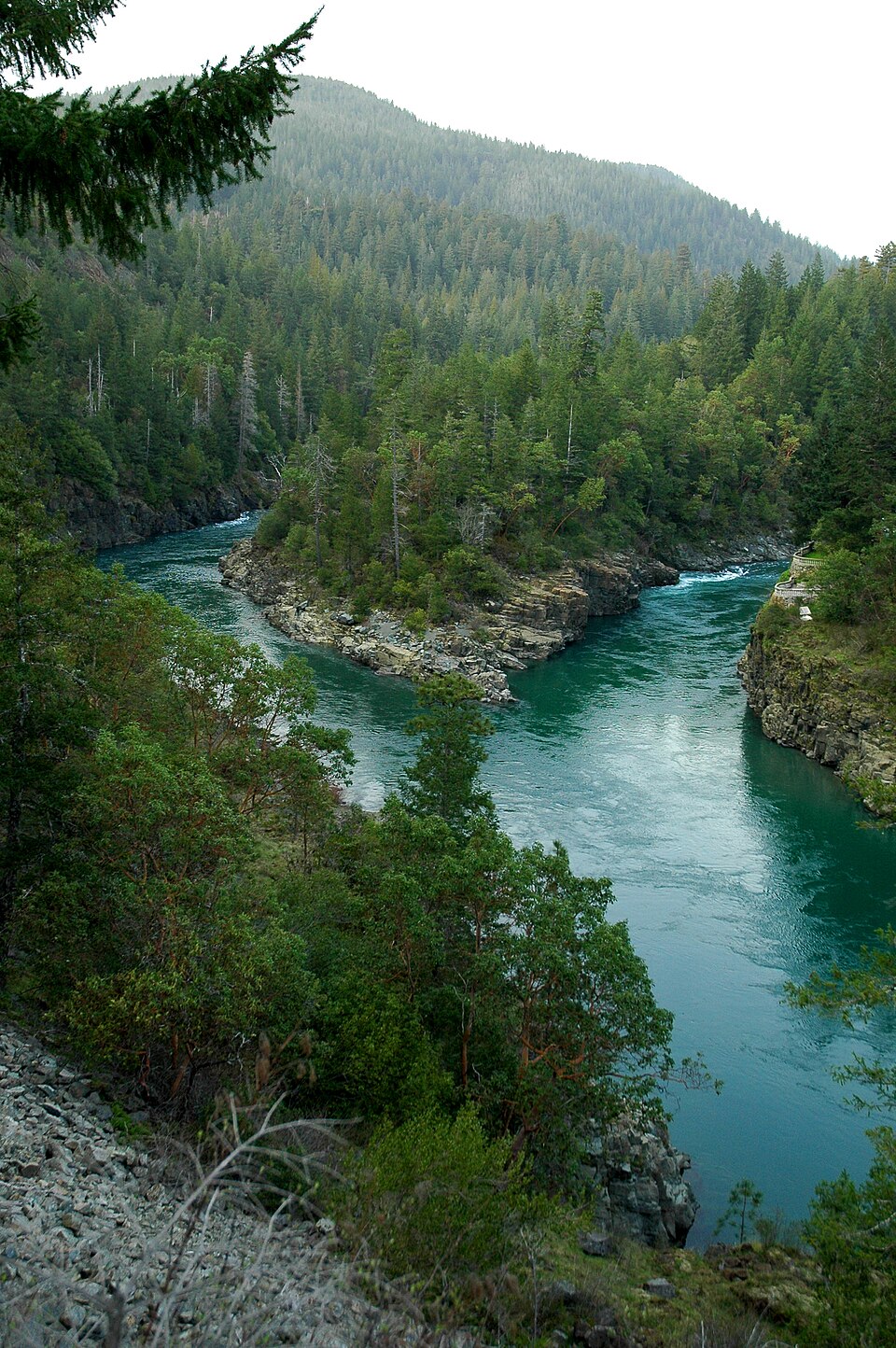
Smith River near Crescent City Clinton Steeds / Wikimedia Commons. CC BY 2.0.
A modern Smith River landscape near Crescent City, in the river setting specifically connected with Tolowa Dee-ni’ stewardship in the inspected partnership release. Not a picture of Nation citizens, a reservation boundary, the 2025 burn itself or current environmental conditions. Complete available retrieved JPEG imported unchanged. Background/card CSS crops and overlays affect presentation; the opened page retains the complete available frame proportionally.
Image, association, and reuse record reviewed 2026-10-28.
Full photographs are displayed proportionally above. A translucent background copy may be cropped by the viewport; it does not replace the complete image or its record.
The visual treatment does not change the research status, evidence, or remaining gaps recorded in this profile.
Start reading here
A short purposeful path through selected actual-content works. Read annotations for community, period and inspection limits; this is not a complete history or community endorsement.
A November 2025 release describes Nation-led cultural burning beside the Smith River, with public-agency support.
These are selected starting points. The full annotated collection, source perspectives, inspection limits and remaining research questions follow below. A starting guide is not an exhaustive history or community endorsement.
01
Identity and context
Tolowa people have coastal homelands near the California–Oregon border.
Focus the next stage of research on: Community-preferred naming, language and distinct tribal institutions. The sources below are selected reading paths; their authorship, dates and community scope should guide how they are used.
The Tolowa Dee-ni’ Nation’s heritage office brings cultural landscapes, collections and documented history into one preservation programme. Its public description includes caring for photographs, recordings and written records and working toward fuller digital inventories. The account explains responsibilities and goals; it does not make all collections public or grant permission to reproduce them.
California State Parks and the Nation describe an October 2025 cultural burn along the mainstem Smith River. In their account, Nation citizens and staff guided cultural objectives while partner agencies supported planning and logistics. The release places this event within a longer history of exclusion and renewed stewardship. Its ecological claims remain the partners’ account rather than an independent assessment.
Add Nation- and community-led historical and language accounts across Tolowa communities without treating a shared name as one government.
Inspect underlying archival and stewardship records where public and appropriate; no sensitive cultural holdings or locations are needed.
Cohort11: selected actual-content reviews preserve their institutional/community scope. Existing source cards are upgraded at the same ID and URL where noted; repeated publications are not globally new works.
Follow the reading path
Sources & further reading
Open any title to read the original source. Annotations explain what each link can help you explore.
No Indigenous-led source is identified in this entry yet. This is a gap in this collection, and does not imply an absence of community knowledge or organization.
Read this community or institutional account for the named entry. Its scope may cover one constituent community; compare the naming notes and other sources before generalizing.
Historical context for this entry. Read “Tolowa Dee-ni' Nation, CA | Official Website” with attention to the author, period covered, and communities named; compare with community-published accounts where available.
Historical context for this entry. Read “Historical and cultural reference for Tolowa” with attention to the author, period covered, and communities named; compare with community-published accounts where available.
The Nation describes how its heritage office links cultural landscapes, collections and archival care. This is a public institutional account, not permission to inspect or reproduce private cultural holdings.
Inspection: Content reviewed for the stated scope
Scope: Complete public office body from the four areas of historic values through Archives Program, before Quick Links. Mission, cultural-resource programme, collections and archives paragraphs read; personal contacts and linked forms excluded.
Review recorded: October 28, 2026
Access note: Normal public HTTP 200 body read. No collection catalogue, restricted records, cultural objects, human remains, cemetery records, consultation files, underlying legal instruments or office inventories inspected. Duties and digitization goals are attributed programme descriptions, not legal advice or verified project outcomes.
A November 2025 release describes Nation-led cultural burning beside the Smith River, with public-agency support. It offers a dated example of cultural knowledge shaping landscape stewardship.
Inspection: Content reviewed for the stated scope
Scope: Complete November20, 2025 main release from Hiouchi/October21 event through the cooperative-stewardship paragraph, before subscription information.
Review recorded: October 28, 2026
Access note: Normal public HTTP 200 prose read. This is the partners’ account of an October21, 2025 event; no burn plan, monitoring data, safety instructions, archaeological evidence or later ecological results inspected. No sensitive site details, ceremony, mapped boundary or instructions for conducting a burn are reproduced.