The Tulalip Tribes brings together histories of Snohomish, Snoqualmie, Skykomish and allied peoples. These readings pair a community-authored account of organizing with Hibulb Cultural Center’s approach to public cultural education.
See each region’s evidence for historical or present-day scope.
Homeland / region
Pacific Northwest / Washington
Research depth
Source guide
Source collection
3 annotated resources · 3 Indigenous-led
Inspected sources
2 substantive works · selected content reviewed
Initial adequacy
Still unfinished
Source review
October 28, 2026
A source guide for a deeper dive.This entry provides a brief orientation and an organized reading path. A comprehensive deep dive has not yet been completed. Follow the annotated sources and distinguish primary community accounts from outside reference material.
Still unfinished
A bounded actual-content starting path and specifically scoped credited picture are available. Fuller history, source comparison and community review remain open; quantity does not establish completion.
Assessment recorded October 28, 2026. This is separate from research completion and community review.
Add individually scoped histories from constituent communities rather than treating one institutional narrative as every person’s experience.
Read original school, government and land records before extending chronology or legal conclusions.
Verify current educational outcomes and visitor conditions independently; the selected guide is not a live schedule.
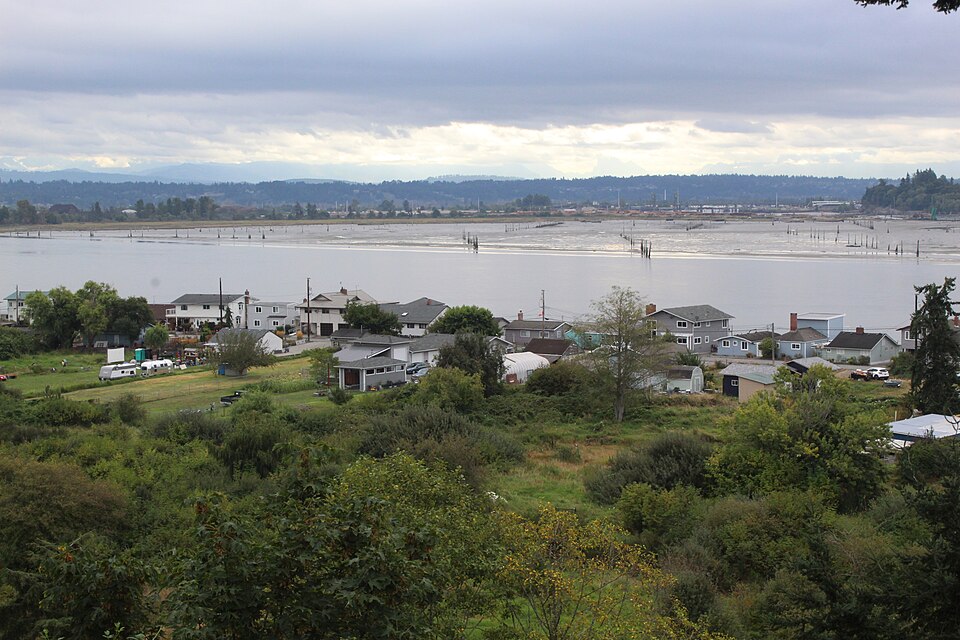
The dated Priest Point view is regional place context; its camera is described as at a cemetery, but no graves or markers are visible. No access or territorial claim follows.
Backdrop photographs & credits
These photographs have individual, documented connections to this entry. Their captions and source records define the people, place, object, and period shown; no one photograph represents every community within a broader label.
Priest Point.jpg Eric Schucht / Wikimedia Commons · CC BY-SA 4.0
Dated Priest Point regional view supported by the official Tulalip named-place service-area paragraph. The photographer describes the camera as at Priest Point Cemetery; the actual complete frame shows houses, marsh, water and trees, with no visible graves or markers. No precise cemetery coordinates, access permission, exact camera-boundary claim or present jurisdiction inferred. Complete available retrieved JPEG imported unchanged. Background/card CSS crops and overlays affect presentation; the opened page retains the complete available frame proportionally.
Image, association, and reuse record reviewed 2026-10-28.
Full photographs are displayed proportionally above. A translucent background copy may be cropped by the viewport; it does not replace the complete image or its record.
The visual treatment does not change the research status, evidence, or remaining gaps recorded in this profile.
Start reading here
A short purposeful path through selected actual-content works. Read annotations for community, period and inspection limits; this is not a complete history or community endorsement.
Then follow a Tulalip-led museum’s educational interpretation.
These are selected starting points. The full annotated collection, source perspectives, inspection limits and remaining research questions follow below. A starting guide is not an exhaustive history or community endorsement.
01
Identity and context
The Tulalip Tribes is a contemporary confederated government in the Puget Sound region.
Focus the next stage of research on: Constituent peoples, Lushootseed, treaty histories and community-published accounts. The sources below are selected reading paths; their authorship, dates and community scope should guide how they are used.
An account credited to Wayne Williams, George Williams, Bernice Williams and Arnold McKay describes elders choosing representatives for intertribal meetings and later efforts to build a tribal government. It follows collective fundraising, council organization and land reacquisition. These are the named authors’ historical account; the original legal and administrative records remain further reading.
Hibulb’s teacher guide introduces the histories of the peoples connected with Tulalip through English and Lushootseed interpretation. Its gallery guide brings waterways, canoes, schooling and community history into an educational path. Reading this guide does not mean the directory has examined its objects, heard its recordings or obtained permission to reproduce its displays.
Add individually scoped histories from constituent communities rather than treating one institutional narrative as every person’s experience.
Read original school, government and land records before extending chronology or legal conclusions.
Verify current educational outcomes and visitor conditions independently; the selected guide is not a live schedule.
The dated Priest Point view is regional place context; its camera is described as at a cemetery, but no graves or markers are visible. No access or territorial claim follows.
Cohort09: selected actual-content reviews preserve their institutional/community scope. Existing source cards are upgraded at the same ID and URL where noted; repeated publications are not globally new works.
Follow the reading path
Sources & further reading
Open any title to read the original source. Annotations explain what each link can help you explore.
No Indigenous-led source is identified in this entry yet. This is a gap in this collection, and does not imply an absence of community knowledge or organization.
Two substantial narratives describe boarding-school experiences and twentieth-century organizing. The second is credited to Wayne Williams, George Williams, Bernice Williams and Arnold McKay; their historical interpretation remains attributed.
Inspection: Content reviewed for the stated scope
Scope: Complete Life in the Tulalip Indian Boarding School and Tulalip History Since World War I narrative units, including text after More controls. The separate chronology is not used as an independently checked timeline.
Review recorded: October 28, 2026
Access note: Public source body inspected through the web reader and/or a normal HTTP200 local copy. Linked recordings, original records, objects and photographs were not automatically inspected or licensed. No login, paywall bypass or outreach. Original school records, constitutional documents, litigation and land transactions were not independently inspected. No current finances, officeholders, legal holdings or universal constituent-community views are inferred.
Community or Indigenous-organization perspective linked for this entry. Use “The Tulalip Tribes” to begin with the publisher’s own account; check whether its scope is one community or a wider people.
Selected guide pages explain Hibulb’s mission, bilingual interpretation and public gallery themes. The guide offers a purposeful route into Tulalip-led education without granting reproduction rights to displays or images.
Inspection: Content reviewed for the stated scope
Scope: Actual8-page PDF: selected PDFpp3,5–7 (printed2,4–6), especially About Us/Main Gallery, stop guide and photography/publication conditions. Planning details are not current visitor advice.
Review recorded: October 28, 2026
Access note: Public source body inspected through the web reader and/or a normal HTTP200 local copy. Linked recordings, original records, objects and photographs were not automatically inspected or licensed. No login, paywall bypass or outreach. Normal HTTP200 full file retrieved; only stated selected pages reviewed. No gallery visit, video viewing or underlying object inspection. PDFp5 requires prior written permission for image publication; no exhibit image is reused.
Related entries may represent alternate names, constituent communities, wider groupings, or historical connections. Read the naming notes before treating entries as equivalent.
Robey’s Atlas of Indigenous North America · Compiled October 19, 2026 · Tulalip