Wampanoag is a broader people label with distinct communities and governments. This starting guide brings together Chappaquiddick community history and Mashpee museum and archive publications. The sources have particular institutional perspectives; none is treated as the single voice or membership authority for all Wampanoag people.
See each region’s evidence for historical or present-day scope.
Homeland / region
Northeast / Massachusetts
Research depth
Source guide
Source collection
5 annotated resources · 5 Indigenous-led
Inspected sources
3 substantive works · selected content reviewed
Initial adequacy
Still unfinished
Source review
October 28, 2026
A source guide for a deeper dive.This entry provides a brief orientation and an organized reading path. A comprehensive deep dive has not yet been completed. Follow the annotated sources and distinguish primary community accounts from outside reference material.
Still unfinished
A bounded actual-content starting path and specifically scoped credited picture are available. Fuller history, source comparison and community review remain open; quantity does not establish completion.
Assessment recorded October 28, 2026. This is separate from research completion and community review.
Expand community-led starting routes across additional Wampanoag communities and governments.
Read underlying public records and individual museum/archive resources within their access and cultural protocols; no blanket reuse or title claim follows from a link.
Backdrop photographs & credits
These photographs have individual, documented connections to this entry. Their captions and source records define the people, place, object, and period shown; no one photograph represents every community within a broader label.
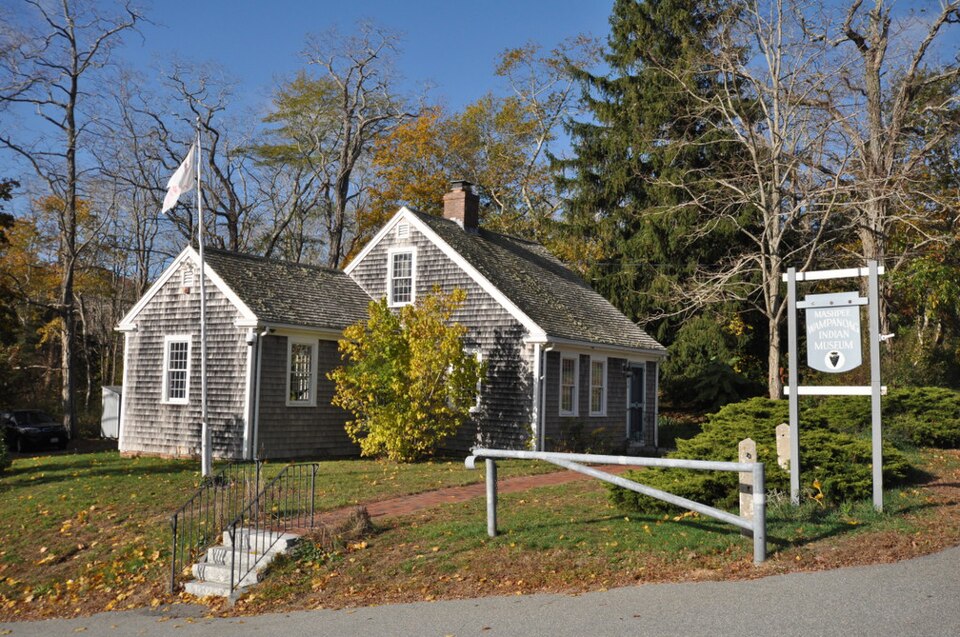
Avant House in Mashpee Magicpiano / Wikimedia Commons. CC BY-SA 4.0.
A dated exterior of Avant House in Mashpee, identified by the individual item and the Mashpee Tribe’s historic-property/museum context. An institution connected with one Wampanoag community, not a generic object or a photograph of every Wampanoag government. No interior object, present opening schedule or separately owned artwork permission is inferred. Complete available retrieved JPEG imported unchanged. Background/card CSS crops and overlays affect presentation; the opened page retains the complete available frame proportionally.
Image, association, and reuse record reviewed 2026-10-28.
Full photographs are displayed proportionally above. A translucent background copy may be cropped by the viewport; it does not replace the complete image or its record.
The visual treatment does not change the research status, evidence, or remaining gaps recorded in this profile.
Start reading here
A short purposeful path through selected actual-content works. Read annotations for community, period and inspection limits; this is not a complete history or community endorsement.
The Tribe describes its museum and the 2020 exhibit 400 Years Ago as ways to interpret Wampanoag histories and colonization from a community perspective..
The Tribe explains archival preservation, education and culturally governed access together.
These are selected starting points. The full annotated collection, source perspectives, inspection limits and remaining research questions follow below. A starting guide is not an exhaustive history or community endorsement.
01
Identity and context
Wampanoag is a wider peoplehood encompassing distinct communities and contemporary tribal governments.
Focus the next stage of research on: Community-authored histories, Wôpanâak language, land and individual nations. The sources below are selected reading paths; their authorship, dates and community scope should guide how they are used.
Chappaquiddick’s history describes island connections, petitions about land and governance, the effects of nineteenth-century state policies and later community organization and gatherings. It offers a particular Wampanoag community account. Original petitions, deeds and court files remain to inspect; the narrative does not determine present title or represent every Wampanoag government.
The Mashpee Wampanoag Museum describes exhibits connecting long histories with the present. Its 2020 exhibit 400 Years Ago responded to Mayflower commemorations by presenting colonization from a Wampanoag perspective. The museum in the pictured Mashpee building is an institutional example from one community, not a generic image of all Wampanoag cultural life.
Mashpee’s archive account connects preserving records with education, language work and institutional memory. It explains that access follows tribal policies and cultural protocols, including protection for confidential and sensitive information. An accessible public introduction helps researchers begin, but does not imply that every record may be freely downloaded, copied or used without context.
Expand community-led starting routes across additional Wampanoag communities and governments.
Read underlying public records and individual museum/archive resources within their access and cultural protocols; no blanket reuse or title claim follows from a link.
Cohort12: selected actual-content reviews preserve their institutional/community scope. Existing source cards are upgraded at the same ID and URL where noted; repeated publications are not globally new works.
Follow the reading path
Sources & further reading
Open any title to read the original source. Annotations explain what each link can help you explore.
No Indigenous-led source is identified in this entry yet. This is a gap in this collection, and does not imply an absence of community knowledge or organization.
Community or Indigenous-organization perspective linked for this entry. Use “History | Seaconke Wampanoag Official” to begin with the publisher’s own account; check whether its scope is one community or a wider people.
This community-authored account relates Chappaquiddick island connections, petitions and later gatherings. It supplies a particular Wampanoag community history rather than one account for every Wampanoag government.
Inspection: Content reviewed for the stated scope
Scope: Opening Brief History prose; selected 1692–1870 petitions/1869-allotment timeline entries and early1900s/1995 community-organization entries. Linked deeds, lawsuits, photographs and burial-ground material not inspected.
Review recorded: October 28, 2026
Access note: Normal public HTTP 200 body read. No original petitions, Briggs/Earle reports, deeds, court decisions, current enrollments or private family material inspected. Land-title and legal-status conclusions, exact acreage and descent criteria are not independently established. One nonprofit community corporation is not treated as another distinct people.
Community or Indigenous-organization perspective linked for this entry. Use “Chappaquiddick Wampanoag Tribe” to begin with the publisher’s own account; check whether its scope is one community or a wider people.
The Tribe describes its museum and the 2020 exhibit 400 Years Ago as ways to interpret Wampanoag histories and colonization from a community perspective.
Inspection: Content reviewed for the stated scope
Scope: Through Our Doors institutional paragraphs, museum-management identification and complete400 Years Ago exhibit description. Visitor prices/hours, source images and physical exhibits not inspected or copied.
Review recorded: October 28, 2026
Access note: Normal public HTTP 200 body read. No museum visit, diorama, object, commissioned artwork or underlying historical archive inspected. Oldest/only-museum superlatives, opening schedules and admission are not adopted. The pictured Avant House is a Mashpee institutional example, not an illustration of every Wampanoag community.
The Tribe explains archival preservation, education and culturally governed access together. It is a valuable starting statement for students and researchers about why public learning does not mean unrestricted access to every record.
Inspection: Content reviewed for the stated scope
Scope: Complete main archive description from Preserving the History and Living Heritage through Long-Term Vision, before email/contact/footer. Linked or underlying archival records not opened.
Review recorded: October 28, 2026
Access note: Normal public HTTP 200 body read. No confidential, sacred, genealogical, legal or other individual archival record inspected. Stated holdings, access policies and goals are attributed institutional descriptions, not a claim of complete digitization, unrestricted download permission or guaranteed research access.
Related entries may represent alternate names, constituent communities, wider groupings, or historical connections. Read the naming notes before treating entries as equivalent.
Robey’s Atlas of Indigenous North America · Compiled October 19, 2026 · Wampanoag