This starting guide follows cultural-preservation work published by the Confederated Tribes of the Colville Reservation. Its history and archaeology program and its language division offer complementary entry points into records, Elders’ accounts and learning resources. These institutional introductions are not a complete history of the distinct peoples represented within the confederation.
See each region’s evidence for historical or present-day scope.
Homeland / region
Pacific Northwest / Washington
Research depth
Source guide
Source collection
4 annotated resources · 3 Indigenous-led
Inspected sources
2 substantive works · selected content reviewed
Initial adequacy
Still unfinished
Source review
October 28, 2026
A source guide for a deeper dive.This entry provides a brief orientation and an organized reading path. A comprehensive deep dive has not yet been completed. Follow the annotated sources and distinguish primary community accounts from outside reference material.
Still unfinished
A bounded actual-content starting path and specifically scoped credited picture are available. Fuller history, source comparison and community review remain open; quantity does not establish completion.
Assessment recorded October 28, 2026. This is separate from research completion and community review.
Develop separate historical reading paths for the Colville people and other constituent peoples without treating a confederated institution as every community’s voice.
Read selected tribal historical publications and original records; the linked story-map introduction and multimedia works were not inspected here.
Review actual language teaching materials separately and retain speaker/community scope.
Backdrop photographs & credits
These photographs have individual, documented connections to this entry. Their captions and source records define the people, place, object, and period shown; no one photograph represents every community within a broader label.
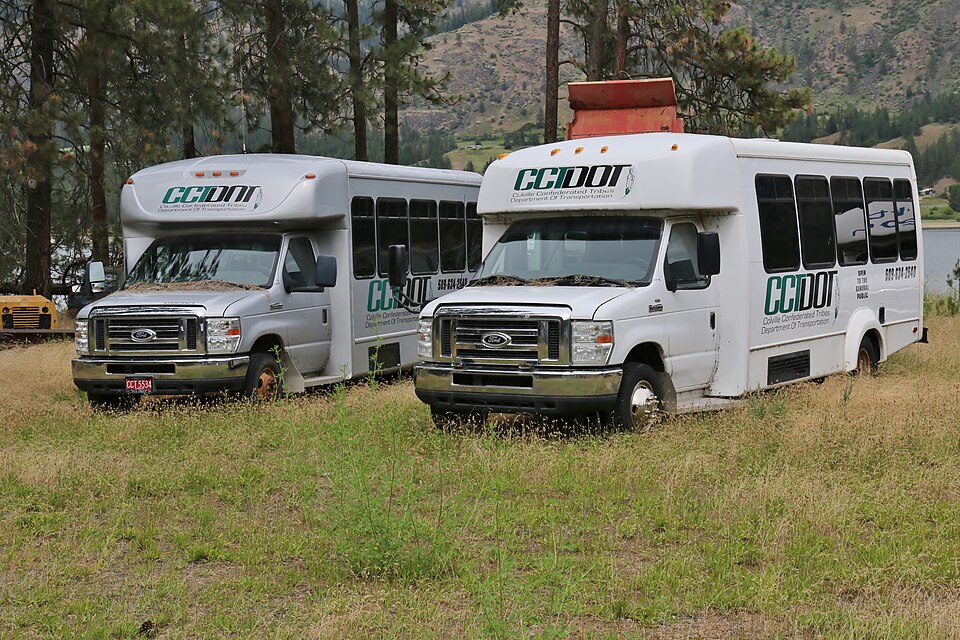
Colville Confederated Tribes DOT minibuses at Inchelium ferry dock, 2026 SounderBruce / Wikimedia Commons · CC BY-SA 4.0
Exact record identifies two Confederated Tribes DOT minibuses at Inchelium ferry dock. The Tribe’s own Transit & Inchelium Ferry page independently identifies its program and route context. Whole public transport vehicles in their setting, not a standalone reproduction of logos, current service guarantee or portrait of every constituent people. Unchanged complete 960×640 JPEG delivered by the exact provider-listed 960px preview link, retrieved normally HTTP 200 by root and independently viewed locally by this agent. The larger record-linked original and camera original were not inspected. No new crop, resizing, compression, retouching, colorization or generation applied; CSS display crops and overlays may affect presentation. Image remains CC BY-SA 4.0 with creator, source and license credits. Whole public vehicles are shown; incidental department marks are not isolated as decorative art or presented as endorsement. Complete available retrieved JPEG imported unchanged. Background/card CSS crops and overlays affect presentation; the opened page retains the complete available frame proportionally.
Image, association, and reuse record reviewed 2026-10-28.
Full photographs are displayed proportionally above. A translucent background copy may be cropped by the viewport; it does not replace the complete image or its record.
The visual treatment does not change the research status, evidence, or remaining gaps recorded in this profile.
Start reading here
A short purposeful path through selected actual-content works. Read annotations for community, period and inspection limits; this is not a complete history or community endorsement.
Then read the language division’s explanation of intergenerational preservation and learning.
These are selected starting points. The full annotated collection, source perspectives, inspection limits and remaining research questions follow below. A starting guide is not an exhaustive history or community endorsement.
01
Identity and context
The Confederated Tribes of the Colville Reservation includes multiple distinct constituent peoples.
Focus the next stage of research on: Confederated governance, individual peoples’ histories, languages and displacement. The sources below are selected reading paths; their authorship, dates and community scope should guide how they are used.
The History/Archaeology Program describes work across archaeology, ethnography, history and cultural-resource management on the Columbia Plateau. Its public services include archival research, oral-history review and transcription, traditional-skills research, collections management and museum interpretation. The page explains how an institution approaches evidence and preservation; it does not itself supply the linked films’ full content or the separate histories of every constituent people.
The Cultural Preservation Division describes a responsibility to preserve and share language, culture and history with coming generations. Its account emphasizes recording and carefully preserving Elders’ stories, and supporting dictionaries, curriculum, translation and access to fluent speakers. Read these as the division’s responsibilities and educational routes. The directory has not assessed the linked lessons, recordings or language outcomes, and restricted community knowledge is not made public by a program listing.
Develop separate historical reading paths for the Colville people and other constituent peoples without treating a confederated institution as every community’s voice.
Read selected tribal historical publications and original records; the linked story-map introduction and multimedia works were not inspected here.
Review actual language teaching materials separately and retain speaker/community scope.
Cohort09: selected actual-content reviews preserve their institutional/community scope. Existing source cards are upgraded at the same ID and URL where noted; repeated publications are not globally new works.
Follow the reading path
Sources & further reading
Open any title to read the original source. Annotations explain what each link can help you explore.
No Indigenous-led source is identified in this entry yet. This is a gap in this collection, and does not imply an absence of community knowledge or organization.
Indigenous-ledConfederated Tribes of the Colville ReservationSource 1
The actual program description and services list explain historical research, ethnography, oral-history work, collections care and preservation. Useful for understanding the Tribe’s cultural-resource institution; linked films, place-name documents and archaeological records were not read.
Inspection: Content reviewed for the stated scope
Scope: Actual History/Archaeology body and selected public service descriptions, reader lines 440–542. Multimedia titles were seen only as links and do not constitute inspections of those works. No site locations or restricted collections content reproduced.
Review recorded: October 28, 2026
Access note: Actual selected public HTML body read through the web reader; no login or paywall encountered. Linked publications, underlying archives, video/audio and photographs were not thereby fully inspected or cleared for reproduction.
Community or Indigenous-organization perspective linked for this entry. Use “Traditional Territories — Colville Tribes” to begin with the publisher’s own account; check whether its scope is one community or a wider people.
Historical context for this entry. Read “Historical and cultural reference for Colville” with attention to the author, period covered, and communities named; compare with community-published accounts where available.
The complete short explanatory body describes preserving Elders’ accounts, supporting language learning and passing culture and history to coming generations. Its stated aims and provision of dictionaries and curriculum are not a measurement of language proficiency or program success.
Inspection: Content reviewed for the stated scope
Scope: Actual Colville Language body, reader lines 296–305: Cultural Preservation Division mandate, recording and preserving Elders’ stories, educational media, three language programs, dictionary/curriculum/translation services. Linked recordings, dictionaries, classes and certification forms not reviewed.
Review recorded: October 28, 2026
Access note: Actual selected public HTML body read through the web reader; no login or paywall encountered. Linked publications, underlying archives, video/audio and photographs were not thereby fully inspected or cleared for reproduction.
Related entries may represent alternate names, constituent communities, wider groupings, or historical connections. Read the naming notes before treating entries as equivalent.
Robey’s Atlas of Indigenous North America · Compiled October 19, 2026 · Colville