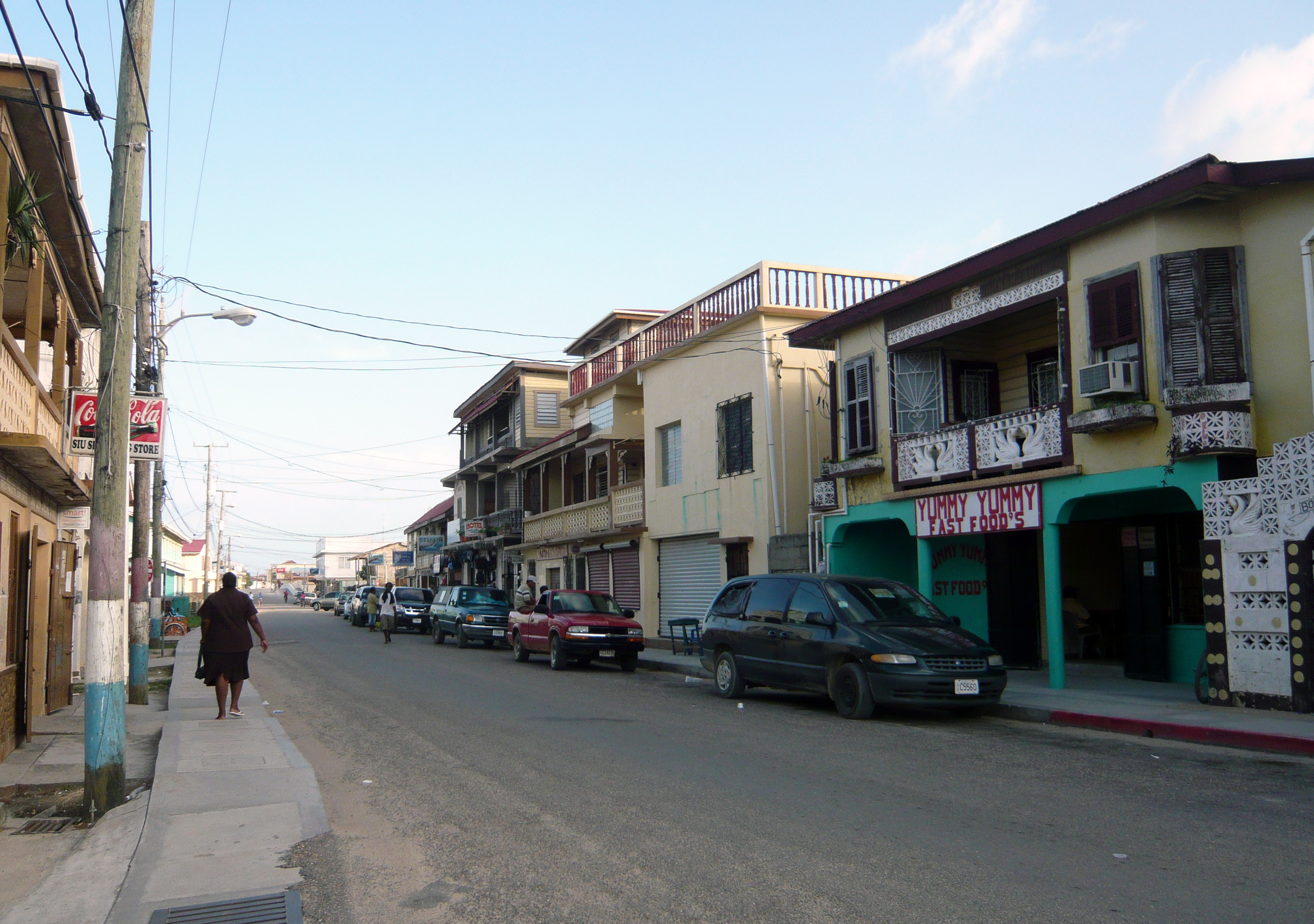
Main street in Dangriga, Belize,2008Haakon S. Krohn,2008; Wikimedia Commons. CC BY-SA 3.0. Complete delivered frame; no pixel crop, retouching or generation. Display crops/overlays disclosed.
Local town community / Garifuna context · Added to the original list
Dangriga (Belize)
Also find this entry through: Dangriga
Dangriga’s local Garifuna history can be approached through civic memory, cultural education and the work of the Gulisi Museum. A community-authored primer and dated interviews offer starting perspectives without making the entire town or its institutions interchangeable with one people.
See each region’s evidence for historical or present-day scope.
Homeland / region
Caribbean / Belize — named local community context
Research depth
Source guide
Source collection
3 annotated resources · 1 Indigenous-led
Inspected sources
3 substantive works · selected content reviewed
Initial adequacy
Still unfinished
Source review
October 29, 2026
Names & relationshipsA separately findable local town reading route for the Garifuna community context of Dangriga, Belize. The place includes a wider local population; this is not a claim that every resident is Garifuna or that this is a separate Indigenous nation or government.
A source guide for a deeper dive.This entry provides a brief orientation and an organized reading path. A comprehensive deep dive has not yet been completed. Follow the annotated sources and distinguish primary community accounts from outside reference material.
Still unfinished
A bounded actual-content source guide and specifically scoped credited image are available. Fuller history and community/source comparison remain open; quantity does not establish completion or endorsement.
Assessment recorded October 29, 2026. This is separate from research completion and community review.
Develop local and community-authored history with actual-content inspected sources.
Clarify local institutions and distinctions among the municipality, Garifuna community and any named organizations; do not infer ethnicity from residence.
Add further community-authored local histories and review interpretations with publicly available community sources.
Named place and municipal institutions are not evidence that all residents are Garifuna or that the route is another people/government.
Dated descriptions, project announcements and samples do not establish present populations, language ability, land ownership or programme outcomes.
Backdrop photographs & credits
These photographs have individual, documented connections to this entry. Their captions and source records define the people, place, object, and period shown; no one photograph represents every community within a broader label.
Main street in Dangriga, Belize,2008 Haakon S. Krohn,2008; Wikimedia Commons. CC BY-SA 3.0. Complete delivered frame; no pixel crop, retouching or generation. Display crops/overlays disclosed.
A particular 2008 public street view in Dangriga, identified exactly in the photographer record. The local guide sources explicitly concern Garifuna civic life and the GulisiMuseum in this town. This photograph illustrates the shared town setting, not a Garifuna-only street, the museum building, named community members, every resident’s ethnicity or territorial extent. Commercial signs/vehicles and pedestrians are incidental; no business or personal identity is inferred. Complete available source frame visually inspected, with no pixel crop, retouching, colorization or generated alteration. Card/backdrop CSS may crop or overlay display only; the complete frame and source/rights remain linked.
Image, association, and reuse record reviewed 2026-10-29.
Full photographs are displayed proportionally above. A translucent background copy may be cropped by the viewport; it does not replace the complete image or its record.
The visual treatment does not change the research status, evidence, or remaining gaps recorded in this profile.
01
Civic memory and recognition
In her 2024 primer, I. Myrtle Palacio connects Garifuna civic participation with Dangriga. Her selected discussion recalls assistance to 1931 hurricane refugees and names C.J. Benguche, T.V. Ramos and Mateo Avaloy in the movement for a public day of recognition. It is an authored historical interpretation; the underlying records and wider political history remain further research.
News5’s November 2004 opening report records National Garifuna Council president Michael Polonio’s emphasis on passing ancestral stories to children. NICH representative Yasser Musa describes contributions to the exhibits by Joseph Palacio and Sebastian Cayetano. The report gives readers named voices in public history; it does not turn every reported ancestral story into a verified genealogy.
A separate 2019 report covers an agreement to rehabilitate the Gulisi Museum. Interviewees explain why exhibits should help residents and visitors understand Garifuna history. The announcement documents intentions and partnerships at that time; it does not establish that every refurbishment was completed or describe current opening arrangements.
Develop local and community-authored history with actual-content inspected sources.
Clarify local institutions and distinctions among the municipality, Garifuna community and any named organizations; do not infer ethnicity from residence.
Add further community-authored local histories and review interpretations with publicly available community sources.
Named place and municipal institutions are not evidence that all residents are Garifuna or that the route is another people/government.
Dated descriptions, project announcements and samples do not establish present populations, language ability, land ownership or programme outcomes.
Follow the reading path
Sources & further reading
Open any title to read the original source. Annotations explain what each link can help you explore.
No Indigenous-led source is identified in this entry yet. This is a gap in this collection, and does not imply an absence of community knowledge or organization.
Community-authored historical synthesisI. Myrtle Palacio; digital edition hosted by NICHSource 1
I. Myrtle Palacio’s 2024 edition connects Garifuna civic participation with Dangriga and the movement for public recognition. This selected account is useful beside dated museum interviews and further archival work.
Inspection: Content reviewed for the stated scope
Scope: Actual root-cached NICH-hosted PDF, selected PDFpp.25–27 (printed19–21), read for civic advocacy, the Dangriga 1931-refugee reference and recognition-day advocates. Duplicate extraction passages treated as the same text.
Review recorded: October 29, 2026
Access note: Not all50pages or underlying statutes, election records, precise voter outcomes, political totals or restricted spiritual chapter reviewed. No current legal determination. This is the author’s account, not government authorship or a licence for images/maps.
The November18,2004 opening report records National Garifuna Council and NICH voices about building the Gulisi Museum, shaping exhibits and sharing ancestral stories. Keep their interpretations attributed.
Inspection: Content reviewed for the stated scope
Scope: Actual full main report and quoted interviews read from normal HTTP 200 HTML; Janelle Chanona reporting, Michael Polonio and Yasser Musa interviews. Unrelated archive navigation/comments not reviewed as sources.
Review recorded: October 29, 2026
Access note: Dated opening report, not current hours, present leadership, visitor numbers or independent confirmation of every genealogical/ancestral statement. Underlying interviews beyond the transcript and museum objects/media not inspected or reproduced.
The August6,2019 report records a rehabilitation agreement and interviews with NICH, funder and National Garifuna Council representatives about telling Garifuna history. An announced project is not evidence that all proposed work was completed.
Inspection: Content reviewed for the stated scope
Scope: Actual complete main report and interviews read from normal HTTP 200 HTML, including Janelle Carcamo, Sapna Budhrani, John August Jr. and Sandra Miranda statements.
Review recorded: October 29, 2026
Access note: Agreement, funding and intended exhibits are reported in 2019; current officeholders, later completion, impact and public access are not inferred. No underlying grant files, original broadcasts or museum media examined.
Related entries may represent alternate names, constituent communities, wider groupings, or historical connections. Read the naming notes before treating entries as equivalent.
Robey’s Atlas of Indigenous North America · Compiled October 19, 2026 · Dangriga (Belize)