Iowa, often written Ioway, is a people name used across distinct governments. This path pairs the Iowa Tribe of Kansas and Nebraska’s own account with an Oklahoma education guide and a northern community account of recovering a former mission site.
See each region’s evidence for historical or present-day scope.
Homeland / region
Great Plains / Kansas / Nebraska / Oklahoma
Research depth
Source guide
Source collection
3 annotated resources · 2 Indigenous-led
Inspected sources
3 substantive works · selected content reviewed
Initial adequacy
Still unfinished
Source review
October 28, 2026
A source guide for a deeper dive.This entry provides a brief orientation and an organized reading path. A comprehensive deep dive has not yet been completed. Follow the annotated sources and distinguish primary community accounts from outside reference material.
Still unfinished
A bounded actual-content starting path and specifically scoped credited picture are available. Fuller history, source comparison and community review remain open; quantity does not establish completion.
Assessment recorded October 28, 2026. This is separate from research completion and community review.
Read original nineteenth-century treaty and school records alongside community histories.
Develop separate Kansas–Nebraska and Oklahoma government guides without treating a broader people label as one present government.
Check dates and original evidence behind differing name-origin traditions; add public community language work without inferring absence from an undated guide.
Backdrop photographs & credits
These photographs have individual, documented connections to this entry. Their captions and source records define the people, place, object, and period shown; no one photograph represents every community within a broader label.
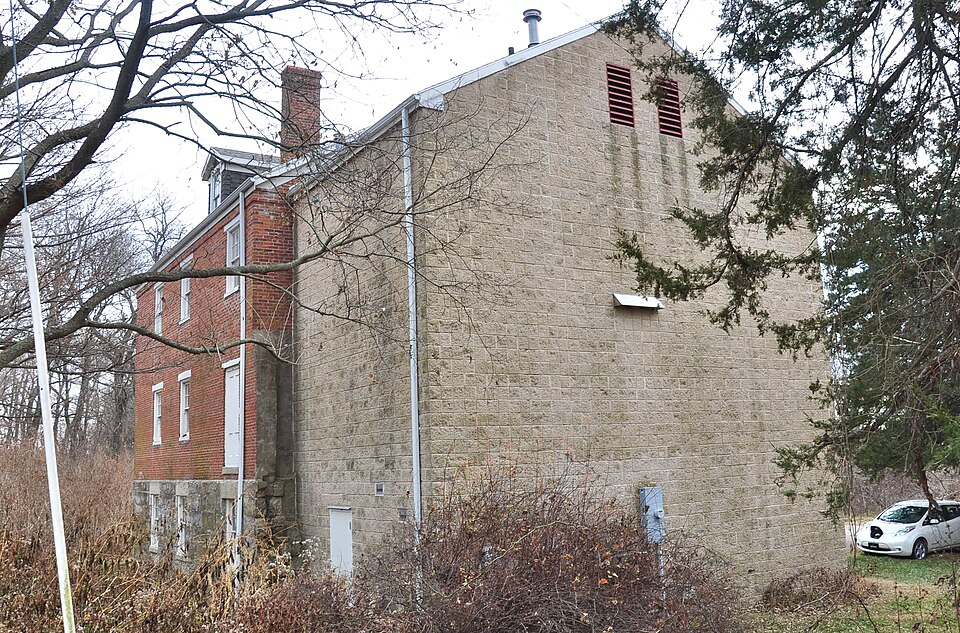
Iowa and Sac & Fox Presbyterian Mission, north facades, 2023 Sharon Papierdreams / Wikimedia Commons · CC BY-SA 4.0
Exact named Iowa and Sac & Fox mission exterior. The Tribe’s own museum account documents its connection and 2021 return. A modern photograph of a colonial educational institution, not an Ioway-made home, a portrait of the people, current visitor-access advice or an endorsement of mission schooling. Complete available retrieved JPEG imported unchanged. Background/card CSS crops and overlays affect presentation; the opened page retains the complete available frame proportionally.
Image, association, and reuse record reviewed 2026-10-28.
Full photographs are displayed proportionally above. A translucent background copy may be cropped by the viewport; it does not replace the complete image or its record.
The visual treatment does not change the research status, evidence, or remaining gaps recorded in this profile.
Start reading here
A short purposeful path through selected actual-content works. Read annotations for community, period and inspection limits; this is not a complete history or community endorsement.
Read how the Tribe presents the return and interpretation of a former mission site.
These are selected starting points. The full annotated collection, source perspectives, inspection limits and remaining research questions follow below. A starting guide is not an exhaustive history or community endorsement.
01
Identity and homelands
Ioway people continue through distinct tribal governments, including the Iowa Tribe of Kansas and Nebraska and the Iowa Tribe of Oklahoma.
The Oklahoma tribal guide supplies a second, distinct community history, with removal and treaty chronology. Neither government represents every Ioway person.
The northern Tribe explains why Ioway is often used to distinguish the people from the state of Iowa. Its account and the Oklahoma guide describe a nineteenth-century separation: some people remained in Kansas and Nebraska while others moved to Indian Territory. These routes should remain separately findable; neither government’s account substitutes for every Ioway family’s history.
The education guide traces successive land cessions and movement toward the Kansas–Nebraska area, followed by an Oklahoma community. Its selected timeline provides a starting chronology, not the original treaty record or a determination of present boundaries. The linked primary documents require their own reading.
A former mission reconsidered through community interpretation
The Tribe’s museum account describes the school built in 1845–1846 and its return to tribal stewardship in 2021. That perspective changes how readers can approach a colonial institution: the site also carries a history of community efforts to tell the story. The dated exterior photograph is a view of that particular building.
Read original nineteenth-century treaty and school records alongside community histories.
Develop separate Kansas–Nebraska and Oklahoma government guides without treating a broader people label as one present government.
Check dates and original evidence behind differing name-origin traditions; add public community language work without inferring absence from an undated guide.
Cohort10: selected actual-content reviews preserve their institutional/community scope. Existing source cards are upgraded at the same ID and URL where noted; repeated publications are not globally new works.
Follow the reading path
Sources & further reading
Open any title to read the original source. Annotations explain what each link can help you explore.
No Indigenous-led source is identified in this entry yet. This is a gap in this collection, and does not imply an absence of community knowledge or organization.
Indigenous-ledIowa Tribe of Kansas and NebraskaSource 1
The northern Tribe explains Ioway naming and the nineteenth-century separation that led to distinct Kansas–Nebraska and Oklahoma governments. Its own historical account should be read alongside the Oklahoma guide.
Inspection: Content reviewed for the stated scope
Scope: Actual About Us / Our History body, from the cross-state introduction through naming and the 1870s northern/southern separation; not merely navigation.
Review recorded: October 28, 2026
Access note: Public body read in the normal web reader and downloaded HTML/text. Undated population estimates, current acreage, membership and legal-boundary assertions are not adopted; underlying treaties and archaeological publications were not inspected.
An Oklahoma education guide presents removal and the development of the Oklahoma and northern communities. The selected pages supply a southern-government perspective rather than an interchangeable history of both governments.
Inspection: Content reviewed for the stated scope
Scope: Actual extracted PDF pp.3–4 and6–7 (migration/removal and selected treaty timeline), plus p.17 language-resource paragraph. The 35-page file was obtained, but only these substantive selections were read; p.1–2 symbol text was encountered and is not used.
Review recorded: October 28, 2026
Access note: Normal HTTP200 PDF; text extraction read. The guide includes a timeline credited to a 2024 history game, not a verified publication date. Maps, original treaties/executive orders, linked books and recordings were not inspected. Conflicting name-origin traditions remain attributed; historical/current numerical claims and claims about programme absence are not adopted.
The Tribe describes the former mission school and the effort to bring its interpretation back into community hands. This offers a community-led way to approach a colonial educational site.
Inspection: Content reviewed for the stated scope
Scope: Actual main historical body, reader lines155–176:1845–1846 mission, boundary-change context, October7, 2021 return and the Tribe’s interpretation of its significance.
Review recorded: October 28, 2026
Access note: Public body read in the normal web reader; a later request timed out. Underlying transfer records, school records and interviews were not inspected. Renovation statements, opening hours and present visitor access are not independently confirmed.
Related entries may represent alternate names, constituent communities, wider groupings, or historical connections. Read the naming notes before treating entries as equivalent.
Robey’s Atlas of Indigenous North America · Compiled October 19, 2026 · Iowa (Ioway)