The Pueblo of Jemez, Walatowa, presents a continuing Towa-speaking community and government. This path compares its attributed historical publication with a state account of Gisewa, while keeping the Pueblo’s cultural privacy rules explicit.
See each region’s evidence for historical or present-day scope.
Homeland / region
New Mexico
Research depth
Source guide
Source collection
4 annotated resources · 3 Indigenous-led
Inspected sources
2 substantive works · selected content reviewed
Initial adequacy
Still unfinished
Source review
October 28, 2026
A source guide for a deeper dive.This entry provides a brief orientation and an organized reading path. A comprehensive deep dive has not yet been completed. Follow the annotated sources and distinguish primary community accounts from outside reference material.
Still unfinished
A bounded actual-content starting path and specifically scoped credited picture are available. Fuller history, source comparison and community review remain open; quantity does not establish completion.
Assessment recorded October 28, 2026. This is separate from research completion and community review.
Read original colonial and Pecos relocation records alongside the attributed narratives.
Develop public community language and education sources without entering restricted materials.
The USGS Red Rocks landscape is not a village, shrine or ceremonial image and conveys no visitor or photography permission.
Backdrop photographs & credits
These photographs have individual, documented connections to this entry. Their captions and source records define the people, place, object, and period shown; no one photograph represents every community within a broader label.
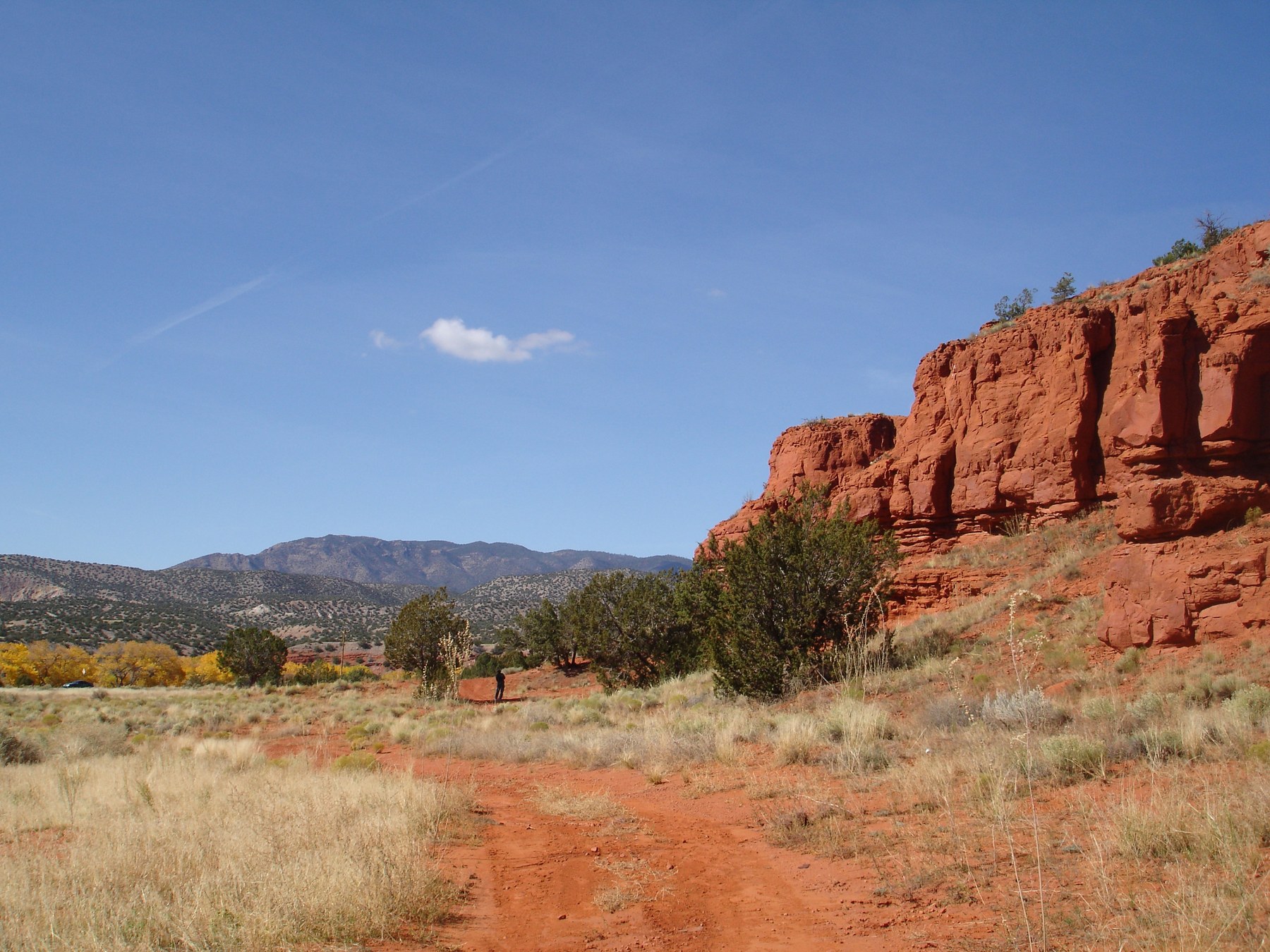
Red Rocks at Walatowa — USGS landscape Annette L. Olson / USGS / U.S. Geological Survey · Public Domain — exact USGS item designation
USGS identifies this natural Red Rocks landscape at Walatowa. The frame shows cliffs, vegetation, a trail and a distant person; no village, shrine, kiva, grave or ceremony is identified. This is regional natural-landscape context, not a tribal boundary or permission to visit/capture new photographs. Present village-photo restrictions remain explicit. The chosen1800×1350 full-frame web JPEG was imported unchanged; the separately hashed3072×2304 source original was proportionally resized as described above. Background/card CSS crops and overlays affect presentation; the opened page retains the complete available frame proportionally.
Image, association, and reuse record reviewed 2026-10-28.
Full photographs are displayed proportionally above. A translucent background copy may be cropped by the viewport; it does not replace the complete image or its record.
The visual treatment does not change the research status, evidence, or remaining gaps recorded in this profile.
Start reading here
A short purposeful path through selected actual-content works. Read annotations for community, period and inspection limits; this is not a complete history or community endorsement.
Compare the state site’s selected account of Gisewa and colonial missionization.
These are selected starting points. The full annotated collection, source perspectives, inspection limits and remaining research questions follow below. A starting guide is not an exhaustive history or community endorsement.
01
Identity and homelands
The Pueblo of Jemez, Walatowa, is a sovereign nation in north-central New Mexico, northwest of Albuquerque.
Gisewa, an ancestral Jemez village, endured missionization, forced labor, and religious suppression; its history connects with the Pueblo Revolt of 1680.
The Pueblo-hosted history describes Spanish missionization, forced concentration into fewer settlements and resistance culminating in the Pueblo Revolt. New Mexico Historic Sites separately recounts the mission at Gisewa and attributes its abandonment partly to forced labor and religious persecution. These are published interpretations, not newly inspected colonial records.
The Pueblo’s historical account describes Pecos people resettling at Jemez in 1838 and maintaining a continuing connection. It should not be read as disappearance of Pecos identity. The Pueblo’s public rules also emphasize that Walatowa is a residential community, with restrictions on village and ceremonial photography.
Read original colonial and Pecos relocation records alongside the attributed narratives.
Develop public community language and education sources without entering restricted materials.
The USGS Red Rocks landscape is not a village, shrine or ceremonial image and conveys no visitor or photography permission.
Cohort13: selected actual-content reviews preserve their institutional/community scope. Existing source cards are upgraded at the same ID and URL where noted; repeated publications are not globally new works.
Follow the reading path
Sources & further reading
Open any title to read the original source. Annotations explain what each link can help you explore.
No Indigenous-led source is identified in this entry yet. This is a gap in this collection, and does not imply an absence of community knowledge or organization.
Indigenous-ledPueblo of JemezSource 1Supporting reference · outside substantive inspected count
The Pueblo identifies Walatowa, Towa language and its continuing government. This brief introduction supports naming and institutional context, rather than another full historical-work count.
Inspection: Supporting or limited review; see scope
Scope: Actual public About body, selected identity, language and government paragraphs and quick-fact labels.
Review recorded: October 28, 2026
Access note: Normal HTTP200. Current population/acreage, officeholders and underlying historical documents not verified. Brief introduction excluded from substantive counts. No outreach or access bypass. Linked media, original records and additional collections were not automatically inspected or licensed.
The state site explains Gisewa, forced mission labor and religious suppression, and the Pueblo Revolt. It offers an outside institutional account to compare with the Pueblo’s own publication.
Inspection: Content reviewed for the stated scope
Scope: Actual public history body: introductory Gisewa identification, Franciscan mission/construction and forced-labor/religious-persecution discussion, abandonment and 1680 relocation account, and description of Jemez-perspective interpretation.
Review recorded: October 28, 2026
Access note: Normal HTTP200. Reconstruction image, kiva, religious details, interiors, artifact collections, visitor access and architectural measurements not inspected or reproduced. Causal wording such as likely remains the institution’s interpretation. No outreach or access bypass. Linked media, original records and additional collections were not automatically inspected or licensed.
The Pueblo-hosted history connects Walatowa with colonial pressure, the Pueblo Revolt and the arrival of Pecos people. Its named author and older publication date matter when assessing the account.
Inspection: Content reviewed for the stated scope
Scope: Actual body: Walatowa/location and secular-government introduction; selected Spanish missionization, revolt and concentration at Walatowa paragraphs; 1838 Pecos relocation account; copyright/byline credit to William Whatley, 1993, with Pueblo administration editing.
Review recorded: October 28, 2026
Access note: Normal HTTP200. Origin narrative, religious leadership details, archaeological-site locations, exact early population/room totals, superlatives and the uninspected 1936 Act are not adopted. The historical narrative is attributed, not original-record verification. No outreach or access bypass. Linked media, original records and additional collections were not automatically inspected or licensed.
The Pueblo’s public rules distinguish a living residential community from a museum and restrict village, religious-site and event photography. A landscape credit does not authorize a new visit or recording.
Inspection: Supporting or limited review; see scope
Scope: Actual public policy body: closed-village statement, residential privacy, no-photography/recording rule, restricted areas and final village/shrine/event notice. Ceremonial procedure details not republished.
Review recorded: October 28, 2026
Access note: Normal HTTP200. Supporting policy reference, excluded from historical source counts. No interpretation of penalties or legal advice; no claim that the landscape photographer’s original on-site permission was reviewed. No outreach or access bypass. Linked media, original records and additional collections were not automatically inspected or licensed.
Related entries may represent alternate names, constituent communities, wider groupings, or historical connections. Read the naming notes before treating entries as equivalent.
Robey’s Atlas of Indigenous North America · Compiled October 19, 2026 · Jemez Pueblo