Pecos Pueblo is both a historical community/place and part of living descendant histories. Christopher Toya’s Pueblo of Jemez account describes the 1838 movement to Jemez and continuing ties; the National Park Service supplies a complementary history of trade and change at the site. Leaving a village does not mean that a people disappeared.
See each region’s evidence for historical or present-day scope.
Homeland / region
Southwest / New Mexico
Research depth
Source guide
Source collection
3 annotated resources · 2 Indigenous-led
Inspected sources
2 substantive works · selected content reviewed
Initial adequacy
Still unfinished
Source review
October 28, 2026
A source guide for a deeper dive.This entry provides a brief orientation and an organized reading path. A comprehensive deep dive has not yet been completed. Follow the annotated sources and distinguish primary community accounts from outside reference material.
Still unfinished
A bounded actual-content starting path and specifically scoped credited picture are available. Fuller history, source comparison and community review remain open; quantity does not establish completion.
Assessment recorded October 28, 2026. This is separate from research completion and community review.
Still unfinished: deeper descendant-authored histories, original documents and additional historical perspectives remain useful.
The sources give different Coronado arrival years; no exact year is asserted here.
The second Jemez URL repeats the same work and is excluded from the count.
Backdrop photographs & credits
These photographs have individual, documented connections to this entry. Their captions and source records define the people, place, object, and period shown; no one photograph represents every community within a broader label.
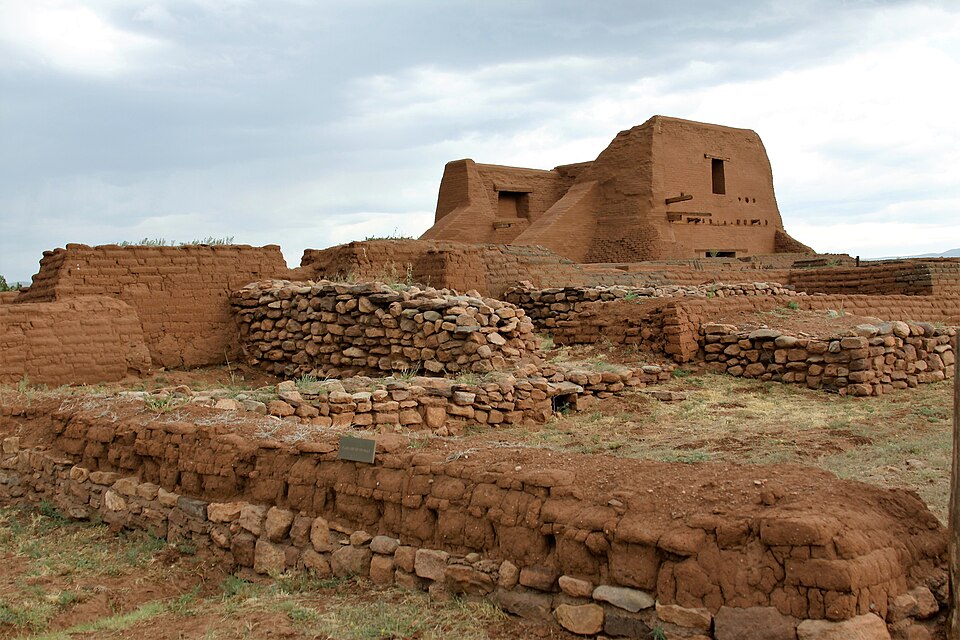
Exterior mission church remains at Pecos, July 18, 2016 Travellover / Photographer’s own work, via Wikimedia Commons · CC BY-SA 4.0
Public exterior remains of a colonial mission at the historical Pecos site. Not precontact Pueblo architecture, a present-community portrait, a claim that Pecos descendants disappeared or permission to photograph restricted spaces. Jemez-published history supplies the living descendant context. Complete available retrieved JPEG imported unchanged. Background/card CSS crops and overlays affect presentation; the opened page retains the complete available frame proportionally.
Image, association, and reuse record reviewed 2026-10-28.
Full photographs are displayed proportionally above. A translucent background copy may be cropped by the viewport; it does not replace the complete image or its record.
The visual treatment does not change the research status, evidence, or remaining gaps recorded in this profile.
Start reading here
A short purposeful path through selected actual-content works. Read annotations for community, period and inspection limits; this is not a complete history or community endorsement.
Compare the park’s account of trade, change and continuity at the historic place.
These are selected starting points. The full annotated collection, source perspectives, inspection limits and remaining research questions follow below. A starting guide is not an exhaustive history or community endorsement.
01
Identity and context
Pecos Pueblo is an ancestral Pueblo place whose descendants continue at Jemez Pueblo.
Focus the next stage of research on: P’aékilâ, trade, colonial change and living descendant relationships. The sources below are selected reading paths; their authorship, dates and community scope should guide how they are used.
Both accounts place Pecos within exchange between Plains communities and the Rio Grande/Pueblo world. They describe a historical centre shaped by trade and its river-and-pass setting. These are selected interpretations of a long history, rather than a map of present jurisdiction or a complete account of every trading relationship.
Toya’s Jemez-published account describes movement to Jemez in 1838 and explains that Pecos descendants and community connections continue there. The park likewise frames the site’s history through continuing stories and traditions. The historic village and a living descendant community must not be collapsed into a claim that Pecos people vanished.
The selected photograph shows the exterior remains of a colonial mission at the historic site. It is not a reconstruction of precontact Pueblo architecture or a portrait of a present community. Read the image beside the Jemez account of Pecos continuity, rather than using an unoccupied ruin as evidence of human absence.
Still unfinished: deeper descendant-authored histories, original documents and additional historical perspectives remain useful.
The sources give different Coronado arrival years; no exact year is asserted here.
The second Jemez URL repeats the same work and is excluded from the count.
Cohort13: selected actual-content reviews preserve their institutional/community scope. Existing source cards are upgraded at the same ID and URL where noted; repeated publications are not globally new works.
Follow the reading path
Sources & further reading
Open any title to read the original source. Annotations explain what each link can help you explore.
No Indigenous-led source is identified in this entry yet. This is a gap in this collection, and does not imply an absence of community knowledge or organization.
Indigenous-ledPueblo of Jemez; Christopher Toya, Tribal Historic Preservation OfficeSource 1
Christopher Toya of the Pueblo of Jemez Tribal Historic Preservation Office presents a community account of Pecos history and living descendant connections at Jemez.
Inspection: Content reviewed for the stated scope
Scope: Actual public article main body, especially trade, colonial disruption, the 1838 movement to Jemez and continuing descendant/community ties. Christopher Toya and Tribal Historic Preservation Office attribution read. Origin and ceremonial passages are not reproduced.
Review recorded: October 28, 2026
Access note: Actual selected public content inspected on 2026-10-28. No access bypass or outreach. Linked media are not cleared by this textual review. A community historical interpretation, not a claim of unanimous individual memory. Exact mortality totals, original manuscripts and consultation files were not independently verified. Its 1541 Coronado date differs from NPS 1540; the synthesis does not choose an exact arrival year.
The park’s historical account describes Pecos as a place of trade and change and explicitly distinguishes departure from the site from the continuation of people, stories and traditions.
Inspection: Content reviewed for the stated scope
Scope: Actual substantive History & Culture body: Pecos River/Glorieta Creek setting, trade connections, consolidation, colonial change and occupation until 1838; continuity framing in the introduction.
Review recorded: October 28, 2026
Access note: Actual selected public content inspected on 2026-10-28. No access bypass or outreach. Linked media are not cleared by this textual review. Institutional park interpretation. No current land boundary, visitor access recommendation, burial/ceremonial information or disappearance claim. NPS 1540 and Toya 1541 arrival dates remain unresolved; linked archaeology and underlying records were not inspected.
Another Pueblo of Jemez route reproducing the same Christopher Toya Pecos history. Kept as contextual navigation, not counted as a second independent work.
Inspection: Supporting or limited review; see scope
Scope: Actual Places/Pecos article body read and compared with p285-s1: same Christopher Toya attribution and matching historical narrative, including trade, 1838 movement and living descendant connection.
Review recorded: October 28, 2026
Access note: Actual selected public content inspected on 2026-10-28. No access bypass or outreach. Linked media are not cleared by this textual review. Same article at a second URL; excluded duplicate. Both inherited IDs and exact URLs are retained. Differences in site navigation do not make another historical work.
Related entries may represent alternate names, constituent communities, wider groupings, or historical connections. Read the naming notes before treating entries as equivalent.
Robey’s Atlas of Indigenous North America · Compiled October 19, 2026 · Pecos Pueblo