This guide concentrates on Kalinago life and institutions in Dominica. Government planning, a public language article and a visitor-facing heritage narrative offer different perspectives; their dates and institutional scope matter, and they do not speak for every Lesser Antillean community.
See each region’s evidence for historical or present-day scope.
Homeland / region
Caribbean / Dominica
Research depth
Source guide
Source collection
6 annotated resources · 0 Indigenous-led
Inspected sources
5 substantive works · selected content reviewed
Initial adequacy
Still unfinished
Source review
October 30, 2026
A source guide for a deeper dive.This entry provides a brief orientation and an organized reading path. A comprehensive deep dive has not yet been completed. Follow the annotated sources and distinguish primary community accounts from outside reference material.
Still unfinished
A bounded actual-content source guide and specifically scoped credited image are available. Fuller history and community/source comparison remain open; quantity does not establish completion or endorsement.
Assessment recorded October 29, 2026. This is separate from research completion and community review.
Community-authored histories and oral-history publications are still needed alongside government accounts.
Compare differing hamlet lists and spellings before adding individual village routes.
Underlying legislation, current statistics, implementation reports and collective consent were not assessed.
Add Council/community-authored historical works and independent scholarship.
Resolve conflicting hamlet/territorial lists before adding individual routes; no boundary inference.
Backdrop photographs & credits
These photographs have individual, documented connections to this entry. Their captions and source records define the people, place, object, and period shown; no one photograph represents every community within a broader label.
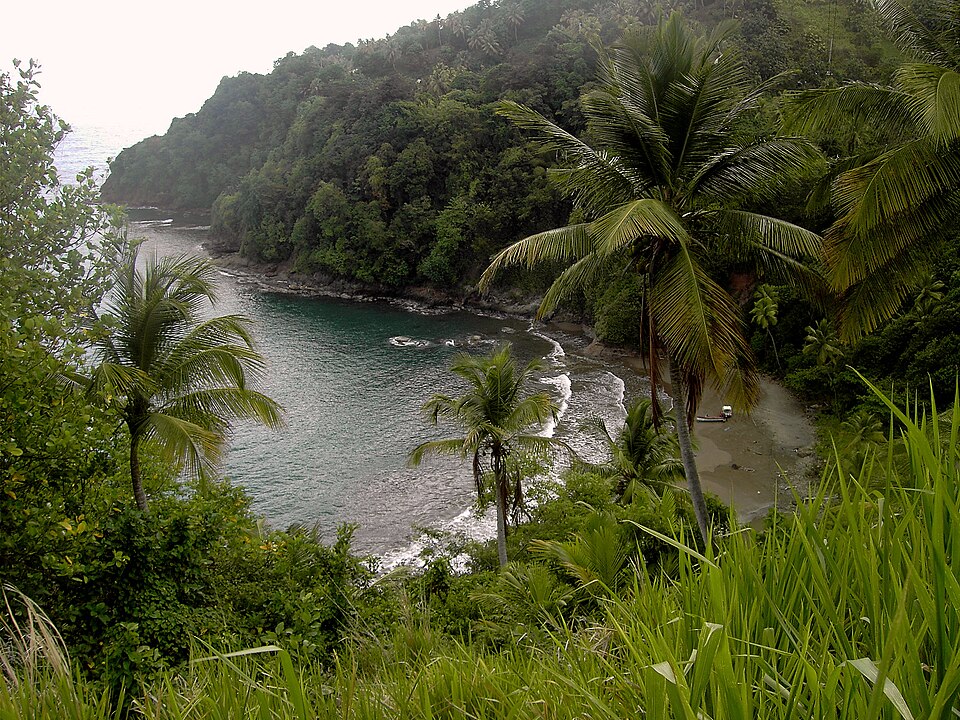
Photographer-identified territory landscape: forested coast, palms, water and a small boat. Precise cove, bank ownership, community activity and present ecological conditions unestablished; not a territorial map or all-Kalinago portrait.
Image, association, and reuse record reviewed 2026-10-28.
Full photographs are displayed proportionally above. A translucent background copy may be cropped by the viewport; it does not replace the complete image or its record.
The visual treatment does not change the research status, evidence, or remaining gaps recorded in this profile.
01
Identity and context
Kalinago people have enduring Caribbean histories and a contemporary territory and council in Dominica.
Focus the next stage of research on: Territorial history, community governance, publicly shared cultural resources and contemporary priorities. Government accounts should be paired with council and community voices. Start with the annotated sources and compare each publisher’s scope and perspective.
The government’s account traces its department to 2000 and a ministry change to 2005. Its coordinating role should be distinguished from the Kalinago Council and from the people themselves. Stated goals are not measured results.
The framework proposes participation, livelihood support and intergenerational knowledge work. It also describes institutional and geographic context. These are dated proposals and interpretations; this guide makes no finding of completed outcomes or collective consent.
The planning text distinguishes Atkinson from the Territory even though both fall within the ministry’s constituency work. Additional hamlet entries need comparison rather than an assumed match between political constituency, territory and Indigenous identity.
Prosper Paris’s Division of Culture article discusses language shift while documenting continuing place names and public vocabulary. The visitor-heritage website also presents language learning as an aspiration. Neither undated account is used here as a current fluency census, and language shift is not evidence that a people disappeared.
The visitor website presents storytelling, colonial displacement and living heritage in a first-person narrative. Its location list includes Atkinson, while the 2022planning framework explicitly distinguishes Atkinson from the Territory within a wider constituency. Readers should keep visitor narratives, political constituencies and territorial descriptions separate.
Grenada National Museum author J. Hanna cautions that colonial uses of “Carib” grouped different peoples together. His article compares historical naming with archaeological gaps and pottery interpretation. This Grenada-focused argument is a comparison route, not a definition of every Kalinago community or an automatic alias for a present government.
Community-authored histories and oral-history publications are still needed alongside government accounts.
Compare differing hamlet lists and spellings before adding individual village routes.
Underlying legislation, current statistics, implementation reports and collective consent were not assessed.
Add Council/community-authored historical works and independent scholarship.
Resolve conflicting hamlet/territorial lists before adding individual routes; no boundary inference.
Caribbean pilot: selected scope/date/access limits retained; supporting object/summary/event leads excluded from substantive counts. Supplementary work, not a completed20-profile cohort.
Follow the reading path
Sources & further reading
Open any title to read the original source. Annotations explain what each link can help you explore.
No Indigenous-led source is identified in this entry yet. This is a gap in this collection, and does not imply an absence of community knowledge or organization.
GovernmentGovernment of Dominica, Kalinago UpliftmentSource 1
The ministry describes its 2000 department and 2005 institutional change and its stated coordinating role. These are government accounts, distinct from a community-authored history.
Inspection: Content reviewed for the stated scope
Scope: Actual About body lines7–8,12–15,25–39: agency chronology, stated mission and coordination.
Review recorded: October 28, 2026
Access note: Staff/officeholder lists and claims of programme effectiveness excluded. Mission statements are intentions, not verified outcomes. No current census, tenure determination or legal advice.
The project framework distinguishes territory, ministry and local governance and sets participation and livelihood goals. It is a dated planning document, not proof those goals were achieved.
Inspection: Content reviewed for the stated scope
Scope: Selected actual PDF text: cover; pp5–6 project purpose/objectives; pp11–12 proposed livelihoods; pp15–16 institutional/geographic context; p25 selected planning-capacity discussion.
Review recorded: October 28, 2026
Access note: Printed pages are one ahead of zero-index PDF pages. Not all70 pages, annex interviews, maps, tables or underlying legislation inspected. Census numbers, tenure rules, precise boundaries, officeholder/gender assertions and consent/outcome claims excluded.
A short government explanation introduces Council and hamlet-committee structures. It is retained as supporting navigation rather than an extra full planning study.
Inspection: Supporting or limited review; see scope
Scope: Actual HTML body lines9–13, not its linked5.9MBPDF.
Review recorded: October 28, 2026
Access note: Government summary with legacy terminology. Linked full plan and current law not inspected; do not equate hamlets with separate nations or assume present committee activity.
A named author discusses language shift, continuing place names and public vocabulary. Its undated fluency descriptions are not a current speaker census.
Inspection: Content reviewed for the stated scope
Scope: Actual web-reader article body lines8–23, selected public vocabulary/place-name lists and byline102 read. Language-contact/heritage explanation and public introductory language route only. Normal HTTP 200 article HTML privately retained; publisher body and byline corroborated.
Review recorded: October 29, 2026
Access note: Actual web-reader body and a successful normal HTTP 200 article retrieval were inspected; no live-browser inspection claimed. No speaker totals, present fluency claims, categorical extinction narrative, entire-Caribbean renaming claim or identity test adopted. Vocabulary is a learning lead, not a verified grammar/orthography or copied dictionary.
A visitor-facing account presents storytelling, historical displacement and living heritage in first-person community language. Its institutional status and claims require contextual reading.
Inspection: Content reviewed for the stated scope
Scope: Actual body lines26–56 on storytelling/heritage and historical narrative read, plus explicitly compared location list82. NormalHTTP 200HTML privately cached; May22,2024 associated launch-post date visible, article itself undated.
Review recorded: October 29, 2026
Access note: Visitor-facing self-presentation, not independently verified Council/government authority or legal boundary. Current population/acreage/chief count, first-recognition claims, migration/origin chronology, restricted healing/creation details and language fluency claims excluded. Its inclusion of Atkinson conflicts with the inspected 2022planning framework’s Territory/constituency distinction; no hamlet route or boundary inferred.
The museum questions a simple invasion narrative and compares colonial labels with incomplete archaeological evidence. Its Grenada interpretation should be read alongside community histories.
Inspection: Content reviewed for the stated scope
Scope: Actual article opening, Mystery Pottery and Grenada comparison, web lines30–46;2021byline62 and reference metadata63–88. Not its linked books or primary records.
Review recorded: October 30, 2026
Access note: Author interpretation, not an official definition of every island community. No image,ceremony,precise-site/map reproduction,linguistic-family determination,current legal-status claim or universal ancestry/migration inference. Underlying historical sources and pottery identifications remain comparison tasks.
Related entries may represent alternate names, constituent communities, wider groupings, or historical connections. Read the naming notes before treating entries as equivalent.
Robey’s Atlas of Indigenous North America · Compiled October 19, 2026 · Kalinago