Karuk Tribe publications connect Klamath River stewardship with land history, museum and library work, and language learning. Their explanations offer linked starting points for understanding institutional continuity and community priorities, with legal records and current numerical claims still to inspect.
See each region’s evidence for historical or present-day scope.
Homeland / region
Klamath River, California
Research depth
Source guide
Source collection
3 annotated resources · 3 Indigenous-led
Inspected sources
3 substantive works · selected content reviewed
Initial adequacy
Still unfinished
Source review
October 28, 2026
A source guide for a deeper dive.This entry provides a brief orientation and an organized reading path. A comprehensive deep dive has not yet been completed. Follow the annotated sources and distinguish primary community accounts from outside reference material.
Still unfinished
A bounded actual-content starting path and specifically scoped credited picture are available. Fuller history, source comparison and community review remain open; quantity does not establish completion.
Assessment recorded October 28, 2026. This is separate from research completion and community review.
Add community-directed historical scholarship and inspect selected underlying treaty and land records before extending precise chronology or legal claims.
Review individual public language resources and culturally appropriate archive access protocols; public links are not blanket access or image permission.
Backdrop photographs & credits
These photographs have individual, documented connections to this entry. Their captions and source records define the people, place, object, and period shown; no one photograph represents every community within a broader label.
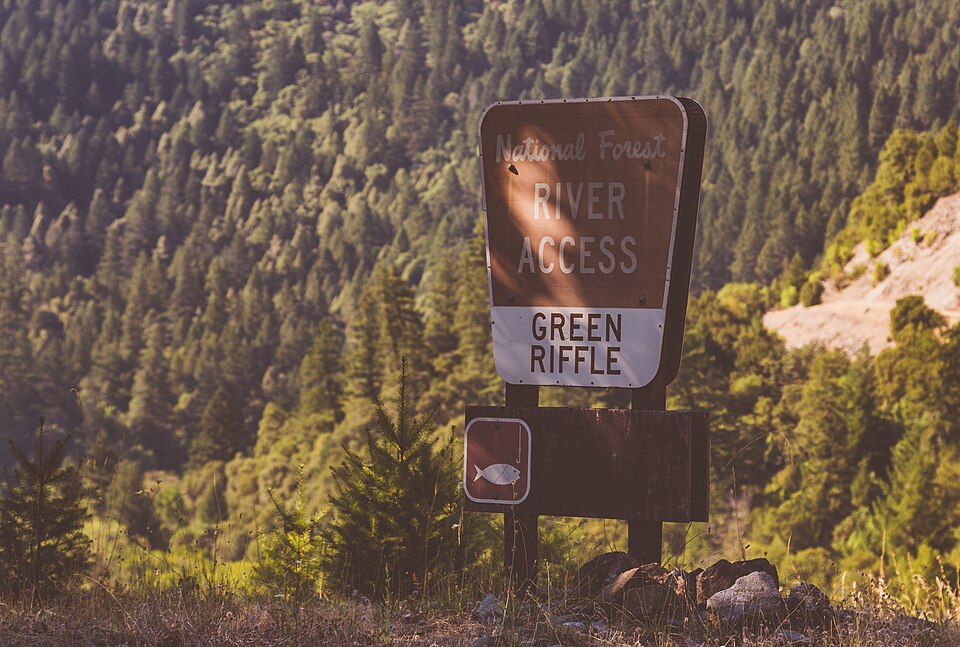
Green Riffle river-access sign, Klamath River setting Tony Webster / Wikimedia Commons. CC BY-SA 2.0.
A dated public river-access sign and wooded hillside, labelled near Happy Camp in the item; the river is not visible. The Tribe’s land-management account specifically discusses the middle Klamath River and community properties in Orleans and Happy Camp. This provides regional landscape context, not a photograph of Karuk people, Tribe-owned facilities, a tribal environmental project or a territorial boundary. The sign’s information is not verified as current access guidance. Complete available retrieved JPEG imported unchanged. Background/card CSS crops and overlays affect presentation; the opened page retains the complete available frame proportionally.
Image, association, and reuse record reviewed 2026-10-28.
Full photographs are displayed proportionally above. A translucent background copy may be cropped by the viewport; it does not replace the complete image or its record.
The visual treatment does not change the research status, evidence, or remaining gaps recorded in this profile.
Start reading here
A short purposeful path through selected actual-content works. Read annotations for community, period and inspection limits; this is not a complete history or community endorsement.
The Tribe describes elder-led learning, school partnerships, youth work and digital resources as parts of language revitalization.
These are selected starting points. The full annotated collection, source perspectives, inspection limits and remaining research questions follow below. A starting guide is not an exhaustive history or community endorsement.
01
Identity and homelands
Karuk homelands center on the middle Klamath River in northwestern California. River relationships and environmental stewardship remain central.
The Tribe’s land-management account links care for the middle Klamath River region with the effects of unratified California treaties and later federal land policies. It also describes community purchases in Orleans and Happy Camp and continuing land-management work. These are the Tribe’s historical interpretations and responsibilities; exact ownership, acreage and jurisdiction require their own records.
The People’s Center presents its museum, community library, archives and learning spaces as connected parts of cultural work. Its account emphasizes Native interpretation and the continuing practice of Karuk arts and history. A public display or programme description does not itself license reproduction of an object, and the page’s paused weaving classes are not advertised here as currently running.
The Language Program describes classes, elder-led learning, youth activities, school partnerships and digital resources. It also connects language support with signs and public communications. These are the programme’s stated approaches to revitalization, rather than a measured claim of fluency outcomes or a guarantee that every linked resource is currently available.
Add community-directed historical scholarship and inspect selected underlying treaty and land records before extending precise chronology or legal claims.
Review individual public language resources and culturally appropriate archive access protocols; public links are not blanket access or image permission.
Cohort11: selected actual-content reviews preserve their institutional/community scope. Existing source cards are upgraded at the same ID and URL where noted; repeated publications are not globally new works.
Follow the reading path
Sources & further reading
Open any title to read the original source. Annotations explain what each link can help you explore.
No Indigenous-led source is identified in this entry yet. This is a gap in this collection, and does not imply an absence of community knowledge or organization.
The Tribe connects middle-Klamath stewardship with unratified treaties, federal land policies and community efforts to regain properties. This is its historical and institutional account, not an independent title determination.
Inspection: Content reviewed for the stated scope
Scope: Mission and History units, including 1851, 1905 and Today timeline entries, before Maps; programme FAQs also read. Maps, linked legal documents and current acreage figures not adopted.
Review recorded: October 28, 2026
Access note: Normal public HTTP 200 prose read. Treaty texts, allotment records, title deeds, service maps and administrative files uninspected. No exact homeland acreage, present ownership, trust status, jurisdiction or legal conclusion independently established; historical wording remains attributed to the Tribe.
The Karuk People’s Center presents museum interpretation, a community library, archival work and cultural learning together. It emphasizes Native interpretation and continuing cultural practice.
Inspection: Content reviewed for the stated scope
Scope: Opening September 2002 institutional paragraph, Karuk Museum, public basket-weaving programme description and Dugout Canoe Exhibit, before Gift Shop. Class scheduling and private contact details not adopted.
Review recorded: October 28, 2026
Access note: Normal public HTTP 200 body read. No museum interiors, objects, regalia, collection records or archive items inspected; public display does not supply image or cultural-object reproduction rights. The page says weaving classes are paused, so no currently running schedule is asserted.
The Tribe describes elder-led learning, school partnerships, youth work and digital resources as parts of language revitalization. These are the programme’s stated activities and aims.
Inspection: Content reviewed for the stated scope
Scope: Main introduction, mission, Services Provided, Language Materials and public FAQs before Contact Department. Leadership paragraph read only to identify programme settings; no personal contacts published.
Review recorded: October 28, 2026
Access note: Normal public HTTP 200 body read. Linked dictionaries, recordings, apps, teaching materials and event schedules not individually inspected. Undated fluent-speaker totals are not adopted. No claim that every listed goal or resource is currently available or produces a measured outcome.
These collections preserve links from supplied studies and further research leads. The collection notes explain their provenance and review status. Links already used above point to their source cards. Supporting references and unread leads are excluded from the substantive inspected-source count.
Klamath and Salmon River War of 1855 and its aftermath · 14 links
A regional historical topic linked here for Karuk, Yurok, and Hupa context. The Klamath River is a place name here; this is not a study of the Klamath people of Oregon. Relevance must be assessed source by source.