Klamath people are one constituent of the Klamath Tribes alongside Modoc and Yahooskin-Paiute people. These readings connect the shared government’s history of termination and restoration with distinct language work and a dated report on control of tribal funds.
See each region’s evidence for historical or present-day scope.
Homeland / region
Klamath Basin, Oregon / California
Research depth
Source guide
Source collection
4 annotated resources · 4 Indigenous-led
Inspected sources
3 substantive works · selected content reviewed
Initial adequacy
Still unfinished
Source review
October 28, 2026
A source guide for a deeper dive.This entry provides a brief orientation and an organized reading path. A comprehensive deep dive has not yet been completed. Follow the annotated sources and distinguish primary community accounts from outside reference material.
Still unfinished
A bounded actual-content starting path and specifically scoped credited picture are available. Fuller history, source comparison and community review remain open; quantity does not establish completion.
Assessment recorded October 28, 2026. This is separate from research completion and community review.
Read more Klamath-authored scholarship and separately scoped Modoc/Yahooskin-Paiute histories.
Inspect original treaty, termination/restoration and judgment-fund records before legal interpretation.
Review actual public language-learning materials and current programme access separately.
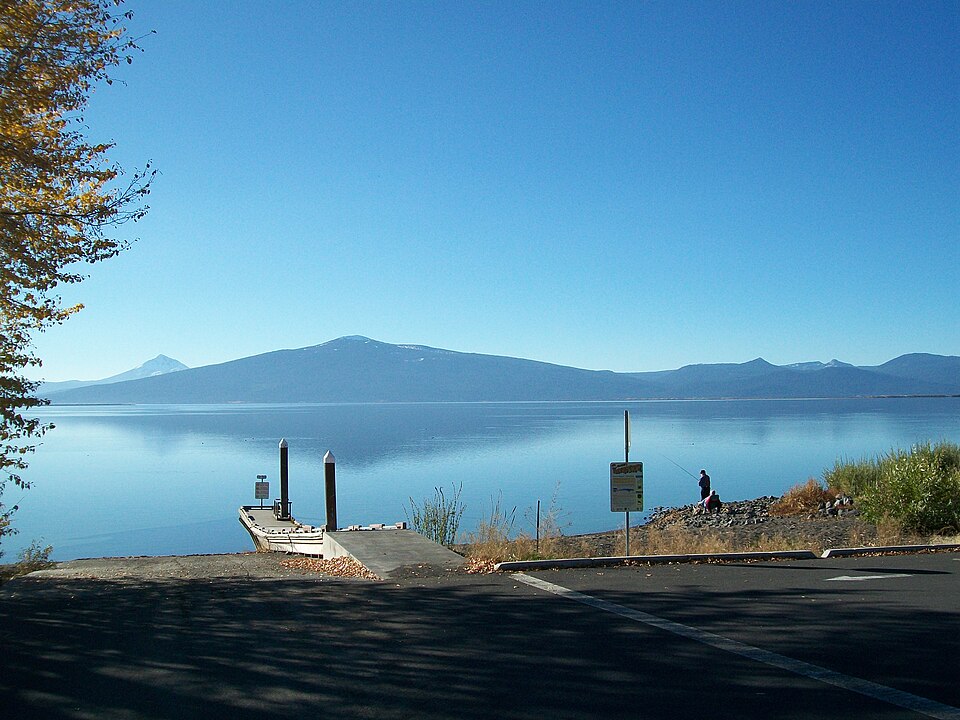
Agency Lake is a named modern regional example, not an exact former village or current boundary;caption/EXIF day conflict remains disclosed.
Backdrop photographs & credits
These photographs have individual, documented connections to this entry. Their captions and source records define the people, place, object, and period shown; no one photograph represents every community within a broader label.
Agency Lake, Oregon Bobjgalindo / Wikimedia Commons — CC BY-SA 4.0
Agency Lake is specifically named in the Klamath Tribes’ historical account. Modern regional view with dock/landscape, not a confirmed village, all constituent peoples or territorial boundary. SummarydateNovember3, 2010 differs from EXIFNovember2; exact day unresolved. Small unidentifiable shore figures are incidental; no community identity or activity is inferred. Complete available retrieved JPEG imported unchanged. Background/card CSS crops and overlays affect presentation; the opened page retains the complete available frame proportionally.
Image, association, and reuse record reviewed 2026-10-28.
Full photographs are displayed proportionally above. A translucent background copy may be cropped by the viewport; it does not replace the complete image or its record.
The visual treatment does not change the research status, evidence, or remaining gaps recorded in this profile.
Start reading here
A short purposeful path through selected actual-content works. Read annotations for community, period and inspection limits; this is not a complete history or community endorsement.
Read a specific reported post-restoration policy question with legal limits visible.
These are selected starting points. The full annotated collection, source perspectives, inspection limits and remaining research questions follow below. A starting guide is not an exhaustive history or community endorsement.
01
Identity and homelands
Klamath people are one component of the Klamath Tribes, alongside Modoc and Yahooskin Paiute people.
The history page identifies Klamath, Modoc and Yahooskin-Paiute as constituent peoples. Its account links their communities with the Klamath Basin while naming different historical places. This Klamath route introduces one constituent people through shared-government sources; it does not turn Modoc or Yahooskin-Paiute into alternative Klamath names.
The Language Department describes older dictionaries, community-led booklets and teaching, including a distinct Yahooskin Paiute documentation effort. It dates a dedicated department to 2022 and explains remote and intergenerational learning aims. These are the department’s reported history and methods, not an independent assessment of current fluency or learner outcomes.
The history page recounts termination and restoration. A separate tribal report explains why termination-era rules continued to affect judgment funds and describes advocacy for 2022 repeal legislation. Reading both shows why recognition and control of particular resources require distinct histories; the report does not settle anyone’s current payment eligibility.
Read more Klamath-authored scholarship and separately scoped Modoc/Yahooskin-Paiute histories.
Inspect original treaty, termination/restoration and judgment-fund records before legal interpretation.
Review actual public language-learning materials and current programme access separately.
Agency Lake is a named modern regional example, not an exact former village or current boundary;caption/EXIF day conflict remains disclosed.
Cohort11: selected actual-content reviews preserve their institutional/community scope. Existing source cards are upgraded at the same ID and URL where noted; repeated publications are not globally new works.
Follow the reading path
Sources & further reading
Open any title to read the original source. Annotations explain what each link can help you explore.
No Indigenous-led source is identified in this entry yet. This is a gap in this collection, and does not imply an absence of community knowledge or organization.
The Tribes identifies Klamath, Modoc and Yahooskin-Paiute constituents and recounts reservation change, termination opposition and restoration. The Klamath people label is distinct from the whole government.
Inspection: Content reviewed for the stated scope
Scope: Actual full historical body read. Synthesis selects constituent names, nonceremonial Agency Lake/waterway paragraph and nineteenth/twentieth-century termination/restoration account. Creation/ceremony narratives not republished.
Review recorded: October 28, 2026
Access note: Actual selected public content read on 2026-10-28 through normalHTTP200, ordinary web reader or stated PDF pages. No access bypass or outreach. Linked originals, recordings, images and full collections were not automatically reviewed or licensed. NormalHTTP200 HTML. Historic economic superlatives, acreage and current legal-rights claims not adopted. Underlying 1864 treaty, statutes, judgments and linked Modoc history uninspected.
The department’s historical account connects older linguistic documentation, community teaching and the creation of a dedicated department. It explicitly distinguishes the Tribes’ different language traditions.
Inspection: Content reviewed for the stated scope
Scope: Actual complete Our Language Story body: early dictionaries, Yahooskin phrasebook, community-led teaching, 2022 department and described training/remote learning. Service list read for context; materials not obtained.
Review recorded: October 28, 2026
Access note: Actual selected public content read on 2026-10-28 through normalHTTP200, ordinary web reader or stated PDF pages. No access bypass or outreach. Linked originals, recordings, images and full collections were not automatically reviewed or licensed. NormalHTTP200 HTML despite a web-reader timeout. No underlying dictionaries, phrasebooks, lessons, recordings or naming services inspected. Undated class/service availability and measured fluency outcomes not established.
A tribal report explains why control of older judgment funds remained an issue after restoration and describes the 2022 repeal legislation. Its interpretation remains attributed; it is not personal distribution or legal advice.
Inspection: Content reviewed for the stated scope
Scope: Complete actual article body: reportedDecember21, 2022 signing of S314, termination-era fund history, restoration and advocacy for changing the distribution framework. Linked full press release not separately counted.
Review recorded: October 28, 2026
Access note: Actual selected public content read on 2026-10-28 through normalHTTP200, ordinary web reader or stated PDF pages. No access bypass or outreach. Linked originals, recordings, images and full collections were not automatically reviewed or licensed. NormalHTTP200 HTML. Publication date not established beyond reported 2022 event; original statute, litigation, individual eligibility, distribution status and financial outcomes unreviewed.
Related entries may represent alternate names, constituent communities, wider groupings, or historical connections. Read the naming notes before treating entries as equivalent.
Robey’s Atlas of Indigenous North America · Compiled October 19, 2026 · Klamath