Makah Tribe publications offer a starting path through coastal village life, maritime knowledge and the Makah Cultural and Research Center. The historical account and museum introduction connect living community interpretation with material recovered at Ozette; fuller archaeology and individual objects require separate review.
See each region’s evidence for historical or present-day scope.
Homeland / region
Cape Flattery / Neah Bay, Washington
Research depth
Source guide
Source collection
3 annotated resources · 2 Indigenous-led
Inspected sources
2 substantive works · selected content reviewed
Initial adequacy
Still unfinished
Source review
October 28, 2026
A source guide for a deeper dive.This entry provides a brief orientation and an organized reading path. A comprehensive deep dive has not yet been completed. Follow the annotated sources and distinguish primary community accounts from outside reference material.
Still unfinished
A bounded actual-content starting path and specifically scoped credited picture are available. Fuller history, source comparison and community review remain open; quantity does not establish completion.
Assessment recorded October 28, 2026. This is separate from research completion and community review.
Read selected community-approved archaeological and language publications; no excavation report or individual museum object was reviewed here.
Keep museum interpretation and current political/legal questions distinct.
Backdrop photographs & credits
These photographs have individual, documented connections to this entry. Their captions and source records define the people, place, object, and period shown; no one photograph represents every community within a broader label.
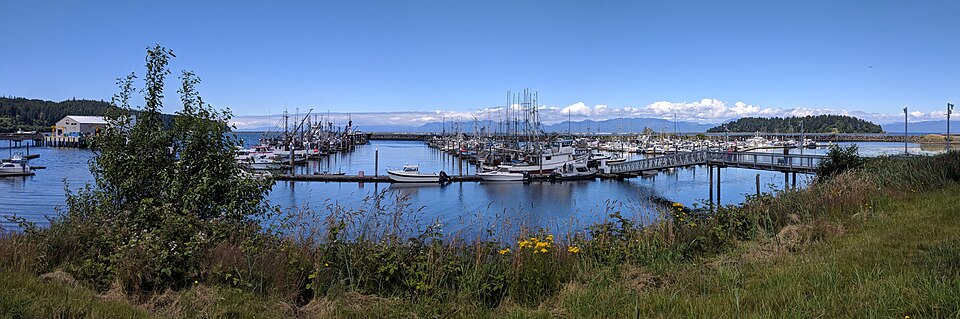
Makah Marina at Neah Bay,2018 Dicklyon / Wikimedia Commons. CC BY-SA 4.0.
A panoramic view of the specifically named Makah Marina at Neah Bay. The Tribe’s history identifies Neah Bay as one Makah village context. This does not depict all Makah citizens, every village, a legal boundary or current marina operation. Complete available retrieved JPEG imported unchanged. Background/card CSS crops and overlays affect presentation; the opened page retains the complete available frame proportionally.
Image, association, and reuse record reviewed 2026-10-28.
Full photographs are displayed proportionally above. A translucent background copy may be cropped by the viewport; it does not replace the complete image or its record.
The visual treatment does not change the research status, evidence, or remaining gaps recorded in this profile.
Start reading here
A short purposeful path through selected actual-content works. Read annotations for community, period and inspection limits; this is not a complete history or community endorsement.
Continue with its museum introduction and Ozette interpretation.
These are selected starting points. The full annotated collection, source perspectives, inspection limits and remaining research questions follow below. A starting guide is not an exhaustive history or community endorsement.
01
Identity and homelands
Makah homelands lie around Cape Flattery and Neah Bay, with a strong relationship to the sea and its resources.
The International Whaling Commission’s account details the cultural and nutritional importance of whaling and the Treaty of Neah Bay’s reserved rights.
The Tribe’s historical account describes permanent shore villages and seasonal movements connected with fishing and gathering. It explains that cedar canoes served different purposes, including transport and several kinds of marine harvesting. This community-authored description connects maritime skill with everyday and extended-family life without reducing Makah history to one activity.
The Tribe presents the Makah Cultural and Research Center as a place to learn from material recovered at the Ozette village site. Its account distinguishes archaeological belongings from historic material and replicas used in interpretation. This is a useful introduction to community-led presentation; the excavation record and each displayed object need their own reading and reuse checks.
Read selected community-approved archaeological and language publications; no excavation report or individual museum object was reviewed here.
Keep museum interpretation and current political/legal questions distinct.
Cohort09: selected actual-content reviews preserve their institutional/community scope. Existing source cards are upgraded at the same ID and URL where noted; repeated publications are not globally new works.
Follow the reading path
Sources & further reading
Open any title to read the original source. Annotations explain what each link can help you explore.
No Indigenous-led source is identified in this entry yet. This is a gap in this collection, and does not imply an absence of community knowledge or organization.
The Tribe describes coastal villages, seasonal movement and the practical diversity of canoes. Begin with its account of relationships between sea, land and family life.
Inspection: Content reviewed for the stated scope
Scope: Complete public historical body under Makah Tribe history, Makah Tribe Villages, and Ecological Practices & Mariner Skills; web lines 37–47. Navigation, photographs and later linked subjects are not source readings.
Review recorded: October 28, 2026
Access note: Actual HTML body read normally. No underlying archaeological reports, oral-history recordings, maps, present boundary or contemporary population figures checked. This is the Tribe’s own historical synthesis; no universal clothing, ceremony or art-reproduction permission inferred.
The Tribe explains how its museum interprets material recovered at Ozette, including the difference between recovered belongings, historic material and replicas. Individual collection objects need their own study and permissions.
Inspection: Content reviewed for the stated scope
Scope: Complete substantive museum-introduction and Visiting the Museum paragraphs, web lines 37–42, plus the historical opening-year statement at 46. Admission and operating information were not adopted.
Review recorded: October 28, 2026
Access note: Actual public HTML prose read; no gallery images copied, linked Ozette site publication read, original excavation report checked, or present hours verified. The interpretation is the Tribe’s visitor-facing museum account. The stated archaeological dating is attributed, not independently redated.
Related entries may represent alternate names, constituent communities, wider groupings, or historical connections. Read the naming notes before treating entries as equivalent.
Robey’s Atlas of Indigenous North America · Compiled October 19, 2026 · Makah