Mopan Maya communities in Guatemala and Belize have connected but locally distinct histories. A San Luis municipal account and the Julian Cho Society’s biography introduce place, education and organizing; the Toledo court record concerns specifically scoped land-rights litigation.
See each region’s evidence for historical or present-day scope.
Homeland / region
Central America / Belize / Guatemala
Research depth
Source guide
Source collection
7 annotated resources · 2 Indigenous-led
Inspected sources
4 substantive works · selected content reviewed
Initial adequacy
Still unfinished
Source review
October 29, 2026
A source guide for a deeper dive.This entry provides a brief orientation and an organized reading path. A comprehensive deep dive has not yet been completed. Follow the annotated sources and distinguish primary community accounts from outside reference material.
Still unfinished
Selected actual-content sources and a specifically scoped credited image provide a starting route. Fuller histories and comparison remain open; quantity does not establish completion or endorsement.
Assessment recorded October 29, 2026. This is separate from research completion and community review.
Inspect Mopan-language educational works and community histories on both sides of the border.
Reconcile migration chronologies with attributed oral histories and primary records.
Existing Glottolog and Missouri reading leads were not inspected here and do not fill substantive counts.
Backdrop photographs & credits
These photographs have individual, documented connections to this entry. Their captions and source records define the people, place, object, and period shown; no one photograph represents every community within a broader label.
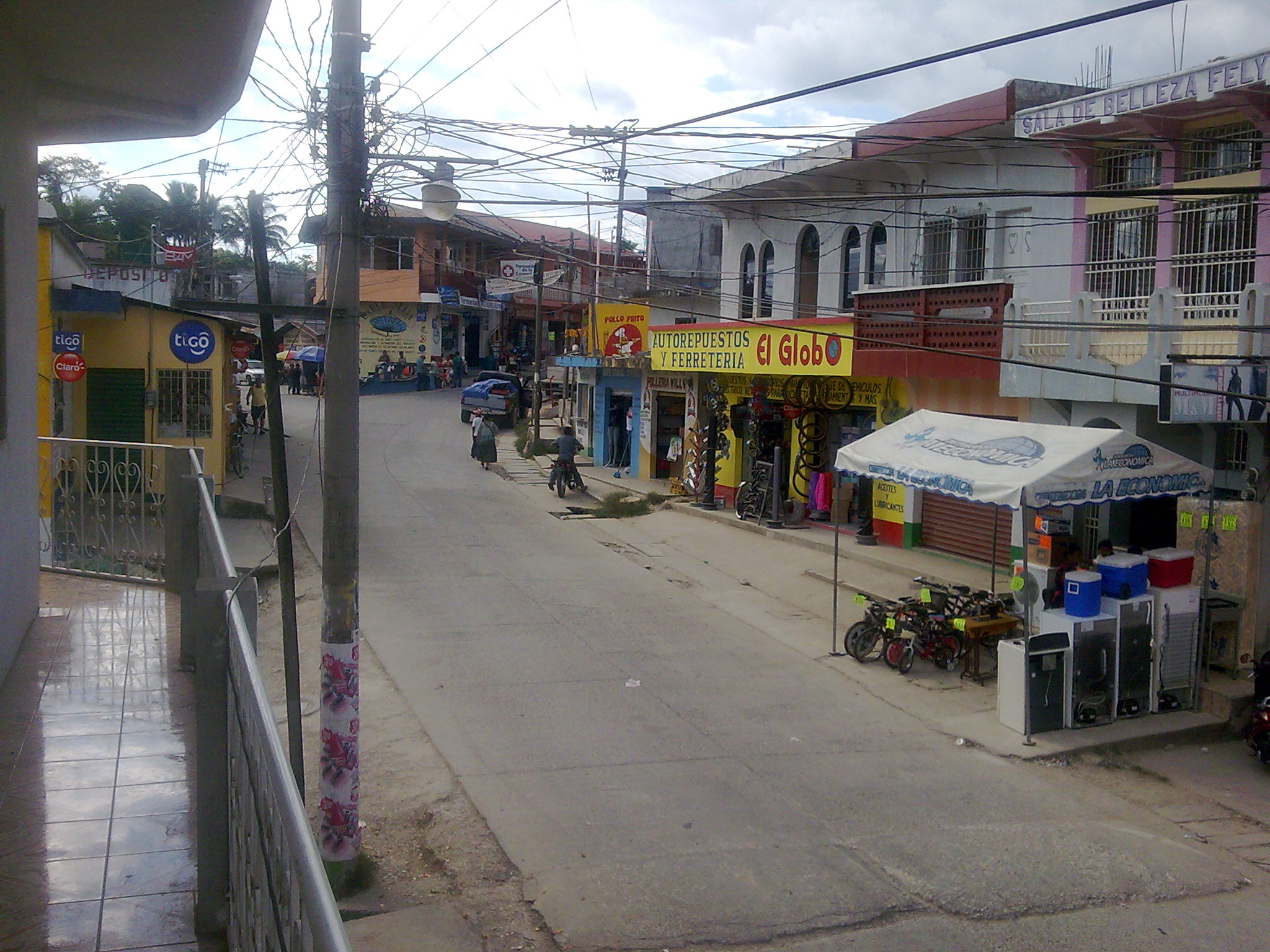
Main street in central San Luis, Petén, Guatemala Danny Hernández / Wikimedia Commons · Photographer’s public-domain dedication
A shared modern public-town setting in San Luis, Petén. The municipality’s historical account specifically connects San Luis with Mopan communities and explicitly acknowledges Q’eqchi’ and Ladino communities too. This does not identify the incidental people as Mopan or establish an exclusively Mopan neighborhood, practice, property or territory. The municipal history alone is insufficient to assign this particular downtown scene to Q’eqchi’ as an additional specific-community image.
Image, association, and reuse record reviewed 2026-10-29.
Full photographs are displayed proportionally above. A translucent background copy may be cropped by the viewport; it does not replace the complete image or its record.
The visual treatment does not change the research status, evidence, or remaining gaps recorded in this profile.
01
Identity and context
Mopan Maya communities have homelands in Belize and Guatemala.
Focus the next stage of research on: Mopan language, local histories, contemporary education and the wider Maya context. The sources below are selected reading paths; their authorship, dates and community scope should guide how they are used.
San Luis’s municipal history identifies Mopan communities in southeastern Petén. It attributes a recollection of families seeking refuge in Belize from forced labor. Its chronology is not adopted as the single account of all Mopan migration, and the municipality also includes other peoples.
The Julian Cho Society identifies Cho as a Mopan Maya educator from San José, Toledo. Its commemorative biography connects teaching with his work in the Toledo Maya Cultural Council and the Maya Atlas. The account is attributed to the organization; speculation about his death is excluded.
The 2015 Caribbean Court of Justice judgment identifies Mopan and Q’eqchi’ appellants and reproduces a consent order protecting customary land tenure in Toledo villages. It should be read as a particular legal record, not a boundary map or proof of present implementation everywhere.
The Cultural Conservancy’s 2018–2019 House of Weavers account names partner villages and several craft activities. It describes a planned collaborative programme, rather than a uniform Mopan tradition or independently verified income results.
Inspect Mopan-language educational works and community histories on both sides of the border.
Reconcile migration chronologies with attributed oral histories and primary records.
Existing Glottolog and Missouri reading leads were not inspected here and do not fill substantive counts.
Follow the reading path
Sources & further reading
Open any title to read the original source. Annotations explain what each link can help you explore.
No Indigenous-led source is identified in this entry yet. This is a gap in this collection, and does not imply an absence of community knowledge or organization.
Historical context for this entry. Read “Glottolog 5.3 - Mopan” with attention to the author, period covered, and communities named; compare with community-published accounts where available.
Inspection: Content review not recorded
Scope: Retained legacy reading lead; no substantive actual-content inspection in this bounded pass.
Access recorded: October 19, 2026
Access note: Original URL and ID retained. Unread full work, directory or other lead does not fill the substantive target.
Historical context for this entry. Read “1. Description” with attention to the author, period covered, and communities named; compare with community-published accounts where available.
Inspection: Content review not recorded
Scope: Retained legacy reading lead; no substantive actual-content inspection in this bounded pass.
Access recorded: October 19, 2026
Access note: Original URL and ID retained. Unread full work, directory or other lead does not fill the substantive target.
A municipal history connects San Luis with Mopan communities and attributes an account of migration under forced labor.
Inspection: Content reviewed for the stated scope
Scope: Actual four-page PDF, selected pages1–2 history and attributed recollection; page4 final identification of Mopan, Q’eqchi’ and Ladino residents. Normal HTTP200 PDF retained.
Review recorded: October 29, 2026
Access note: The document juxtaposes differing foundation/migration chronologies and oral accounts. Exact dates, etymology, population estimates, ceremonial procedures and universal customs not adopted; municipal identity is not the same as a people. No linked media, cited underlying works, or additional publications automatically inspected. No outreach or access bypass.
The Society’s biography follows a named Mopan educator and his work with Maya organizations and land documentation.
Inspection: Content reviewed for the stated scope
Scope: Actual indexed biography: San José/Toledo Mopan identification; education and teaching; TMCC role, organizing and Maya Atlas discussion.
Review recorded: October 29, 2026
Access note: Normal direct request406 was stopped; indexed primary body read. Commemorative perspective is attributed. Speculation surrounding Cho’s death, universal representation and current officeholders not adopted. No linked media, cited underlying works, or additional publications automatically inspected. No outreach or access bypass.
The court distinguishes the appeal, the parties’ settlement and the constitutional protection of Maya customary land tenure in Toledo.
Inspection: Content reviewed for the stated scope
Scope: Actual PDF pages 2–6, paragraphs 1–9 and consent-order clauses 1–4, read through the web reader.
Review recorded: October 29, 2026
Access note: Normal local retrieval failed certificate validation and was stopped; web-reader actual PDF text was inspected. This is the 2015 decision, not verification of present implementation or a title/boundary determination for every Maya person. No linked media, cited underlying works, or additional publications automatically inspected. No outreach or access bypass.
A grant account names Q’eqchi’ and Mopan partners and describes six-village work in weaving, basketry, carving and clothing.
Inspection: Content reviewed for the stated scope
Scope: Actual main body: Julian Cho Society/Maya Leaders Alliance partnership, 2018–2019 grant period, six-village project paragraph and named craft activities. Normal HTTP200 body also retained.
Review recorded: October 29, 2026
Access note: A dated project proposal/account, not verified outcomes or permission to reproduce its photographs. No craft is assigned to every member of either people. No linked media, cited underlying works, or additional publications automatically inspected. No outreach or access bypass.
A brief university account describes youth learning interviewing and digital-media research with the Julian Cho Society.
Inspection: Supporting or limited review; see scope
Scope: Actual June 20, 2023 page body: two project/training paragraphs and stated research goals read through indexed web content.
Review recorded: October 29, 2026
Access note: Local request failed certificate validation and was stopped. Brief programme report excluded from substantive-work count; no outcomes or current programme continuity verified. No linked media, cited underlying works, or additional publications automatically inspected. No outreach or access bypass.
Related entries may represent alternate names, constituent communities, wider groupings, or historical connections. Read the naming notes before treating entries as equivalent.
Robey’s Atlas of Indigenous North America · Compiled October 19, 2026 · Mopan Maya