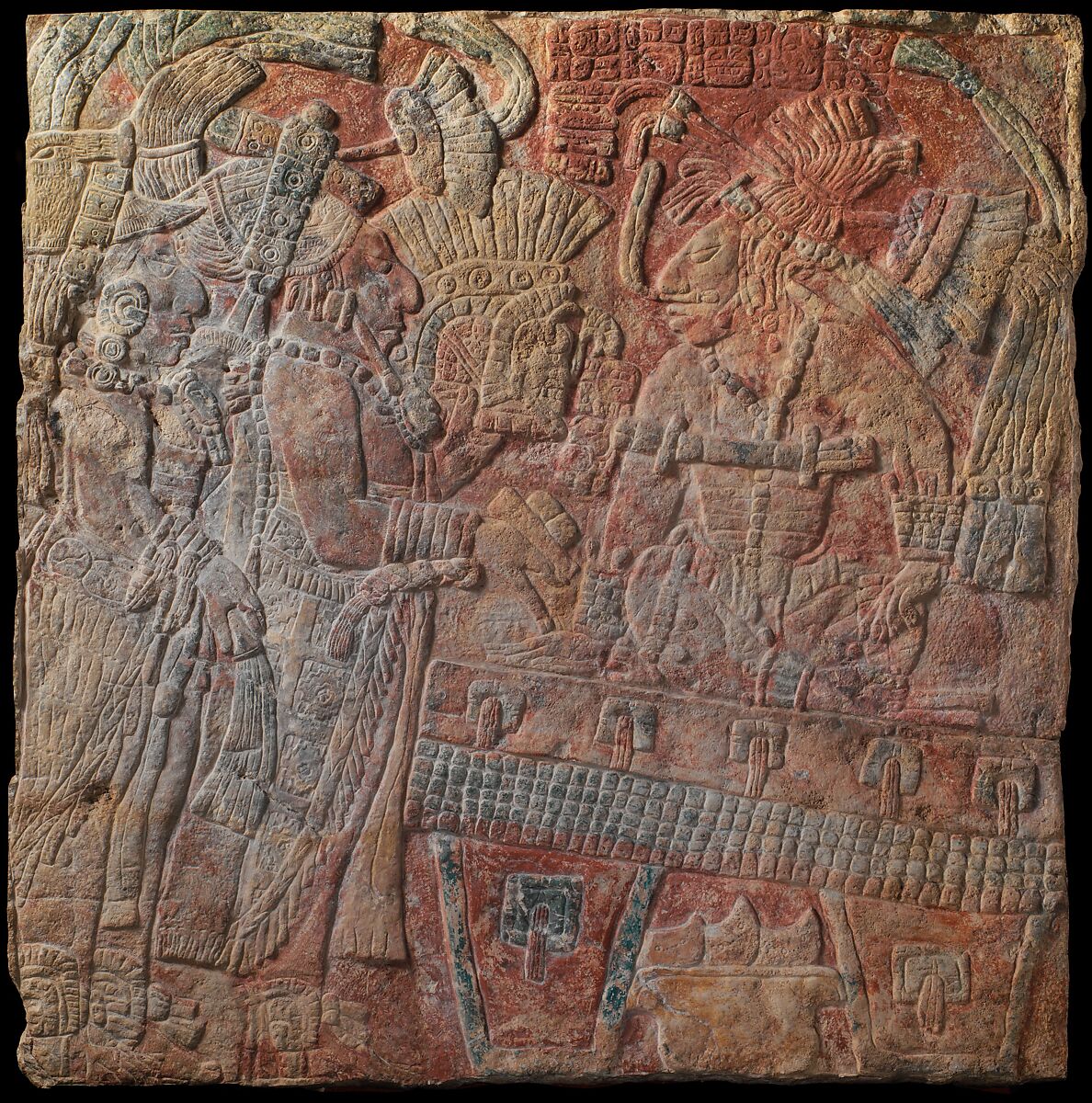
Relief with enthroned ruler, Chakalte’,770 CEChakalte’, Relief with enthroned ruler,770 CE, La Pasadita, Guatemala. The Metropolitan Museum of Art, The Michael C. Rockefeller Memorial Collection, Bequest of Nelson A. Rockefeller,1979, object 1979.206.1047. Open Access / CC0.
Maya is a broad route connecting many living peoples, languages and communities across Mesoamerica and beyond. Archaeology, a contemporary Maya organization and research on forest gardening offer different educational perspectives; none replaces an individual community’s history.
See each region’s evidence for historical or present-day scope.
Homeland / region
Southern Mexico / Guatemala / Belize / Honduras / El Salvador
Research depth
Source guide
Source collection
8 annotated resources · 2 Indigenous-led
Inspected sources
6 substantive works · selected content reviewed
Initial adequacy
Still unfinished
Source review
October 30, 2026
A source guide for a deeper dive.This entry provides a brief orientation and an organized reading path. A comprehensive deep dive has not yet been completed. Follow the annotated sources and distinguish primary community accounts from outside reference material.
Still unfinished
A bounded actual-content source guide and specifically scoped credited image are available. Fuller history and community/source comparison remain open; quantity does not establish completion or endorsement.
Assessment recorded October 29, 2026. This is separate from research completion and community review.
Add individual community-published educational works and distinct historical periods.
Compare further archaeological and environmental interpretations, without a single collapse explanation.
Inspect the legacy ALMG directory separately; it remains a reading lead rather than a substantive source.
Backdrop images & credits
These images have individual, documented connections to this entry. Their captions and source records define the people, place, object, and period shown; no one image represents every community within a broader label.
Relief with enthroned ruler, Chakalte’,770 CE Chakalte’, Relief with enthroned ruler,770 CE, La Pasadita, Guatemala. The Metropolitan Museum of Art, The Michael C. Rockefeller Memorial Collection, Bequest of Nelson A. Rockefeller,1979, object 1979.206.1047. Open Access / CC0.
One Classic-period Maya royal artwork from La Pasadita, Guatemala, signed by the named sculptor Chakalte’. Connected only to the broad historical Maya route, not assigned to Itza’, Mopan, Q’eqchi’ or modern Yucatec communities. No present identity, membership, universal design or government endorsement inferred. Complete delivered 1188×1200 source frame viewed; black surrounding field is part of the delivered image.
Image, association, and reuse record reviewed 2026-10-29.
Full images are displayed proportionally above. A translucent background copy may be cropped by the viewport; it does not replace the complete image or its record.
The visual treatment does not change the research status, evidence, or remaining gaps recorded in this profile.
01
Identity and homelands
Maya is an umbrella identity encompassing many living peoples, languages, communities, and political histories across Mesoamerica.
Smithsonian’s Living Maya Time connects ancient intellectual traditions with present-day Maya voices, rather than treating Maya history as a vanished civilization.
ALMG’s community directory opens routes to specific language communities. Study Itza’, Ixil, Mam, K’iche’, Mopan, and other peoples separately as well.
Robert Sharer’s archaeological overview distinguishes Preclassic, Classic and Postclassic histories and multiple independent kingdoms. It also warns that elite monuments dominate the surviving written evidence. The fall of particular cities or courts should not be read as disappearance of Maya peoples.
The International Maya League describes cultural transmission, intergenerational work and connections across borders as organizational priorities. These are its stated aims, not proof of measured outcomes or a claim that one organization speaks for every Maya community.
UCSB’s MesoAmerican Research Center describes milpa as intercropping connected to managed regrowth and forest gardening. Its model directs attention to a changing landscape rather than only to a freshly planted field. Local farming histories and conditions require separate study.
James Doyle’s Met essay identifies Chakalte’ as the sculptor of a limestone relief from La Pasadita, dated around770 CE. The work belongs to a particular royal setting associated with Yaxchilan. It is presented here as one historical artwork, rather than a motif shared by all Maya communities.
Smithsonian’s Living Maya Time distinguishes the 365-day Haab, the 260-day Tzolk’in and their interlocking Calendar Round from the Long Count. Its arithmetic provides a public educational starting point; it does not establish one present practice for all Maya communities or validate a particular date-conversion app.
Michael D. Carrasco argues that repeated and framing structures in Maya narrative can work together with imagery and architectural setting. His approach encourages readers to consider a composition’s whole context instead of extracting isolated symbols. This is an attributed scholarly interpretation, not a universal meaning assigned to every Maya artwork.
Add individual community-published educational works and distinct historical periods.
Compare further archaeological and environmental interpretations, without a single collapse explanation.
Inspect the legacy ALMG directory separately; it remains a reading lead rather than a substantive source.
Follow the reading path
Sources & further reading
Open any title to read the original source. Annotations explain what each link can help you explore.
No Indigenous-led source is identified in this entry yet. This is a gap in this collection, and does not imply an absence of community knowledge or organization.
Museum / archiveSmithsonian National Museum of the American IndianSource 1Supporting reference · outside substantive inspected count
A brief introduction includes a named Yucatec Maya contributor and emphasizes living communities.
Inspection: Supporting or limited review; see scope
Scope: Actual indexed introductory body and José Huchim Herrera attribution.
Review recorded: October 29, 2026
Access note: Normal direct request returned403 and was stopped; indexed primary body read. Brief gateway excluded from substantive counts; video unviewed, demographic totals not adopted. No linked media, cited underlying works, or additional publications automatically inspected. No outreach or access bypass.
An archaeological overview distinguishes multiple periods and kingdoms and emphasizes continuing Maya peoples.
Inspection: Content reviewed for the stated scope
Scope: Actual article body: periodization, agriculture and independent polities; final discussion of elite bias in evidence and continuing communities. Indexed primary body read.
Review recorded: October 29, 2026
Access note: A local request timed out and was stopped. The 2012 synthesis is attributed; precise population totals, universal collapse explanations and the phrase ending Maya civilization are not adopted. No linked media, cited underlying works, or additional publications automatically inspected. No outreach or access bypass.
The organization explains its intergenerational, cultural and cross-border priorities in its own words.
Inspection: Content reviewed for the stated scope
Scope: Actual mission-and-vision paragraphs and organizational self-description. Normal HTTP 200 main body retained.
Review recorded: October 29, 2026
Access note: Organizational goals are attributed, not independent outcome evaluations or authority to represent every Maya community. No linked media, cited underlying works, or additional publications automatically inspected. No outreach or access bypass.
The research centre explains annual crops within a longer cycle of managed regrowth and forest gardening.
Inspection: Content reviewed for the stated scope
Scope: Actual main explanatory body on intercropping, annual crops, managed intermediate vegetation and closed-forest regeneration. Normal HTTP 200 retained.
Review recorded: October 29, 2026
Access note: The particular timing and sustainability assertion are the centre’s model, not a universal schedule or outcome for every Maya farmer. No linked media, cited underlying works, or additional publications automatically inspected. No outreach or access bypass.
The museum identifies Chakalte’ and explains a specific La Pasadita royal commission in its political context.
Inspection: Content reviewed for the stated scope
Scope: Actual curatorial essay selected paragraphs on La Pasadita/Yaxchilan relations, artist signature and commissioned royal representation; artwork details and acquisition credit.
Review recorded: October 29, 2026
Access note: One Classic-period work, not a universal Maya design or evidence for a specific modern community’s descent. Collection provenance, circumstances of removal and all cited original publications not independently investigated. No linked media, cited underlying works, or additional publications automatically inspected. No outreach or access bypass.
A substantive public teaching page distinguishes interlocking cycles from the Long Count. Read the mathematical explanation without assuming every Maya community follows one practice.
Inspection: Content reviewed for the stated scope
Scope: Actual explanatory body: named cycles,Haab 365-day arithmetic,Tzolk’in 260-day combination,Calendar Round and Long Count,web lines6–9,11,15–18. Not just an index or the existing brief Maya introduction.
Review recorded: October 30, 2026
Access note: Undated text. No ceremonial practices,day-keeper biographies,origin/creation dates,astronomical precision rankings,current frequency claims or exact date-conversion results adopted. Images,videos,linked transcripts and detailed PDF not inspected/reproduced. One page is one work.
A scholarly interpretation relates repeated narrative structures to writing,image and architectural context. Compare the author’s argument with other readings rather than treating it as a universal rule.
Inspection: Content reviewed for the stated scope
Scope: Actual 19-page publisher PDF: introduction/ethnopoetics printedpp70–72(PDF1–3); selected Conclusions printedpp83–84(PDF14–15). Copyright 2024; volume 35(1), pp70–88. DOI 10.1017/S0959774324000167.
Review recorded: October 30, 2026
Access note: Selected text only,not full article,all examples,figures,translations,recordings,supplements or cited underlying studies. Current PDF explicitly notes earlier errors corrected; separate correction notice not read. No private narrative/ritual reproduction,community-membership rule or generalization from one author’s analysis. No new artwork reuse.
These collections preserve links from supplied studies and further research leads. The collection notes explain their provenance and review status. Links already used above point to their source cards. Supporting references and unread leads are excluded from the substantive inspected-source count.
Maya history, culture and timeline · 25 links
Owner-supplied overview of the many Maya peoples, languages and historical periods. Linked to the broad Maya reading entry; individual Maya communities are not interchangeable. Bibliography descriptions and access statements are supplied by the study and require original-source review.
Related entries may represent alternate names, constituent communities, wider groupings, or historical connections. Read the naming notes before treating entries as equivalent.
Robey’s Atlas of Indigenous North America · Compiled October 19, 2026 · Maya